
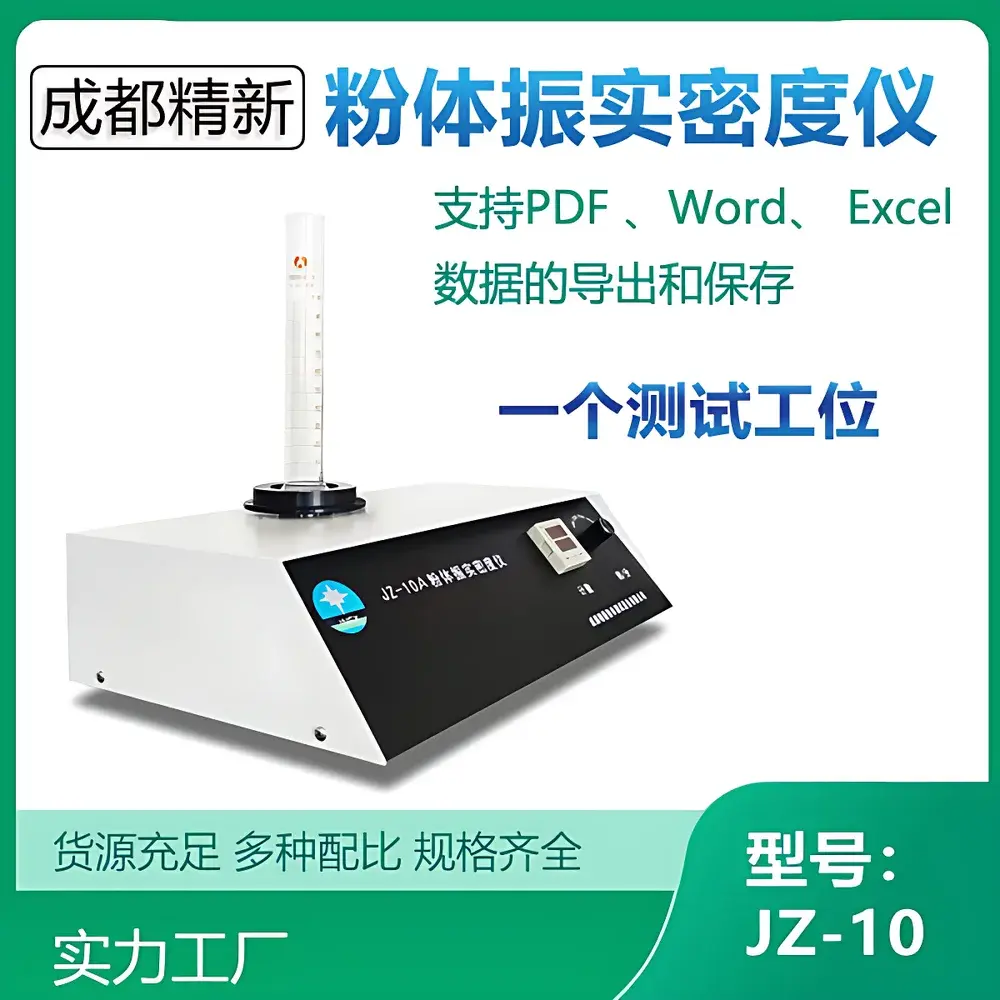
Chengdu Jingxin JZ-10A Single-Tube Tap Density Tester
| Brand | Chengdu Jingxin (CDJX) |
|---|---|
| Origin | Sichuan, China |
| Manufacturer Type | Direct Manufacturer |
| Product Category | Domestic |
| Model | JZ-10A |
| Price Range | USD 920–1,120 (FOB) |
| Application Field | General-purpose powder density testing |
| Instrument Type | Tap density tester |
| Form Factor | Benchtop (not portable |
| Sample Type | Solid powders and granules |
| Density Measurement Range | 0–10 g/cm³ |
| Primary Function | Tap density and bulk density determination of free-flowing and cohesive powders |
| Repeatability | ≤ ±1% |
| Stroke Amplitude | 3.0 ± 0.2 mm |
| Tap Count Range | 1–9999 cycles (user-programmable) |
| Tap Frequency Options | 100, 200, 250, or 300 taps/min |
| Standard Vessel | Two 100 mL borosilicate glass cylinders |
| Dimensions (L×W×H) | 455 × 280 × 125 mm |
| Weight | ~15 kg |
| Power Supply | AC 220 V, 50/60 Hz, 110 W |
Overview
The Chengdu Jingxin JZ-10A Single-Tube Tap Density Tester is a precision-engineered benchtop instrument designed to determine the tap density (also known as tapped density) and bulk density of dry, free-flowing or slightly cohesive powders and granular materials. It operates on the standardized mechanical tapping principle defined in ISO 3953:1993, ASTM D4781–22, USP , and Chinese national standards GB/T 5162–2021 and GB/T 31057.2–2018. The device subjects a precisely weighed powder sample in a calibrated glass cylinder to controlled vertical oscillation combined with simultaneous low-amplitude horizontal rotation—ensuring uniform particle rearrangement and minimizing surface segregation. This dual-motion mechanism significantly improves measurement reproducibility compared to single-axis tap testers. The JZ-10A is not a handheld or field-deployable unit; its rigid steel frame, integrated motor drive, and thermal management system (rear ventilation grille) support stable, unattended operation over extended test sequences. It is intended for routine QC labs, R&D facilities, and regulatory-compliant environments where traceable, repeatable powder compaction data are required for formulation development, process validation, or material release.
Key Features
- Programmable tap count from 1 to 9999 cycles, set via microprocessor-based timer with LED display
- Four discrete tap frequency options (100, 200, 250, 300 taps/min), selected via rotary switch for rapid method alignment with pharmacopeial or internal SOPs
- Fixed 3.0 ± 0.2 mm stroke amplitude compliant with ISO 3953 and USP requirements
- Simultaneous vertical tapping and gentle horizontal rotation (≤5 rpm) to maintain planar powder surface and reduce channeling artifacts
- Quick-release stainless-steel cradle for easy insertion, removal, and cleaning of standard 100 mL borosilicate glass cylinders (two included)
- Built-in thermal dissipation design with rear perforated vent panel ensuring stable motor performance during multi-cycle runs
- Robust structural architecture: all-load-bearing components fabricated from corrosion-resistant stainless steel and reinforced polymer housing
Sample Compatibility & Compliance
The JZ-10A accommodates powders ranging from fine metal alloys (e.g., Ti-6Al-4V, Ni-based superalloys) to pharmaceutical actives, battery cathode precursors (e.g., LiCoO₂, NMC), food-grade starches, and ceramic granulates. Maximum sample mass is ≤500 g per test, constrained by vessel volume and gravitational settling limits. All measurements conform to internationally recognized metrological frameworks: compliance with GB/T 5162–2021 (equivalent to ISO 3953), USP (Bulk and Tapped Density), and ASTM D4781–22 (Standard Test Method for Determining the Tap Density of Powders). While the instrument itself does not provide GLP/GMP audit trails, its deterministic mechanical action, calibrated stroke, and programmable parameters support full traceability when paired with documented SOPs and electronic lab notebooks.
Software & Data Management
The JZ-10A includes standalone Windows-compatible software for post-test calculation and reporting. Users manually enter initial mass, final tapped volume, and bulk volume readings into the application, which computes tap density (g/cm³), bulk density (g/cm³), and compressibility index (Carr Index) per USP . Results are displayed with two-decimal precision and may be exported in native PDF, Microsoft Word (.docx), or Excel (.xlsx) formats. Reports include timestamp, operator ID (user-input field), instrument model and serial number (manually entered), test parameters (tap count, frequency), and raw input values. No cloud connectivity or real-time USB data streaming is supported; data integrity relies on local file management and user-controlled versioning.
Applications
This instrument serves critical roles across regulated and industrial sectors: in pharmaceutical manufacturing, it supports excipient qualification, blend uniformity assessment, and capsule/fill weight consistency studies; in battery materials R&D, it correlates tap density with electrode coating rheology and volumetric energy density predictions; in metallurgy, it informs gas atomization process optimization and additive manufacturing feedstock acceptance criteria; and in food science, it evaluates flow behavior of powdered dairy, spices, or nutritional supplements. Academic users apply it to fundamental studies of interparticle forces, cohesion-adhesion balance, and humidity-dependent densification kinetics.
FAQ
Is the JZ-10A compliant with FDA 21 CFR Part 11?
No—the device lacks electronic signature capability, audit trail logging, or user access controls required for Part 11 compliance. It is suitable for non-GxP environments or as a supporting tool under validated SOPs.
Can I use custom-sized cylinders with this instrument?
Only standard 100 mL borosilicate glass cylinders (DIN EN ISO 4788) are mechanically compatible. Non-standard vessels may compromise stroke accuracy and rotational synchronization.
What maintenance is required?
Routine cleaning of the cylinder cradle and glass vessels; periodic inspection of motor coupling and timing belt tension (annual recommended); no lubrication required for sealed gearmotor.
Does the instrument include calibration certification?
No factory calibration certificate is supplied. Users must perform volumetric calibration of glass cylinders per ISO 4787 and verify tap amplitude using a certified displacement sensor prior to first use and at scheduled intervals.
How does the horizontal rotation improve measurement accuracy?
Rotation prevents localized void formation and promotes isotropic particle reorientation, yielding more representative packing states than vertical-only tapping—particularly for anisotropic or elongated particles.



