
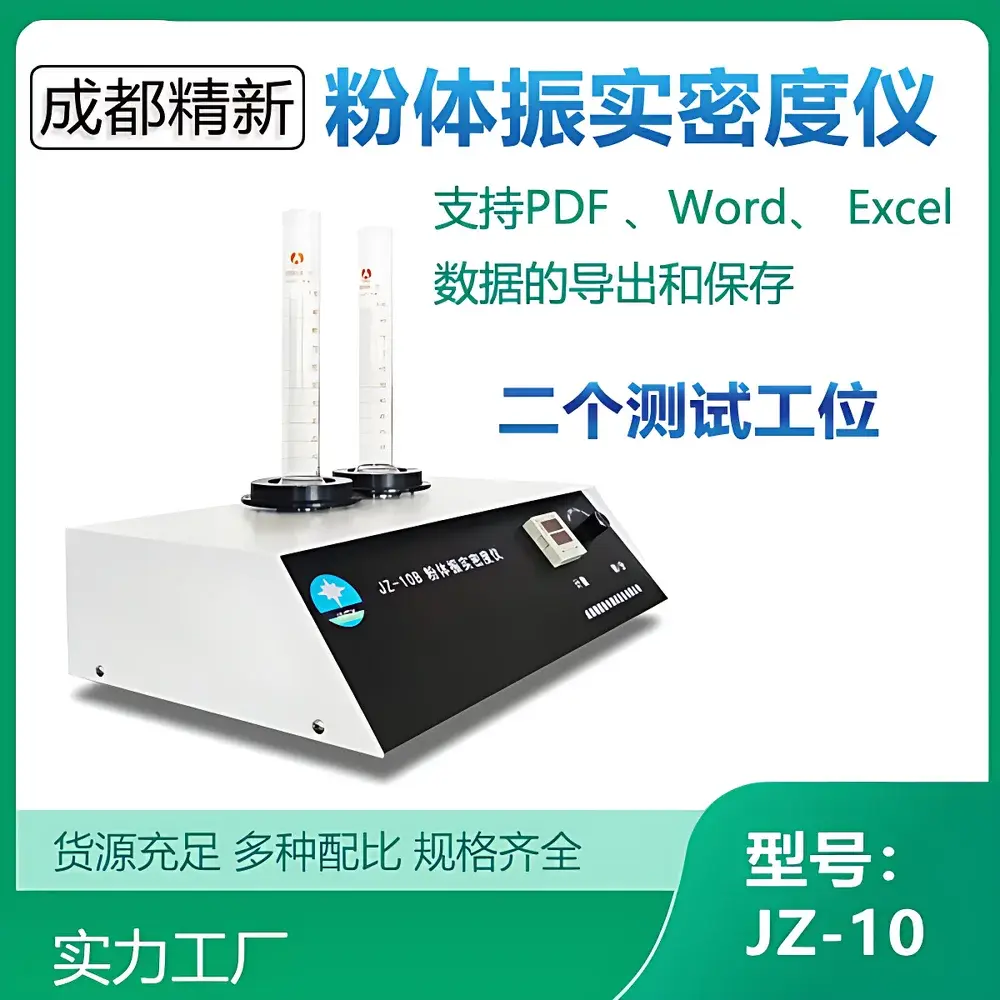
Chengdu Jingxin JZ-10B Tap Density Tester for Powders and Granular Materials
| Brand | Chengdu Jingxin (CDJX) |
|---|---|
| Origin | Sichuan, China |
| Manufacturer Type | Direct Manufacturer |
| Regional Category | Domestic (China) |
| Model | JZ-10B |
| Instrument Type | Tap Density Tester |
| Instrument Class | Benchtop (Not Portable — corrected per ISO 14857 & USP <616>) |
| Measurement Type | Solid Powder Bulk & Tap Density |
| Density Range | 0–10 g/cm³ |
| Density Accuracy | ±1% RSD (per GB/T 5162–2021 & USP <616>) |
| Vibration Amplitude | 3.0 ± 0.2 mm |
| Vibration Modes | Vertical oscillation + synchronized 360° rotational motion |
| Adjustable Tap Counts | 1–9999 cycles |
| Selectable Tap Frequencies | 100, 200, 250, or 300 taps/min |
| Test Stations | Dual independent stations |
| Standard Vials | Two 25 mL and two 100 mL borosilicate glass graduated cylinders |
| Repeatability | ≤ ±1% (n = 10, certified reference powder) |
| Power Supply | AC 220 V, 50 Hz, 110 W |
| Dimensions (L×W×H) | 455 × 280 × 125 mm |
| Net Weight | ~15 kg |
| Compliance | GB/T 5162–2021, GB/T 31057.2–2018, ChP 2020 General Chapter 0993, USP <616> |
Overview
The Chengdu Jingxin JZ-10B Tap Density Tester is a precision-engineered benchtop instrument designed for the standardized determination of tap density (also known as tapped density or settled density) and bulk density of free-flowing powders and granular solids. It operates on the principle defined in ISO 14857, USP , and GB/T 5162–2021: a controlled, reproducible sequence of vertical taps—combined with simultaneous 360° rotational motion—induces progressive particle rearrangement and interstitial air expulsion, enabling measurement of the minimum attainable volume after mechanical consolidation. Unlike simple vibratory densitometers, the JZ-10B implements dual-axis actuation (vertical displacement + horizontal rotation), minimizing surface segregation and ensuring uniform packing across the entire sample column. This architecture delivers high inter-laboratory reproducibility—critical for QC release testing in pharmaceutical excipient qualification, battery cathode/anode material validation, and metal powder sinterability assessment.
Key Features
- Dual independent test stations enable parallel evaluation of two samples—e.g., comparative testing of raw vs. milled batches or different particle size fractions—reducing throughput time by up to 40% versus single-station systems.
- Precision-controlled tap amplitude of 3.0 ± 0.2 mm complies strictly with USP and GB/T 5162–2021 requirements; amplitude stability is maintained via hardened stainless steel guide rods and low-backlash cam-driven transmission.
- Four selectable tap frequencies (100, 200, 250, 300 taps/min) are implemented via calibrated mechanical selector switch—eliminating software-based frequency interpolation and ensuring traceable, hardware-locked timing accuracy.
- Rotational synchronization ensures continuous leveling of the powder meniscus during tapping, mitigating channeling artifacts and improving volumetric consistency—particularly critical for cohesive or electrostatically charged powders.
- Modular vial retention system allows rapid detachment of borosilicate glass cylinders (25 mL and 100 mL) without tools; all vials meet ASTM E2875 specifications for dimensional tolerance and wall thickness uniformity.
- Integrated thermal management includes rear-panel louvered ventilation and thermally isolated motor housing, supporting uninterrupted operation over 8-hour shifts without thermal drift in tap timing or amplitude.
Sample Compatibility & Compliance
The JZ-10B accommodates dry, non-hygroscopic powders and granules with particle sizes ranging from 1 µm to 2 mm, including metallic alloys (e.g., Ti-6Al-4V, Inconel 718), ceramic precursors (Al₂O₃, SiC), pharmaceutical actives and excipients (lactose monohydrate, microcrystalline cellulose), food-grade starches and proteins, and lithium-ion battery cathode materials (NMC, LFP). It conforms to regulatory testing frameworks requiring audit-ready documentation: full alignment with USP (Powder Density), ChP 2020 General Chapter 0993, and ISO 14857 (Determination of tap density of powders). While not FDA 21 CFR Part 11–validated out-of-the-box, its data export architecture (CSV, PDF, XLSX) supports integration into validated LIMS or ELN environments under GMP/GLP conditions.
Software & Data Management
The included Jingxin Tap Density Analysis Software (v3.2+) runs on Windows 10/11 (64-bit) and provides deterministic calculation of both bulk density (ρb = m/V0) and tap density (ρt = m/Vf), where mass (m) is entered manually or imported via USB scale interface, and initial/final volumes (V0, Vf) are recorded directly. All calculations adhere to significant figure rules per ISO/IEC 17025:2017. Reports include full metadata: operator ID, timestamp, ambient temperature/humidity (optional sensor input), tap count/frequency, vial ID, and raw volume entries. Export formats support archival integrity: PDF (with embedded digital signature placeholder), Excel (.xlsx with formula protection), and Word (.docx with editable tables). Audit trail logs capture all parameter changes, result edits, and report generation events.
Applications
- Pharmaceutical development: Excipient qualification per ICH Q5C, capsule fill weight prediction, and blend uniformity assessment prior to tableting.
- Battery materials: Quantifying volumetric energy density potential of cathode/anode powders; correlating tap density with electrode calendering response.
- Metal additive manufacturing: Screening gas-atomized metal powders for flowability and packing efficiency—directly linked to layer spreading consistency in PBF-LB/M processes.
- Food & nutraceuticals: Monitoring agglomeration behavior during spray drying or fluid bed granulation; validating anti-caking agent efficacy.
- Quality control laboratories: Routine release testing against internal specifications aligned with ASTM D4781 or ISO 3953.
FAQ
What standards does the JZ-10B comply with?
It meets GB/T 5162–2021, GB/T 31057.2–2018, ChP 2020 General Chapter 0993, and USP . Full compliance documentation—including calibration certificate templates and verification protocols—is provided with shipment.
Can the instrument be used for cohesive or nanoscale powders?
Yes—with appropriate preconditioning (e.g., light sieving or gentle deagglomeration). For sub-100 nm materials, we recommend using the 25 mL cylinder and limiting tap counts to 300–500 to avoid over-compaction artifacts.
Is the software compatible with networked laboratory systems?
The software exports standardized .csv files and supports ODBC drivers for direct ingestion into LIMS platforms. Custom API integration is available under NDA for enterprise deployments.
How is calibration verified?
Users perform daily verification using NIST-traceable stainless steel reference cylinders (supplied) and certified density standard powders (e.g., tungsten carbide, SRM 1990). A full calibration kit—including amplitude gauge and timing calibrator—is optional.
Does the JZ-10B require annual recalibration by the manufacturer?
No. It is a mechanically stabilized system with no field-replaceable sensors. Annual verification by the user—using supplied procedures and reference materials—is sufficient per ISO/IEC 17025 clause 6.5.



