
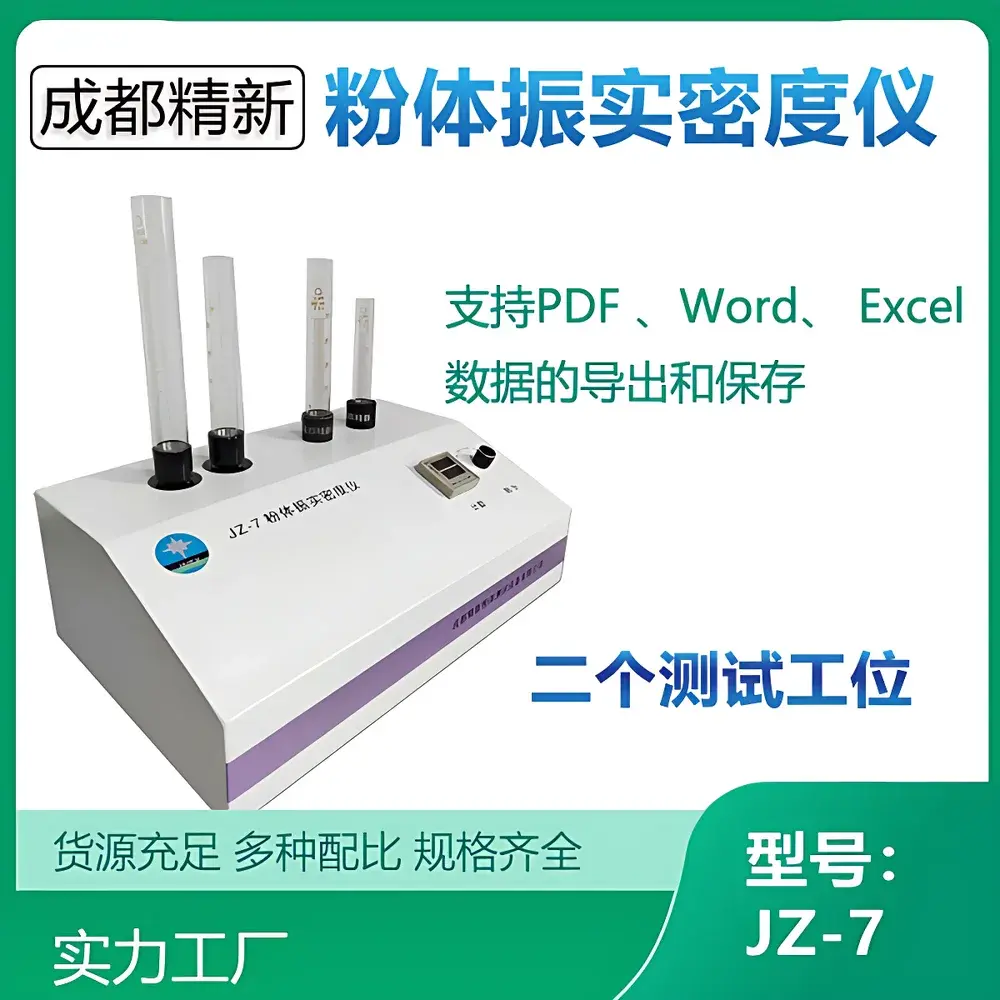
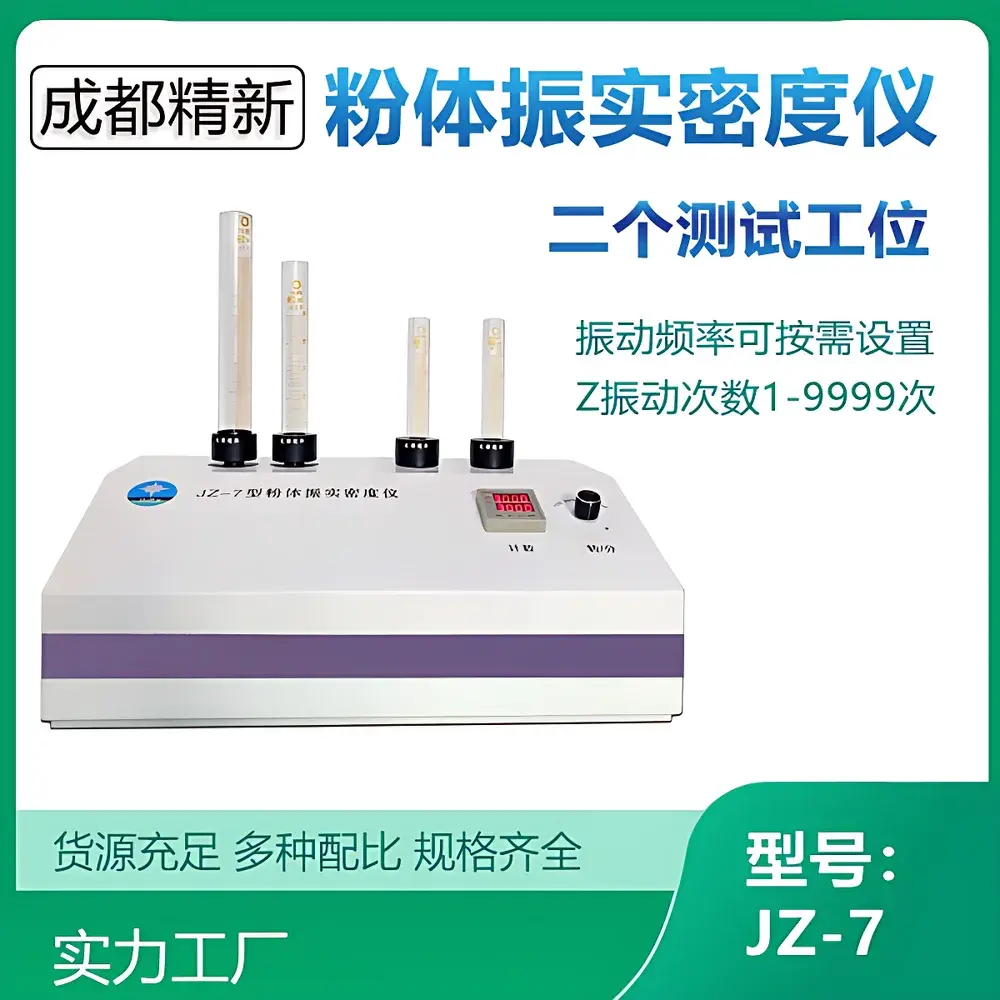
Chengdu Jingxin JZ-7 & JZ-10 Tap Density Analyzers for Powders
| Key | Brand: Chengdu Jingxin (CDJX) |
|---|---|
| Model | JZ-7, JZ-10A / JZ-10B / JZ-10C |
| Origin | Sichuan, China |
| Manufacturer Type | Direct Manufacturer |
| Instrument Type | Tap Density Tester |
| Instrument Category | Benchtop Laboratory Densimeter |
| Sample Form | Solid Powders |
| Primary Measurement | Tap Density & Bulk Density |
| Vibration Amplitude | 3.0 ± 0.2 mm |
| Vibration Frequency Options | 100 / 200 / 250 / 300 taps/min |
| Tapping Count Range | 0–9999 cycles (user-programmable) |
| Repeatability | ≤ ±1% RSD |
| Power Supply | AC 220 V, 110 W |
| Dimensions (L×W×H) | 455 × 280 × 125 mm |
| Weight | ~15 kg |
| Compliance | GB/T 5162–2021, USP <616> |
| Software | Integrated tap density calculation module with PDF/Excel export capability |
Overview
The Chengdu Jingxin JZ-7 and JZ-10 series Tap Density Analyzers are precision-engineered benchtop instruments designed for standardized determination of tap density (also known as tapped density) and bulk density of free-flowing and cohesive powders. Based on the fundamental principle of controlled mechanical tapping—where a powder-filled graduated cylinder undergoes vertical oscillation under defined amplitude and frequency—the instrument induces progressive particle rearrangement and interstitial air expulsion until volume stabilization is achieved. This method aligns with internationally recognized pharmacopeial and industrial standards, including GB/T 5162–2021 (equivalent to ISO 3953:2014) and United States Pharmacopeia Chapter <616>. The resulting tap density value (g/mL or g/cm³) serves as a critical physical parameter in powder characterization, directly influencing downstream processes such as die filling in tablet manufacturing, powder flowability assessment, storage volume estimation, and quality control of raw materials across metallurgical, ceramic, pharmaceutical, and additive manufacturing industries.
Key Features
- Programmable tapping parameters: Adjustable vibration frequency (100, 200, 250, or 300 taps per minute) and user-defined tap count (0–9999 cycles), enabling strict adherence to method-specific protocols.
- Precision mechanical design: Stainless steel guiding components and robust motor-driven actuation ensure consistent 3.0 ± 0.2 mm vertical stroke amplitude and long-term operational stability.
- Simultaneous vertical tapping and horizontal rotation: The sample cylinder rotates slightly during each tap cycle, promoting uniform surface leveling and minimizing segregation or channeling artifacts—enhancing measurement reproducibility.
- Modular cylinder configuration: Three model variants (JZ-10A: dual 250 mL; JZ-10B: dual 25 mL + dual 100 mL; JZ-10C: dual 25 mL + dual 50 mL + dual 100 mL) accommodate diverse sample mass requirements (≤500 g) and particle size distributions.
- Detachable cylinder mount: Facilitates rapid cleaning, calibration verification, and interchangeability of glass volumetric cylinders without tooling.
- Microprocessor-based timing control: High-accuracy digital timer ensures precise cycle execution and eliminates mechanical wear-related drift.
Sample Compatibility & Compliance
The JZ-7/JZ-10 analyzers support a broad spectrum of dry, granular, and powdered materials—including metallic powders (e.g., Al, Ni, Mo, W, Ti, Zr, Cu alloys), metal oxides, ceramic precursors, pharmaceutical excipients and APIs, catalysts, pigments, food additives, agricultural chemicals, soils, and construction materials (e.g., cement, fly ash). All models comply with GB/T 5162–2021 “Metallic powders — Determination of tap density” and USP <616> “Density of Powders”, ensuring data integrity for regulatory submissions and inter-laboratory comparisons. While not inherently compliant with 21 CFR Part 11, the instrument’s software output supports audit-trail-ready reporting when integrated into validated laboratory information management systems (LIMS) operating under GLP or GMP frameworks.
Software & Data Management
An embedded calculation module processes raw input (sample mass, initial and final volumes) to compute both bulk density and tap density in real time. Results are displayed numerically and stored locally with timestamped metadata. Export functionality includes standardized PDF reports (with instrument ID, operator name, date/time, and test parameters) and Excel-compatible CSV files for statistical analysis, trend monitoring, and integration into enterprise QA databases. No cloud dependency or proprietary runtime environment is required—software operates offline and is compatible with Windows OS platforms commonly deployed in regulated laboratories.
Applications
- Pharmaceutical development: Excipient qualification, blend uniformity assessment, and capsule/tablet formulation optimization per ICH Q5C and Q8(R2) guidelines.
- Metal powder metallurgy: Quality release testing of atomized metal powders for sintering, hot isostatic pressing (HIP), and binder jetting AM feedstocks.
- Ceramic and battery material production: Characterization of LiCoO₂, NMC, SiOₓ, and alumina powders prior to slurry preparation and electrode coating.
- Quality assurance in pigment and coating manufacturing: Batch-to-batch consistency evaluation of titanium dioxide, carbon black, and functional fillers.
- Research in geotechnical and environmental science: Sediment compaction behavior analysis and soil porosity modeling.
FAQ
What standards does the JZ-10 series conform to?
It fully implements GB/T 5162–2021 and USP <616>, with mechanical specifications traceable to ISO 3953:2014 requirements for tap density instrumentation.
Can the instrument measure both bulk and tap density in one workflow?
Yes—bulk density is measured before tapping initiation; tap density is calculated after the programmed tapping sequence concludes. Both values are automatically derived and reported.
Is calibration verification supported?
The system accepts certified reference cylinders (NIST-traceable volumetric glassware) and allows manual entry of certified volume values for validation against manufacturer-specified tolerances.
Does the software support multi-user access control or electronic signatures?
The standalone application does not include role-based authentication or digital signature modules; however, exported reports may be incorporated into validated LIMS or ELN platforms that provide such controls.
What maintenance is required for long-term accuracy?
Routine inspection of cylinder alignment, motor belt tension (if applicable), and periodic verification of tap amplitude using calibrated displacement sensors are recommended annually or per internal SOPs.



