
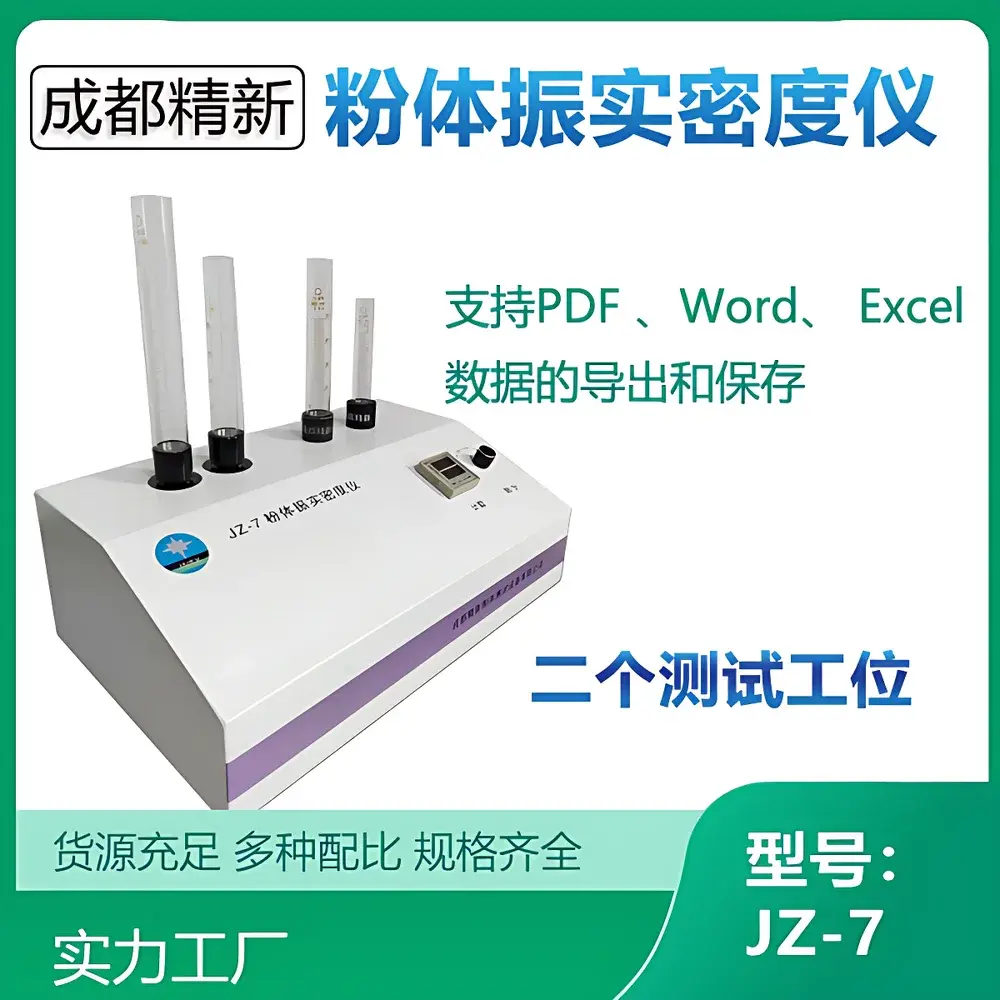
Chengdu Jingxin JZ-7 Tap Density Tester & Bulk Density Tester
| Brand | Chengdu Jingxin (CDJX) |
|---|---|
| Origin | Sichuan, China |
| Manufacturer Type | Direct Manufacturer |
| Origin Category | Domestic |
| Model | JZ-7 |
| Instrument Type | Tap Density Tester |
| Instrument Class | Benchtop Laboratory |
| Sample Form | Solid Powders |
| Application | Tap Density & Bulk Density Measurement of Powders |
| Density Accuracy | < ±1% |
| Vibration Amplitude | 3 mm ±0.2 mm |
| Repeatability Error | ≤ ±1% |
| Vibration Frequency Options | 100 / 200 / 250 / 300 taps/min |
| Tapping Count Range | 1–9999 cycles (user-configurable) |
| Sample Capacity | ≤ 500.00 g per cylinder |
| Standard Compliance | GB/T 5162–2021 |
| Dimensions (W×D×H) | 450 × 280 × 180 mm |
| Weight | ~13 kg |
| Power Supply | AC 220 V, 110 W |
| Included Cylinders | 25 mL, 50 mL, 100 mL (each ×1) |
| Software Output | PDF, Word, Excel report generation with audit-ready calculation logs |
Overview
The Chengdu Jingxin JZ-7 Tap Density Tester & Bulk Density Tester is an engineered benchtop instrument designed for standardized determination of tap density and bulk density of free-flowing and cohesive powders. It operates on the principle of controlled mechanical tapping—subjecting a powder column in a calibrated cylindrical vessel to reproducible vertical impacts under defined amplitude and frequency—until volume stabilization is achieved. This method aligns with the fundamental physical definition of tap density: the ratio of powder mass to its final settled volume after mechanical densification. The JZ-7 implements dual-mode operation—bulk density measurement (no tapping) and tap density measurement (programmable tapping)—in accordance with GB/T 5162–2021, which is technically harmonized with ISO 3953:2013 and ASTM D4781–21 for powder packing behavior characterization. Its robust stainless-steel guiding frame, precision-tuned DC motor drive, and synchronized vertical oscillation with gentle horizontal rotation ensure uniform powder surface leveling—minimizing channeling and segregation artifacts common in single-axis tap testers.
Key Features
- Dual independent test stations: Two active tapping positions enable concurrent measurement of two different powder samples, improving throughput without cross-contamination risk.
- Four selectable tapping frequencies: 100, 200, 250, or 300 taps per minute—adjusted via rotary switch for rapid method adaptation across material classes (e.g., fine pharmaceutical actives vs. coarse ceramic granules).
- Precision-controlled vibration parameters: Fixed 3 mm ±0.2 mm stroke amplitude; programmable tap count from 1 to 9999 cycles—supporting both standard compliance protocols and internal R&D optimization studies.
- Integrated microprocessor timer with real-time cycle monitoring: Ensures consistent timing accuracy and eliminates operator-dependent start/stop variability.
- Modular cylinder compatibility: Standard set includes 25 mL, 50 mL, and 100 mL stainless-steel or borosilicate glass cylinders (ISO-compliant dimensions); optional 10 mL, 250 mL, and 500 mL variants available upon request for specialized applications including high-value API screening or battery cathode slurry pre-characterization.
- Benchtop footprint (450 × 280 × 180 mm) and lightweight construction (~13 kg) facilitate integration into QC labs, formulation development suites, and GLP-compliant analytical workspaces.
Sample Compatibility & Compliance
The JZ-7 accommodates dry, non-hygroscopic, and moderately cohesive powders with particle sizes ranging from submicron aerosols to granules up to 2 mm. It supports regulatory testing workflows requiring traceable density data for raw material release (e.g., USP for pharmaceutical excipients), process validation (e.g., ICH Q5C stability assessment of lyophilized cake morphology), and quality-by-design (QbD) parameter mapping in solid dosage manufacturing. All measurements comply with GB/T 5162–2021, whose methodology mirrors ISO 3953:2013 (determination of tap density of metal powders) and ASTM D4781–21 (standard test method for tap density of catalysts and catalyst carriers). Instrument calibration verification is supported through certified reference powders and documented system suitability checks per internal SOPs aligned with ISO/IEC 17025 requirements.
Software & Data Management
The JZ-7 interfaces with dedicated Windows-based software that captures raw input parameters (mass, initial/final volume, tap count, frequency), performs automated density calculations (g/cm³), and applies statistical evaluation (mean, SD, CV%) across replicate runs. Reports are exportable in PDF (print-ready), Word (editable), and Excel (raw + summary sheets) formats—with embedded timestamps, operator ID fields, and instrument serial number tagging. Audit trail functionality records all user actions—including parameter changes, manual overrides, and report exports—enabling compliance with FDA 21 CFR Part 11 requirements when deployed within validated environments. Data integrity safeguards include password-protected configuration access and immutable result archiving.
Applications
This instrument serves critical functions across multiple regulated and industrial domains: pharmaceutical powder flowability assessment during formulation development; metal powder qualification for additive manufacturing feedstock; cathode/anode material density profiling in lithium-ion battery R&D; quality control of pigment dispersion consistency in coatings; bulk handling design input for silo and hopper engineering; and academic research into powder compaction mechanics and interparticle force modeling. Its versatility extends to food science (e.g., flour and spice density standardization), ceramics (green body density correlation), and catalyst support characterization—where reproducible packing metrics directly influence downstream performance.
FAQ
What standards does the JZ-7 comply with?
The JZ-7 conforms to GB/T 5162–2021, and its operational methodology is technically equivalent to ISO 3953:2013 and ASTM D4781–21.
Can the instrument measure both bulk and tap density in one run?
No—bulk density is measured prior to tapping; tap density requires a separate, post-tapping volume reading. The software automatically calculates both values when sequential measurements are entered.
Is the software compatible with LIMS integration?
Yes—CSV and Excel exports support manual or scripted ingestion into most LIMS platforms; API-based integration is available via custom development upon request.
What maintenance is required for long-term accuracy?
Annual verification of tap amplitude using a calibrated dial indicator and periodic cleaning of cylinder contact surfaces with isopropyl alcohol are recommended. No routine calibration certificates are supplied, but documentation templates for internal verification are included.
Does the JZ-7 meet GLP/GMP documentation requirements?
When used with the full software audit trail enabled and operated under documented SOPs, the system satisfies core GLP/GMP data integrity expectations for density testing in regulated laboratories.



