Chengyi CQY-1 Small Animal Hypoxia Monitoring System
| Brand | Chengyi (SCChengyi) |
|---|---|
| Origin | Sichuan, China |
| Manufacturer Type | Authorized Distributor |
| Country of Origin | China |
| Model | CQY-1 |
| Pricing | Available Upon Request |
Overview
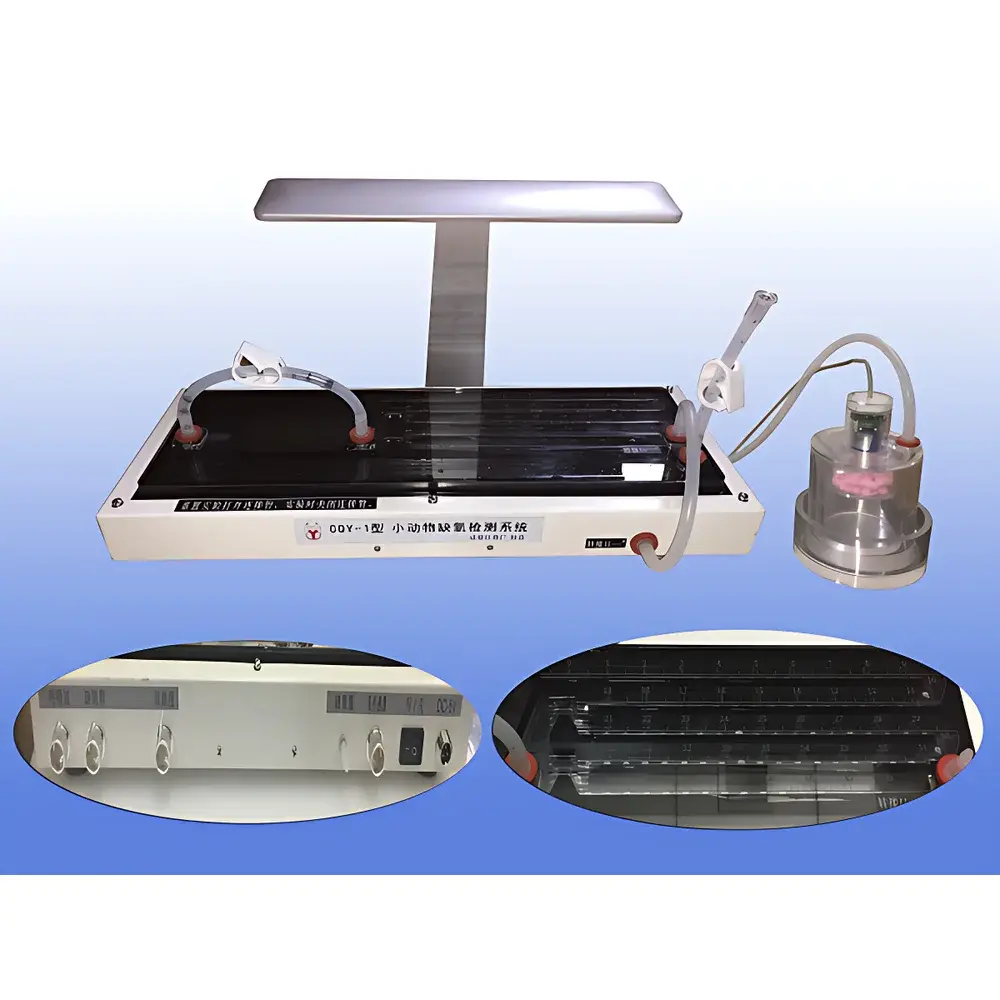
The Chengyi CQY-1 Small Animal Hypoxia Monitoring System is a purpose-built, research-grade instrumentation platform engineered for quantitative, real-time assessment of hypoxic tolerance and respiratory physiological responses in small laboratory animals—primarily mice and rats. Unlike conventional vertical-seal hypoxia chambers reliant on manual endpoint observation or intermittent gas sampling, the CQY-1 employs a horizontally oriented, water-sealed measurement architecture grounded in volumetric displacement principles. This design eliminates pressure-driven leakage artifacts common in vertically aligned systems by integrating an auto-balancing hydraulic circuit and dual-phase sealing (silicone gasket + water seal), ensuring stable, leak-tight containment during progressive normobaric hypoxia induction. The system operates on the principle of closed-circuit oxygen consumption monitoring: as the animal metabolizes O₂ within the sealed chamber, the resultant pressure differential drives water displacement in a calibrated horizontal column; this mechanical change is transduced simultaneously via high-sensitivity photometric detection (98-channel optical array), precision differential pressure sensing, and fast-response electrochemical O₂ sensing (0–21% vol, ±0.1% resolution). All three signal streams—respiratory waveform (via pressure transduction), volumetric hypoxia consumption (ml), and real-time fractional O₂ concentration (%)—are acquired synchronously at ≥1 kHz sampling rate and output in both analog (±5 V, BNC) and digital (USB 2.0, TTL-compatible) formats for integration with third-party acquisition platforms such as the RM6240 multi-channel physiological signal processing system.
Key Features
- Horizontal, water-balanced hypoxia measurement chamber with integrated auto-leveling fluid circuit—eliminates gravitational bias and improves reproducibility across repeated trials.
- Dual-mode hypoxia quantification: high-resolution mechanical displacement (0.5 mL刻度, full scale 50 mL) coupled with redundant electronic photometric detection (98 independent optical sensing loops) for cross-validated volumetric accuracy.
- Simultaneous triple-parameter acquisition: respiratory waveform (pressure-derived, 0.9 mmHg/10 mV sensitivity), real-time O₂ concentration (electrochemical sensor, 0.1% minimum detectable change, 1%/10 mV output gain), and cumulative hypoxic volume (0.5 mL/10 mV analog output).
- Modular chamber compatibility: standard 120 mL acrylic hypoxia bottle includes integrated O₂ sensor; optional auxiliary chambers (150–1500 mL) available in threaded or snap-lock configurations—O₂ sensing capability retained only in factory-integrated units.
- Low-noise, externally powered 5 V DC illumination system with three-step adjustable intensity—optimized for consistent optical path stability without thermal interference to animal physiology.
- Fully compliant analog/digital I/O interface: BNC outputs for legacy physiological recorders; USB 2.0 interface supports direct PC connection and native driver support for time-synchronized data logging and timestamped waveform export (CSV, MAT, BIN).
Sample Compatibility & Compliance
The CQY-1 is validated for use with rodents weighing ≤500 g, including C57BL/6, BALB/c, Sprague-Dawley, and Wistar strains. Chamber geometry and airflow dynamics have been empirically optimized to minimize CO₂ accumulation and thermal drift during 30–120 minute exposures under normobaric conditions (21% → 5% O₂). All wetted components—including acrylic chamber body, medical-grade silicone gaskets, and borosilicate glass water seal reservoir—are autoclavable or compatible with 70% ethanol disinfection. The system meets ISO 10993-5 biocompatibility requirements for short-term contact with biological specimens. While not certified for GLP-regulated toxicology studies, its synchronized multi-signal architecture supports audit-ready data provenance when paired with RM6240 or equivalent FDA 21 CFR Part 11-compliant acquisition software (e.g., Spike2, LabChart with electronic signature modules).
Software & Data Management
The CQY-1 ships with standalone Windows-based acquisition and analysis software (v3.2+), providing real-time visualization of all three primary signals with configurable overlay, event tagging, and automatic latency-compensated alignment. Raw data are stored in timestamped binary files with embedded metadata (animal ID, chamber ID, ambient T/P, operator initials). Export options include IEEE-compliant CSV (with header annotations), MATLAB .mat, and EDF+ format for interoperability with open-source neurophysiology toolchains (e.g., EEGLAB, FieldTrip). The software implements built-in algorithms for apnea detection, O₂ depletion rate calculation (mL/min/kg), and hypoxic onset latency (time to first 10% O₂ drop from baseline). Audit trail functionality logs all parameter changes, file exports, and calibration events—supporting basic ALCOA+ data integrity principles.
Applications
- Preclinical evaluation of hypoxia-inducible factor (HIF) pathway modulators and erythropoietin-stimulating agents.
- Respiratory phenotyping in genetically modified rodent models (e.g., PHD2 knockouts, carotid body ablation studies).
- Neuroprotective compound screening via quantification of hypoxic ventilatory response (HVR) and time-to-apnea endpoints.
- Validation of non-invasive O₂ delivery systems (e.g., nasal cannulae, hyperbaric protocols) using controlled chamber desaturation kinetics.
- Teaching laboratories: demonstration of oxygen consumption stoichiometry, respiratory quotient estimation, and comparative metabolic scaling across species.
FAQ
What animal weight range is supported?
The standard 120 mL chamber accommodates rodents up to 500 g; larger chambers (up to 1.5 L) extend usability to rabbits and guinea pigs—though O₂ sensor integration is limited to the 120 mL unit.
Is the system compatible with existing RM6240 hardware?
Yes—the CQY-1 provides matched BNC analog outputs (respiratory pressure, hypoxia volume, O₂ %) and includes three dedicated interface cables conforming to RM6240 channel input specifications (±5 V, 100 kΩ impedance, 1 kHz bandwidth).
Can hypoxia data be exported for statistical analysis in R or Python?
All raw datasets export natively to CSV and MATLAB .mat formats; Python users may leverage the provided SDK (PySerial + NumPy) for real-time streaming or batch post-processing.
Does the system require external gas cylinders or vacuum pumps?
No—it operates exclusively in normobaric mode using ambient air; O₂ depletion occurs solely via animal metabolism within the sealed, water-balanced chamber.
How is calibration performed?
Factory calibration is traceable to NIST-certified pressure and gas standards. End-user verification uses supplied syringe-based volume displacement checks (5 mL increments) and zero-O₂ reference (sodium hydroxide scrubber) for sensor baseline validation—procedures documented in the ISO/IEC 17025-aligned calibration manual.