
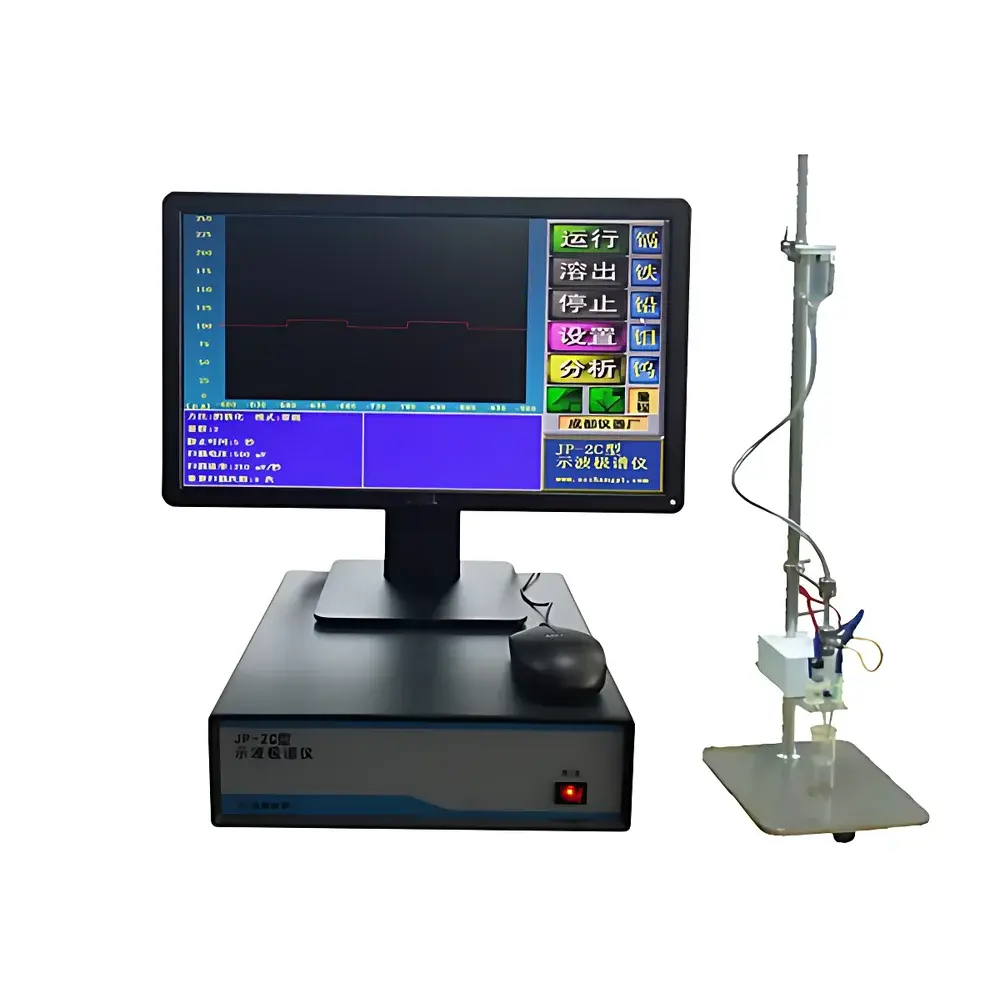
Chengyi JP-2C Oscilloscopic Polarograph
| Brand | Chengyi |
|---|---|
| Origin | Sichuan, China |
| Manufacturer Type | Authorized Distributor |
| Country of Origin | China |
| Model | JP-2C |
| Price Range | USD 2,800 – 4,300 (FOB) |
| Polarographic Sensitivity | <5×10⁻⁸ mol/L (Cd²⁺, Linear Sweep Polarography) |
| Resolution of Polarographic Peaks | <32 mV |
| Tolerance to Pre-reduced Interferents | >10,000:1 |
| Repeatability Error | <0.5% |
| Range Switching Error | <0.5% |
| Current Range | 15 nA – 400 µA F.S., 23 programmable decades |
| Polarization Potential Range | ±3904 mV, minimum step 32 mV |
| Scan Rate | 250 mV/s |
| Scan Amplitude | 500 mV |
| Scan Period | 1 s – 1000 s |
| Power Supply | 100–240 VAC, 50/60 Hz |
| Weight | 15 kg |
| Display | 19″ LED LCD (1366×768), USB mouse & dual USB host ports (for firmware update & data export) |
| Parameter Storage | Up to 5 user-defined methods |
| Onboard Quantification | Standard Comparison Method supported |
| ADC/DAC Resolution | 12-bit (1/4096 precision) |
| Embedded Platform | ARM-based real-time control system |
| Compliance | Designed for GLP-aligned laboratory workflows |
Overview
The Chengyi JP-2C Oscilloscopic Polarograph is a microprocessor-controlled, high-stability voltammetric analyzer engineered for classical DC polarography and derivative polarographic measurements in academic, industrial, and regulatory laboratories. Based on the classical dropping mercury electrode (DME) principle, it applies controlled linear potential sweeps across a mercury drop while measuring faradaic current response—enabling quantitative and qualitative analysis of electroactive species in solution. Its oscilloscopic display architecture provides real-time visualization of current–voltage (i–E) curves, facilitating immediate assessment of peak shape, onset potential, and diffusion-controlled behavior. Unlike modern pulse or stripping techniques, the JP-2C emphasizes fundamental polarographic theory and pedagogical clarity—making it especially suitable for teaching electroanalytical principles, method development, and validation of redox-active analytes such as heavy metal ions (e.g., Cd²⁺, Pb²⁺, Zn²⁺), organic nitro compounds, and pharmaceutical redox couples.
Key Features
- ARM-based embedded control system ensuring deterministic timing, low-latency response, and long-term operational stability during extended scans (up to 1000 s).
- 12-bit analog-to-digital and digital-to-analog conversion (1/4096 resolution), enabling precise current measurement down to 15 nA full-scale with <0.5% repeatability error and range-switching fidelity.
- Dual-mode polarographic operation: conventional DC polarography and first-/second-derivative polarography—both fully programmable and auto-compensated for capacitive and residual faradaic background currents.
- Real-time on-screen curve rendering via integrated 19″ LED display (1366×768), eliminating dependency on external PCs for basic acquisition and qualitative interpretation.
- Onboard parameter management: up to five user-defined methods—including scan rate, potential window, drop time, and amplification gain—stored non-volatile memory with recall-on-power-up functionality.
- USB-host interface supporting plug-and-play U disk operations: firmware updates without factory return, direct export of raw i–E datasets (ASCII CSV format), and printer connectivity for hardcopy documentation.
- Programmable polarization range from −3904 mV to +3904 mV (32 mV step resolution), compatible with both cathodic and anodic analyses across diverse electrolyte systems.
Sample Compatibility & Compliance
The JP-2C is optimized for aqueous and mixed-aqueous electrolyte solutions containing supporting electrolytes (e.g., KCl, KNO₃, acetate buffers) at pH 2–9. It interfaces seamlessly with standard three-electrode configurations: dropping mercury electrode (DME), calomel reference electrode (SCE), and platinum auxiliary electrode. While not certified to IEC 61010-1 or ISO/IEC 17025 out-of-the-box, its design aligns with foundational requirements for GLP-compliant electrochemical analysis—particularly in environmental testing (e.g., EPA Method 7060A for trace metals), pharmacopeial assay development (USP and referencing polarographic validation), and academic curriculum standards (ASTM E291–22, “Standard Test Methods for Polarographic Analysis”). All measurement parameters, timestamps, and curve metadata are logged internally with immutable sequence indexing—supporting retrospective review and laboratory audit readiness.
Software & Data Management
No proprietary PC software is required for core operation; however, exported CSV files are fully compatible with MATLAB, OriginLab, Python (Pandas/SciPy), and Excel for advanced deconvolution, peak fitting, and calibration modeling. The instrument’s internal storage retains up to 200 full polarograms with embedded method identifiers, scan conditions, and operator tags. Each dataset includes calibrated current (nA) and potential (mV) axes, baseline-subtracted derivatives, and annotated peak height/position values. Firmware upgrades are performed via signed binary modules loaded from FAT32-formatted USB drives—ensuring version traceability and eliminating service downtime. Audit trails are maintained through sequential log entries recording power cycles, parameter changes, and measurement initiations—consistent with FDA 21 CFR Part 11 principles for electronic records where local policy mandates such controls.
Applications
- Quantitative determination of trace heavy metals (Cd²⁺, Pb²⁺, Cu²⁺) in soil extracts, wastewater, and biological fluids using standard addition or calibration curve protocols.
- Teaching electrochemical kinetics: measurement of diffusion coefficients, electron transfer numbers (n), and half-wave potentials (E₁/₂) in undergraduate physical chemistry labs.
- Pharmaceutical quality control: assay of reducible functional groups (e.g., nitro, azo, quinone) in active pharmaceutical ingredients (APIs) per compendial guidelines.
- Food safety screening: detection of preservatives (e.g., sulfites), antioxidants (e.g., ascorbic acid), and adulterants via characteristic polarographic waves.
- Geochemical speciation studies: differentiation of labile vs. complexed metal fractions in sediment pore waters using controlled-potential electrolysis coupling.
FAQ
Does the JP-2C support solid electrodes or only mercury-based systems?
It is designed exclusively for use with dropping mercury electrodes (DME) and static mercury drop electrodes (SMDE). Solid electrodes (e.g., glassy carbon, gold) require separate potentiostatic hardware and are not compatible.
Can polarographic data be exported in machine-readable format for LIMS integration?
Yes—raw current-potential datasets export as UTF-8 encoded CSV files via USB drive, including header metadata (timestamp, method ID, electrode type, sensitivity setting) for automated ingestion into laboratory information management systems.
Is the instrument compliant with ISO/IEC 17025 for accredited testing?
While the JP-2C itself is not third-party accredited, its measurement traceability, parameter logging, and reproducibility metrics (<0.5% RSD) meet technical prerequisites for inclusion in ISO/IEC 17025 scope documentation when operated within a validated laboratory quality system.
What maintenance is required for long-term DME performance?
Regular cleaning of the capillary tip with dilute HNO₃ and ultrasonic rinsing is recommended every 200–300 drops; mercury purity (99.999%) and degassing of supporting electrolyte are critical for baseline stability and peak resolution.
How is calibration verified between user sessions?
Built-in reference checks include standardized Cd²⁺ solution (5×10⁻⁸ mol/L) for sensitivity verification and known redox couples (e.g., K₃Fe(CN)₆/K₄Fe(CN)₆) for potential axis calibration—both traceable to NIST SRMs.




