
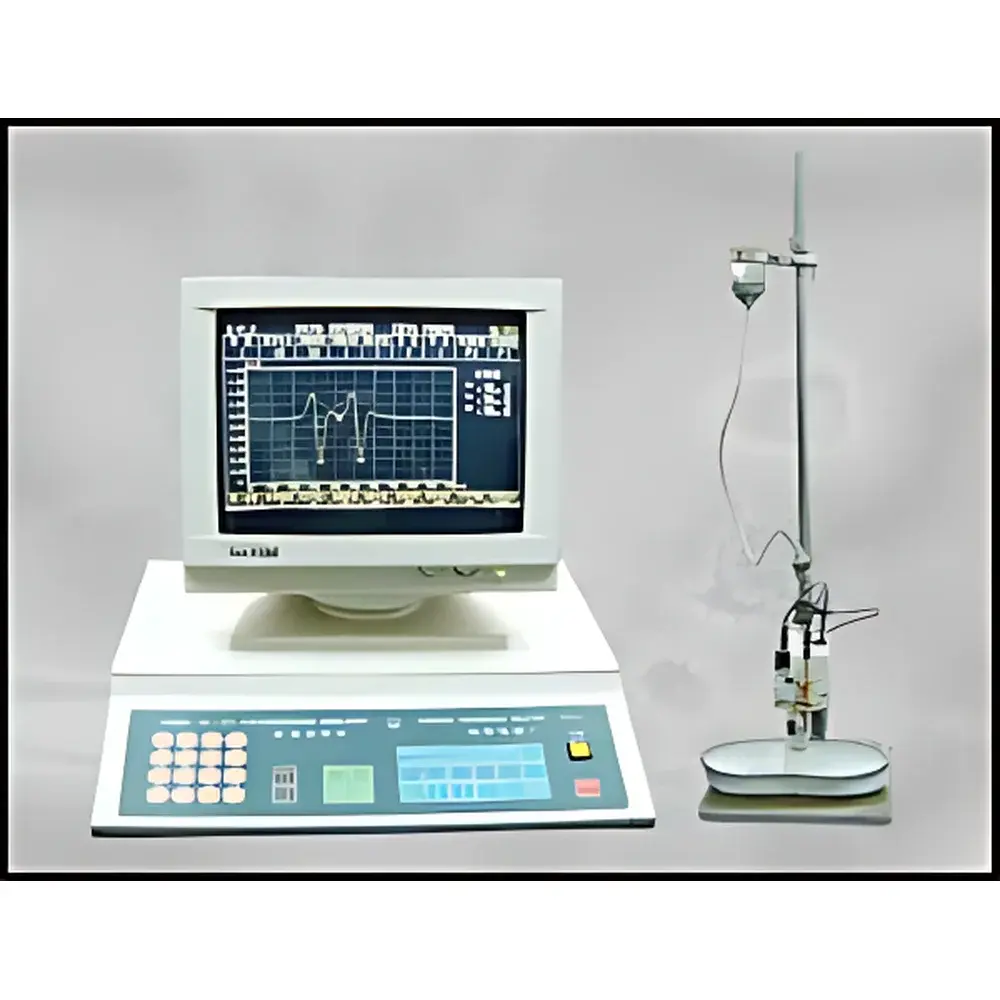
Chengyi JP-303E Digital Voltammetric Polarograph
| Brand | Chengyi |
|---|---|
| Model | JP-303E |
| Origin | Sichuan, China |
| Sensitivity | <2×10⁻⁸ mol/L (Cd²⁺, linear sweep polarography) |
| Peak Resolution | <30 mV |
| Antioxidant Tolerance | >20,000:1 |
| Repeatability Error | <0.1% |
| Range Switching Error | <0.2% (≥1.5×10³ nA), <0.4% (≤1.0×10³ nA) |
| Potential Resolution | 2 mV |
| Current Resolution | 0.03% of full scale (conventional, 1st & 2nd derivative modes) |
| Current Range | (6–4×10⁵) nA, 25 programmable ranges |
| Polarization Potential Range | ±4094 mV, min. step 2 mV |
| Scan Rate | 50–1000 mV/s, continuously adjustable |
| Scan Amplitude | 0–1600 mV, min. step 2 mV |
| Scan Duration | 1–1000 s |
| Power Supply | AC 220 V, 50/60 Hz |
Overview
The Chengyi JP-303E Digital Voltammetric Polarograph is a microprocessor-controlled, fully automated analytical instrument engineered for high-precision electrochemical quantification and speciation in aqueous and non-aqueous electrolyte systems. Based on classical polarographic principles—specifically controlled-potential voltammetry with dropping mercury electrode (DME) or solid electrodes—the JP-303E implements linear sweep polarography (LSP), differential pulse polarography (DPP), square-wave voltammetry (SWV), anodic/cathodic stripping voltammetry (ASV/CSV), and cyclic voltammetry (CV), including first- and second-derivative signal processing. Its design targets laboratories requiring trace-level detection (sub-nanomolar) of metal ions (e.g., Cd²⁺, Pb²⁺, Zn²⁺, Cu²⁺, Mo⁶⁺, W⁶⁺), organic redox-active compounds, and ligand-metal complexes in environmental, pharmaceutical, metallurgical, and quality control applications. The instrument operates under constant-current-free conditions and employs digital signal synthesis and real-time adaptive compensation to eliminate capacitive and residual faradaic background contributions—ensuring robust baseline stability and quantitative fidelity across wide dynamic current ranges.
Key Features
- Multi-method electrochemical platform supporting LSP, ASV, CSV, CV, and derivative polarography with automatic parameter optimization per scan rate and current range.
- Real-time signal processing: automatic background subtraction, digital filtering (Butterworth IIR), peak identification via tangent-intersection algorithm, and precise peak current/potential measurement.
- Adaptive compensation engine that dynamically corrects for charging current and pre-reduction interference without manual intervention—critical for high-fidelity analysis in complex matrices.
- Integrated quantitative engine supporting standard addition, calibration curve, and single-point comparison methods; computes concentration, standard deviation, coefficient of variation (CV%), and linear regression statistics with R² output.
- Non-volatile internal memory stores up to 100 complete experiment profiles—including method parameters, raw data, processed curves, and metadata—with recall and replay functionality.
- USB-host interface enables direct export of ASCII-formatted current-potential datasets and Windows-compatible bitmap/vector graphics (BMP, EMF) to USB flash drives for offline analysis in Excel, Origin, or MATLAB.
- Firmware-resident operating system ensures immunity to host PC viruses and enables cold-start boot time under 8 seconds.
Sample Compatibility & Compliance
The JP-303E accommodates conventional three-electrode configurations (working, reference, counter) using mercury-based (DME, HMDE) or solid-state electrodes (glassy carbon, gold, platinum). It supports analysis of aqueous solutions, buffered electrolytes (e.g., KCl, HClO₄, acetate), and mixed organic-aqueous media. While not certified to ISO/IEC 17025 or FDA 21 CFR Part 11 out-of-the-box, its data integrity architecture—including timestamped audit trails, uneditable raw data logs, and parameter-locked method files—aligns with GLP/GMP documentation requirements for regulated QC environments. Method validation protocols for trace metal analysis conform to ASTM D3559 (lead in water), ISO 8466-2 (calibration models), and USP <798> (electrochemical assay validation guidelines).
Software & Data Management
Data acquisition and visualization are handled by embedded firmware with no external PC dependency during measurement. All polarograms are stored in IEEE 754-compliant floating-point format with 16-bit potential resolution and 20-bit current resolution. Exported .TXT files contain tab-delimited columns: potential (mV), current (nA), first derivative (nA/mV), second derivative (nA/mV²). Graphics exports retain vector scalability for publication-ready figures. Post-acquisition analysis on Windows PCs leverages standard tools: Excel for statistical regression, PowerPoint for report integration, and third-party packages (e.g., DMFit, GPES) for advanced deconvolution or kinetic modeling. No proprietary software license or dongle is required.
Applications
- Environmental monitoring: quantification of heavy metals (Cd, Pb, As, Hg) in drinking water, wastewater, and soil extracts at EPA-defined action levels.
- Pharmaceutical QC: assay of redox-active excipients (e.g., ascorbic acid, cysteine) and metal catalyst residues in APIs per ICH Q2(R2).
- Geochemical research: speciation of Mo(VI)/W(VI) oxyanions in acidic leachates and hydrothermal fluids.
- Electroplating bath control: real-time monitoring of Cu²⁺, Ni²⁺, and Co²⁺ concentrations in industrial plating solutions.
- Academic electrochemistry: teaching fundamental concepts of diffusion-controlled currents, electron transfer kinetics, and adsorption phenomena via CV and DPP.
FAQ
Does the JP-303E support solid working electrodes other than mercury-based ones?
Yes—it is fully compatible with glassy carbon, platinum, gold, and carbon paste electrodes when configured with appropriate supporting electrolytes and deoxygenation protocols.
Is method validation documentation provided for regulatory submissions?
The instrument includes built-in validation aids (linearity checks, repeatability reports, LOD/LOQ estimation tools), but formal IQ/OQ/PQ protocols must be developed per site-specific SOPs and regulatory jurisdiction.
Can scan parameters be programmed for unattended sequential analysis?
Yes—up to 100 pre-stored methods can be queued for autonomous execution with inter-method delay control and auto-zeroing between runs.
What is the minimum detectable concentration for lead(II) using ASV mode?
Under optimized deposition (60 s, –1.0 V vs. Ag/AgCl) and SWV detection, typical LOD is 5×10⁻¹⁰ mol/L in 0.1 M acetate buffer (pH 4.5), consistent with ASTM D7282 performance benchmarks.
Is firmware upgrade capability available via USB?
Firmware updates are delivered as signed binary files and installed through the front-panel USB port using the included update utility—no serial adapter or service technician required.




