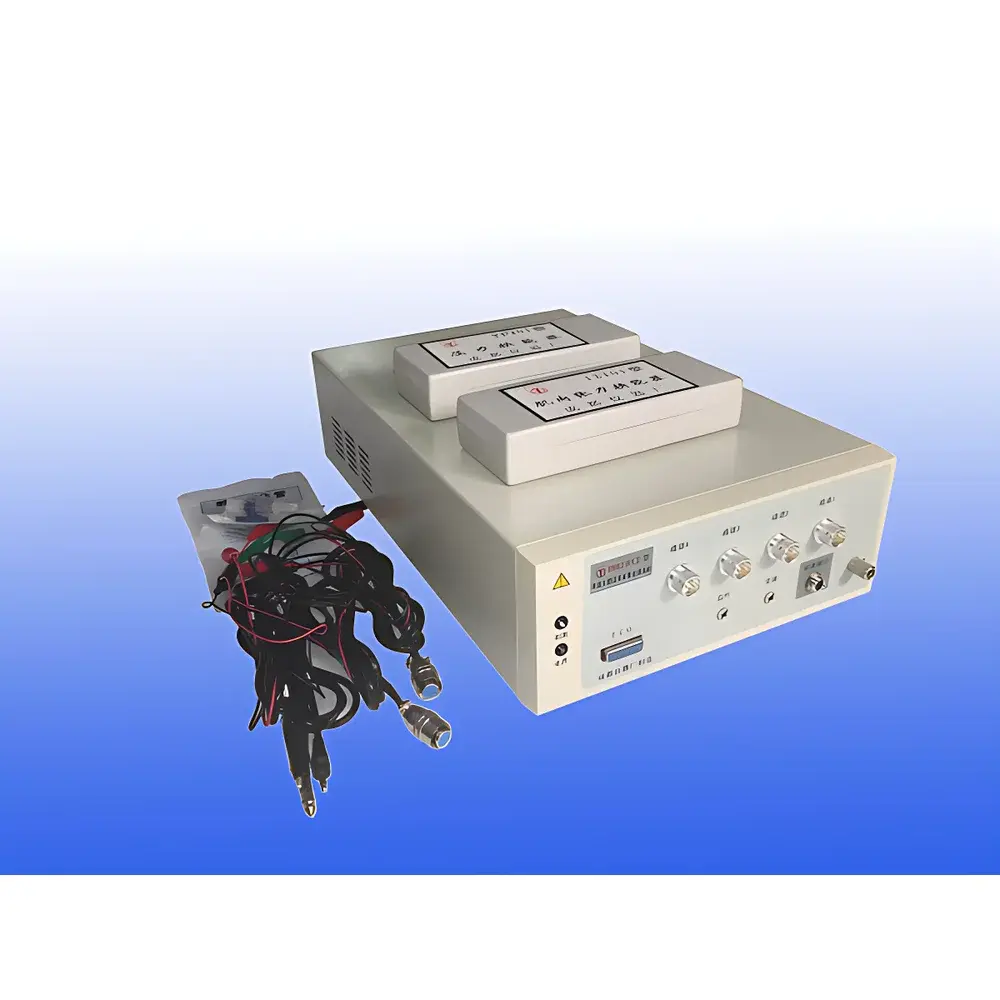
Chengyi RM-6240BD/CD Physiological Signal Acquisition and Processing System
| Brand | Chengyi (SCChengyi) |
|---|---|
| Origin | Sichuan, China |
| Model | RM-6240BD / RM-6240CD |
| Interface | USB 2.0 |
| Max Sampling Rate | 1000 kHz (single channel) |
| Input Impedance | ≥100 MΩ (differential) |
| CMRR | ≥100 dB |
| Input Noise | ≤±1 µV RMS |
| Frequency Response | DC–10 kHz |
| Input Range | 5 µV–500 mV |
| Sensitivity Ranges | Bioelectric: 20 µV/div–500 mV/div |
| Blood Pressure | 0.48–24 kPa/div or 3.6–180 mmHg/div |
| Hardware Filters | Low-pass: 3/10/30/100/500/1k/3k Hz, OFF |
| Time Constant | 0.001–5 s, DC |
| Stimulator Output | Voltage: 0–150 V (opt.), Current: 0–150 mA |
| Pulse Width/Delay/Interval | 0.1–1000 ms |
| Frequency | 1–3000 Hz |
| Calibrated Transducers | Tension: 0–50 g, Sensitivity: 100 mV/30 g (6 V DC) |
| Pressure | −10 to +40 kPa, Sensitivity: 25 mV/12 kPa (6 V DC) |
Overview
The Chengyi RM-6240BD/CD Physiological Signal Acquisition and Processing System is a modular, high-fidelity data acquisition platform engineered for preclinical life science research and medical physiology education. It operates on the principle of high-resolution analog-to-digital conversion coupled with real-time digital signal processing (DSP), enabling precise capture and analysis of low-amplitude, low-frequency bioelectrical and biomechanical signals—including ECG, EEG, EMG, arterial blood pressure, respiratory flow, muscle tension, intracranial pressure, pH, and temperature—under controlled in vivo and ex vivo experimental conditions. Designed for compliance with international standards for biomedical instrumentation (IEC 60601-1, IEC 62304 Class B), the system integrates isolated front-end amplification, optically decoupled stimulation, and software-based signal conditioning to ensure subject safety, measurement integrity, and reproducibility across repeated trials. Its architecture supports both acute animal experiments (e.g., rodent, rabbit, canine cardiovascular or neuropharmacological studies) and long-term chronic monitoring protocols when paired with appropriate transducers and telemetry interfaces.
Key Features
- USB 2.0–based external acquisition unit compatible with Windows 10/11; no internal PC hardware modification required—fully portable with laptops.
- Simultaneous multi-channel acquisition up to 4 channels at 250 kHz continuous sampling, or single-channel operation at up to 1000 kHz—enabling high-temporal-resolution capture of action potentials, spike trains, or rapid pressure transients.
- Programmable isolation amplifiers per channel: each functions as a bioelectric amplifier (DC–10 kHz), pressure amplifier (with kPa/mmHg scaling), bridge amplifier (for strain-gauge or plethysmographic transducers), or differential thermistor interface—all selectable via software configuration.
- Optically isolated, fully programmable stimulator with dual-mode output (voltage/current), adjustable pulse parameters (width, delay, interval, frequency), and configurable polarity (±V, ±I)—validated for neural, muscular, and cardiac stimulation under GLP-aligned protocols.
- Hardware-level filtering: 8-pole low-pass (3 Hz–3 kHz + OFF) and time-constant control (0.001 s–5 s + DC) combined with zero-phase-shift digital filters (high-pass, low-pass, band-pass, notch) for artifact suppression without phase distortion.
- Calibrated, interchangeable transducer ecosystem: factory-traceable pressure transducers (−10 to +40 kPa), tension transducers (0–50 g), and flow heads compliant with ISO 26794 respiratory measurement conventions.
Sample Compatibility & Compliance
The RM-6240BD/CD is validated for use with mammalian models including mice, rats, guinea pigs, rabbits, and dogs in accordance with NIH Guide for the Care and Use of Laboratory Animals and EU Directive 2010/63/EU. Its galvanically isolated inputs and stimulus outputs meet IEC 60601-1 requirements for patient-adjacent equipment, making it suitable for terminal surgical preparations and non-invasive physiological monitoring. The integrated 12-lead ECG converter conforms to ANSI/AAMI EC11 and IEC 60601-2-51 standards for electrocardiographic performance. All signal processing workflows support audit-ready metadata tagging and timestamp synchronization—facilitating compliance with FDA 21 CFR Part 11 for electronic records and signatures when deployed in regulated pharmacology or toxicology laboratories.
Software & Data Management
The native acquisition software runs natively on Windows with bilingual (English/Chinese) UI support and provides full API access for MATLAB, Python (via DLL wrappers), and LabVIEW integration. Data files are saved in HDF5 format—self-describing, hierarchical, and compressible—with embedded calibration coefficients, transducer IDs, and acquisition metadata. Built-in analysis modules include: automated ECG interval detection (RR, PR, QT), heart rate variability (HRV) spectral analysis (LF/HF ratio), respiratory mechanics (compliance, resistance, work of breathing), spirometric quantification (FVC, FEV1, FEV1/FVC), and pharmacodynamic modeling (pA2, pD2, LD50, ED50, nonlinear regression). All measurements—including peak amplitude, slope, area under curve, latency, and spectral power density—are exportable to CSV, Excel, or Word with embedded vector graphics. Software updates are delivered via signed firmware packages with version-controlled changelogs.
Applications
- Cardiovascular physiology: invasive/non-invasive blood pressure monitoring, baroreflex sensitivity assessment, ventricular pressure-volume loop analysis.
- Neuroscience: extracellular single-unit recording, evoked potential mapping, cortical EEG spectral analysis, autonomic nervous system evaluation (sympathovagal balance).
- Respiratory research: dynamic lung compliance, airway resistance, tidal volume quantification, CO2 response curves.
- Pharmacology & toxicology: dose–response characterization, receptor affinity estimation, chronotropic/inotropic drug screening, QT prolongation risk assessment.
- Musculoskeletal studies: isometric/isotonic contractile force profiling, fatigue index calculation, electromechanical delay measurement.
- Educational labs: standardized curricula covering 7 major categories—neuromuscular, circulatory, respiratory, digestive, sensory, central nervous, and urogenital systems—with >40 preconfigured experiment templates.
FAQ
Is the system compatible with third-party transducers?
Yes—the analog input stage accepts standard ±5 V or 0–5 V output transducers with user-defined calibration tables. Full transducer configuration (sensitivity, offset, units) is stored per experiment.
Does the software support GLP-compliant audit trails?
Yes—software logs all parameter changes, file saves, calibration events, and user actions with timestamps and operator ID. Audit trail reports are exportable in PDF format.
Can I perform offline reprocessing with different filter settings?
Yes—raw acquired data retains full bit depth and sample timing. Digital filters, baseline correction, and derivative operations can be reapplied non-destructively to archived datasets.
What is the maximum number of simultaneous channels supported?
Four analog input channels plus one dedicated stimulator output channel; additional channels may be added via cascaded units using synchronized USB triggering.
Are calibration certificates provided with transducers?
Each calibrated pressure and tension transducer ships with a traceable calibration report referencing NIST-traceable standards, valid for 12 months from date of shipment.