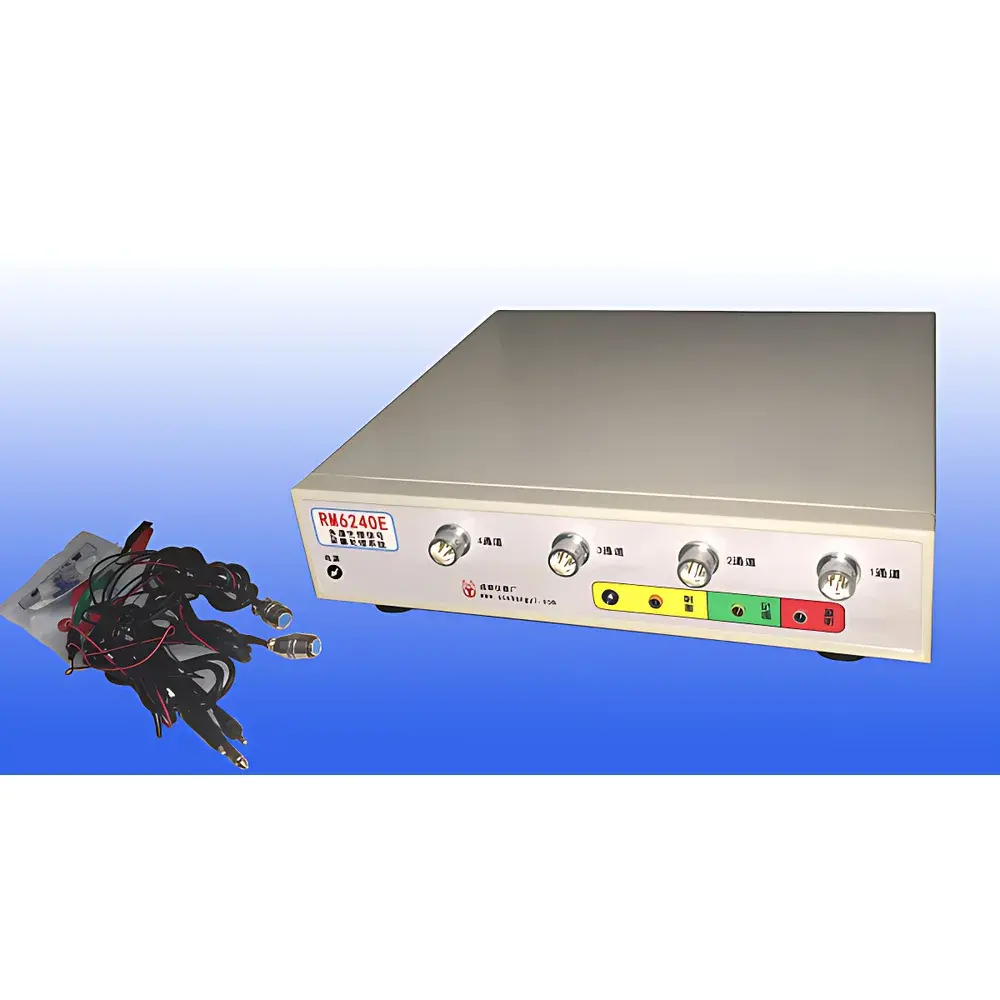
Chengyi RM6240E/EC Multi-Channel Physiological Signal Acquisition and Processing System
| Brand | Chengyi (scchengyi) |
|---|---|
| Origin | Sichuan, China |
| Model | RM6240E/EC |
| Channel Count | 4 (expandable to 8 or 16 via daisy-chaining) |
| A/D Resolution | 16-bit |
| Max Single-Channel Sampling Rate | 1,000 kHz |
| Min Sampling Rate | 0.01 Hz |
| Continuous 4-Channel Sampling Rate | 200 kHz |
| Input Impedance | ≥100 MΩ (differential), ≥50 MΩ (single-ended) |
| CMRR | ≥100 dB |
| Input Noise | ≤±1 µV RMS / ≤±3 µV P-P |
| Frequency Response | DC–20 kHz |
| Input Range | 5 µV–500 mV |
| Gain Settings | 10 µV/div–500 mV/div (bioelectric), 0.36–360 mmHg/div (blood pressure) |
| Hardware Filters | Low-pass (0.3 Hz–20 kHz, OFF), Time Constant (0.001 s–DC), 5+ order analog filtering |
| Stimulator Output | ±50 V max, ≤100 mA, programmable pulse modes (single, train, dual, incremental, timed), galvanically isolated |
| ECG Lead Support | Full 12-lead (I, II, III, aVR, aVL, aVF, V1–V6), software-switchable |
| Environmental Sensors | Integrated temperature, atmospheric pressure, and humidity measurement |
| Software Certifications | Certified software copyright (No. 2012SR137470), Sichuan Software Registration Certificate (Chuan DGY-2013-0154) |
| Data Export | MATLAB (.mat), SPSS (.sav), SAS (.sas7bdat), CSV |
| Compliance | Meets national safety standards for biomedical instrumentation (leakage current <3 mA) |
Overview
The Chengyi RM6240E/EC is a modular, high-fidelity multi-channel physiological signal acquisition and processing system engineered for rigorous preclinical research in animal physiology, pharmacology, and integrative life sciences. Built upon a galvanically isolated, low-noise analog front-end architecture, it employs precision 16-bit analog-to-digital conversion with real-time adjustable sampling rates ranging from 0.01 Hz to 1,000 kHz per channel—enabling simultaneous high-temporal-resolution capture of fast neural spikes and slow hemodynamic trends. Its core measurement principle integrates differential bioelectric amplification, bridge-based transducer interfacing (for pressure, force, flow), and digitally synchronized stimulus delivery—all within a single compact chassis designed to minimize electromagnetic interference without requiring external grounding. The system complies with fundamental safety requirements for Class I medical-grade laboratory equipment, including leakage current <3 mA and output voltage limited to ≤50 V, ensuring operator and subject safety during acute in vivo preparations.
Key Features
- Four fully independent, software-configurable input channels—each capable of functioning as a bioelectric amplifier, blood pressure amplifier, bridge amplifier (for strain gauges or plethysmographs), thermistor interface, or spirometry module.
- Hardware-level isolation between channels eliminates crosstalk and enables mixed-modality experiments (e.g., simultaneous ECG, arterial pressure, and respiratory airflow).
- Dual-domain filtering: analog low-pass and time-constant circuits (0.001 s to DC; 0.3 Hz to 20 kHz cutoff) combined with zero-phase-shift digital filters (adjustable order, high-pass/low-pass/band-pass/band-stop).
- Integrated galvanically isolated stimulator supporting 12 programmable paradigms—including strength-, frequency-, and interval-incremental protocols—with bidirectional current output and TTL synchronization.
- Full 12-lead ECG acquisition capability per channel, with programmable lead selection and automatic calibration routines for clinical-grade waveform fidelity.
- Onboard environmental monitoring (temperature, barometric pressure, relative humidity) logged synchronously with physiological data for experimental metadata traceability.
- Expandable architecture: up to four RM6240E/EC units can be daisy-chained to form an 8- or 16-channel system, managed under unified software control with shared timebase and trigger coordination.
Sample Compatibility & Compliance
The RM6240E/EC is validated for use with standard rodent, rabbit, canine, and non-human primate preparation models. It interfaces seamlessly with commercially available pressure transducers (−10 to +40 kPa range), force transducers (0–50 g full scale), spirometric sensors, thermistors, and optical plethysmographs. All analog inputs meet IEC 60601-1 essential performance criteria for leakage current (<3 mA) and electrical isolation—ensuring safe operation during chronic or acute surgical recordings. While not FDA-cleared or CE-marked as a medical device, its hardware architecture aligns with GLP-compliant data integrity expectations: all raw waveforms are stored with embedded timestamps, hardware gain/filter settings, and sensor calibration coefficients. Audit trails for parameter changes and stimulus event logs are preserved in native file format for regulatory review readiness.
Software & Data Management
The bundled Windows-native acquisition and analysis suite (compatible with Windows XP through Windows 10) provides comprehensive experimental workflow support—from real-time visualization and audio playback of electrophysiological signals (e.g., cochlear microphonics, heart sounds) to post-hoc quantitative analysis. Key capabilities include: automated HRV spectral decomposition (LF/HF ratio, SDNN), Bliss-method LD50 estimation, PA2 calculation, LTP slope quantification, respiratory mechanics modeling (compliance, resistance), and spike sorting via amplitude-thresholding or template-matching. Data export supports open formats (.MAT, .CSV, .SAV) and includes documented APIs for Python, MATLAB, and LabVIEW integration. The software holds formal Chinese software copyright registration (No. 2012SR137470) and includes context-sensitive help, multi-language UI support (including English localization), and full backward compatibility across firmware revisions. All files embed metadata tags for ISO/IEC 17025-aligned traceability.
Applications
This system serves as a foundational platform for hypothesis-driven investigations in cardiovascular physiology (baroreflex sensitivity, ventricular pressure-volume loops), neuropharmacology (synaptic plasticity, seizure threshold modulation), respiratory control (chemoreceptor response kinetics), autonomic neuroscience (vagal tone assessment), and integrative pathophysiology (sepsis-induced hemodynamic collapse). Its flexible transducer support enables longitudinal studies requiring concurrent hemodynamic, metabolic, and electrophysiological endpoints—such as measuring myocardial contractility alongside coronary flow reserve in isolated perfused heart preparations. In academic teaching laboratories, the network-capable software supports synchronized demonstration, remote student monitoring, and standardized assessment workflows compliant with ABET-accredited life sciences curricula.
FAQ
Is the RM6240E/EC compatible with third-party transducers?
Yes—any transducer with standard ±5 V or 0–5 V analog output and appropriate excitation voltage (if bridge-type) can be interfaced using the system’s configurable bridge amplifier and calibration utility.
Can the software run on macOS or Linux?
No—the native application is Windows-only; however, exported data files (.MAT, .CSV) are fully cross-platform and can be analyzed using open-source tools like Python (SciPy, Neo), R, or GNU Octave.
Does the system support FDA 21 CFR Part 11 compliance?
It does not include electronic signature or audit trail modules required for Part 11 enforcement; however, raw data files contain immutable metadata (timestamp, gain, filter, user ID), enabling manual validation for GLP audits.
What is the maximum sustained sampling rate when recording from all four channels simultaneously?
200 kHz aggregate (50 kHz per channel), with full real-time display, filtering, and stimulus triggering maintained without buffer overflow.
How is calibration performed for pressure or force measurements?
Calibration is software-guided using two-point or multi-point reference standards; coefficients are saved per-channel and automatically applied during data acquisition and export.