
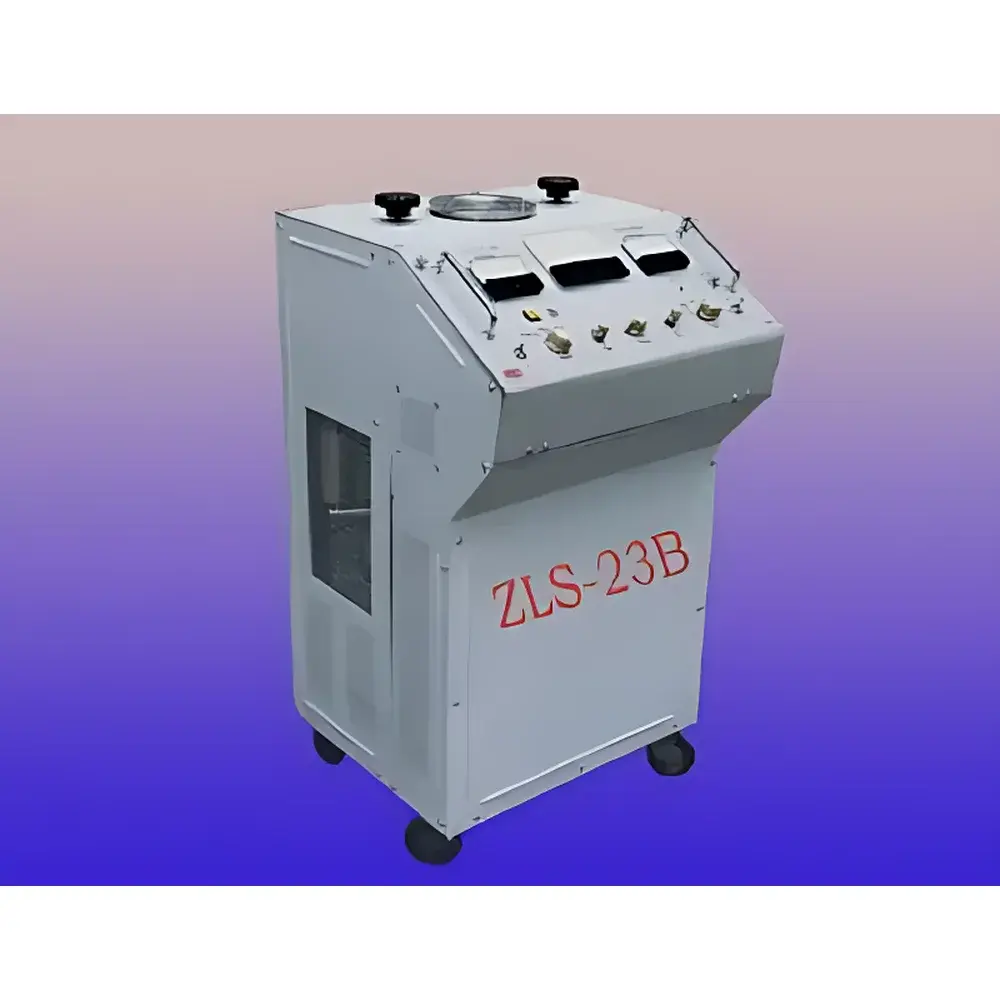
Chengyi ZLS-23B Helium Mass Spectrometer Leak Detector
| Brand | Chengyi (SCChengyi) |
|---|---|
| Origin | Sichuan, China |
| Manufacturer Type | Authorized Distributor |
| Country of Origin | China |
| Model | ZLS-23B |
| Pricing | Available Upon Request |
| Minimum Detectable Leak Rate | < 2 × 10⁻¹¹ Pa·m³/s |
| Warm-up Time | ~1 h |
| Response Time | ≤ 3 s |
| Maximum Operating Pressure in Mass Spectrometer Chamber | 1 × 10⁻² Pa |
| Leak Test Port | KF25 |
| Dimensions (L×W×H) | 950 × 600 × 570 mm |
| Weight | ~65 kg |
| Power Supply | AC 220 V, ~2 kW |
| Ambient Temperature Range | +5 °C to +40 °C |
| Relative Humidity | < 80 % RH |
| Electromagnetic Environment | Low-interference zone recommended |
Overview
The Chengyi ZLS-23B Helium Mass Spectrometer Leak Detector is a high-sensitivity, benchtop vacuum-based leak detection system engineered for quantitative identification and localization of minute leaks in sealed components and vacuum systems. It operates on the principle of positive ion flow mass spectrometry—specifically optimized for helium (⁴He⁺) detection at mass-to-charge ratio m/z = 4. The instrument employs a dedicated magnetic sector mass analyzer coupled with a hot-cathode ion source and electron multiplier detector, delivering stable ion current amplification under ultra-high vacuum conditions. Its core vacuum architecture integrates a domestically manufactured oil diffusion pump backed by a rotary vane forepump, achieving base pressures compatible with sensitive helium ion signal discrimination. Designed for industrial QA/QC laboratories, aerospace component validation, semiconductor equipment maintenance, and cryogenic system integrity verification, the ZLS-23B meets functional requirements aligned with ISO 9001-compliant leak testing workflows and supports traceable calibration per national metrological standards.
Key Features
- High-sensitivity detection limit of < 2 × 10⁻¹¹ Pa·m³/s, enabling identification of sub-micron defects in stainless steel, aluminum, and glass-metal hermetic seals.
- Dedicated helium-specific magnetic sector mass spectrometer with optimized ion optics for enhanced signal-to-noise ratio and long-term stability.
- Integrated oil diffusion pumping system (Chengyi-manufactured) backed by a Zhejiang-sourced rotary vane forepump, providing robust vacuum performance without reliance on turbomolecular pumps.
- KF25 standardized leak test port ensures compatibility with industry-standard vacuum fittings, flexible hose connections, and automated test fixtures.
- Pre-calibrated reference leak (certified per national metrology institute standards) included for routine sensitivity verification and drift monitoring.
- Five-year lamp life expectancy for the tungsten filament assembly; 50 spare filaments supplied to support extended operational uptime in production environments.
- Integrated helium spray probe (handheld, ergonomic design) with adjustable gas flow control for localized sniffing-mode leak localization.
Sample Compatibility & Compliance
The ZLS-23B accommodates rigid and semi-rigid vacuum-compatible samples up to 1.2 m in maximum dimension when mounted externally via KF25 interface. It supports both vacuum-integrated (vacuum chamber mode) and sniffer (tracer gas mode) methodologies in accordance with ASTM E493-22 “Standard Test Methods for Leaks Using the Mass Spectrometer Leak Detector in the Vacuum Mode” and ISO 10852:2021 “Leak testing — Mass spectrometer leak detectors — Vocabulary and general principles.” All internal wetted surfaces are passivated stainless steel or borosilicate glass; no elastomeric seals contact the mass spectrometer chamber. Instrument operation complies with IEC 61000-6-3 (EMC emission limits) and IEC 61010-1 (safety requirements for electrical equipment for measurement). Calibration documentation conforms to JJG 1107-2015 (Chinese National Verification Regulation for Helium Mass Spectrometer Leak Detectors).
Software & Data Management
The ZLS-23B operates via embedded microcontroller-based firmware with real-time analog signal processing and digital leak rate computation. Front-panel LED indicators display vacuum status, filament emission current, amplifier gain, and detected ion current. While the base configuration does not include PC connectivity, optional RS-232 or USB-to-serial interface modules enable integration with laboratory data acquisition systems. Raw ion current output (0–10 V DC) and relay-controlled status signals (e.g., alarm trigger, pump interlock) are accessible via rear-panel terminals. Audit trail functionality is implemented through timestamped manual log entries; for GLP/GMP-regulated environments, external electronic lab notebooks (ELN) may be used to record calibration events, leak test reports, and maintenance logs per 21 CFR Part 11 compliance guidelines.
Applications
- Verification of hermeticity in MEMS packages, laser diode housings, and fiber optic feedthroughs.
- In-process leak screening of vacuum vessel welds, flange joints, and bellows assemblies in nuclear and fusion research infrastructure.
- Final acceptance testing of vacuum-insulated panels (VIPs), refrigeration compressors, and medical imaging detector modules.
- Root-cause analysis of outgassing anomalies during bake-out procedures in UHV thin-film deposition systems.
- Calibration transfer and cross-validation between primary and secondary helium leak standards in metrology labs.
FAQ
What vacuum level must be achieved before initiating a leak test?
The mass spectrometer chamber requires a pressure ≤ 1 × 10⁻² Pa—typically reached after ~1 hour of pump-down with the diffusion/forepump combination. A vacuum gauge with Pirani/cold cathode dual sensing is recommended for real-time monitoring.
Is helium the only detectable tracer gas?
Yes—the ZLS-23B is specifically tuned for helium-4 (m/z = 4) and does not provide multi-gas analysis capability. Its mass resolution excludes interference from hydrogen (H₂⁺ at m/z = 2) or water fragments under normal operating conditions.
Can the instrument operate continuously for extended periods?
Continuous operation is supported within ambient temperature (+5 °C to +40 °C) and humidity (<80 % RH) specifications. Filament replacement intervals depend on cumulative ionization duty cycle; typical service life exceeds 2,000 hours under standard test protocols.
Does the system meet international regulatory requirements for pharmaceutical manufacturing?
While not pre-certified for FDA 21 CFR Part 11 out-of-the-box, the ZLS-23B’s deterministic analog signal path, calibrated reference leak, and documented maintenance history support qualification under GMP Annex 15 and EU GMP Chapter 4 when integrated into validated leak test procedures.
What is the recommended preventive maintenance schedule?
Oil diffusion pump fluid should be replaced every 12 months or after 2,000 hours of operation; forepump oil every 6 months; and KF25 sealing O-rings inspected prior to each major test campaign. Full system sensitivity verification using the certified reference leak is advised before each shift in high-reliability applications.
Related Products




