
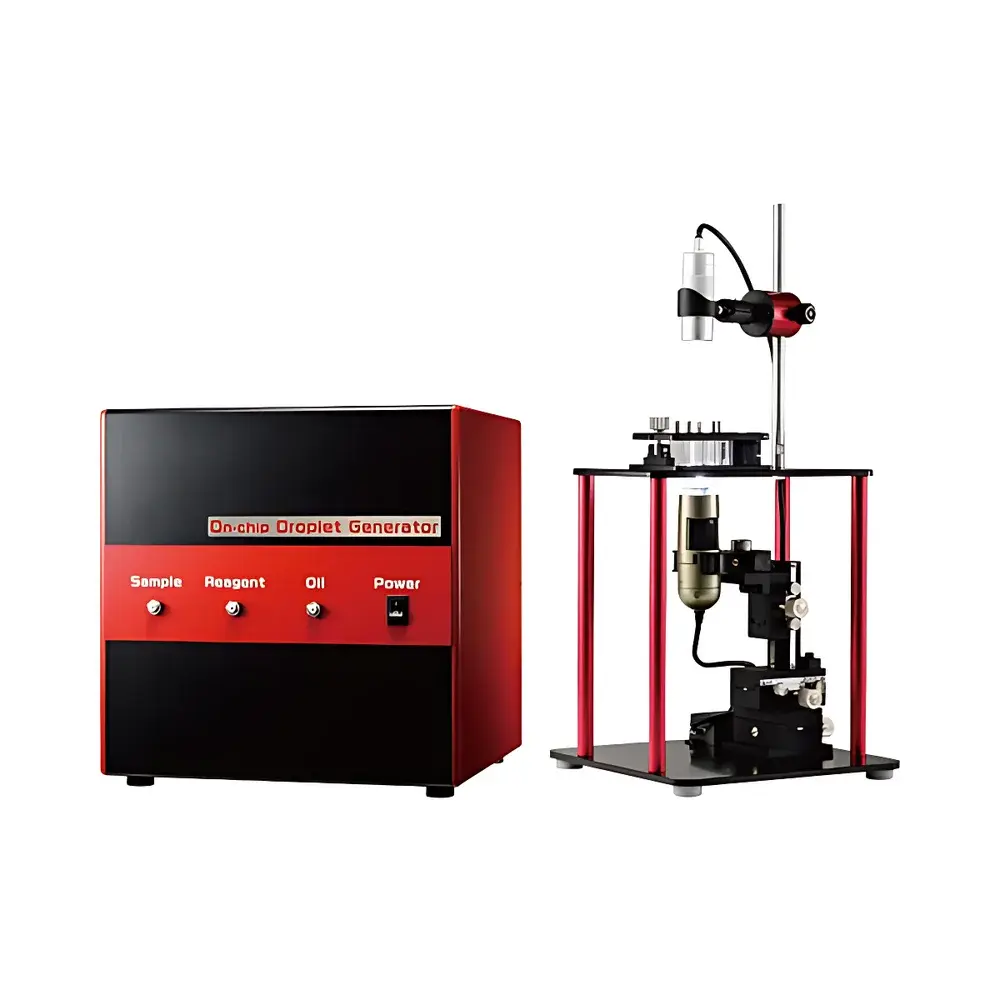
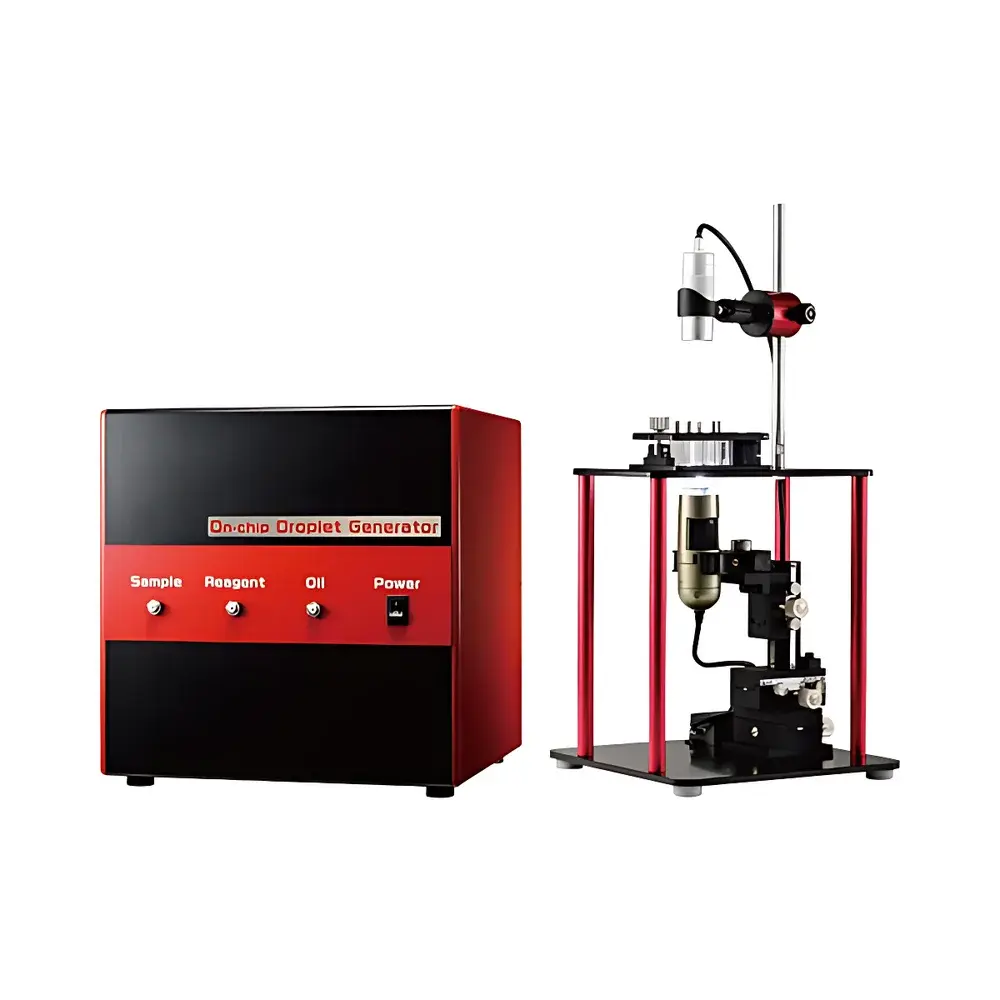
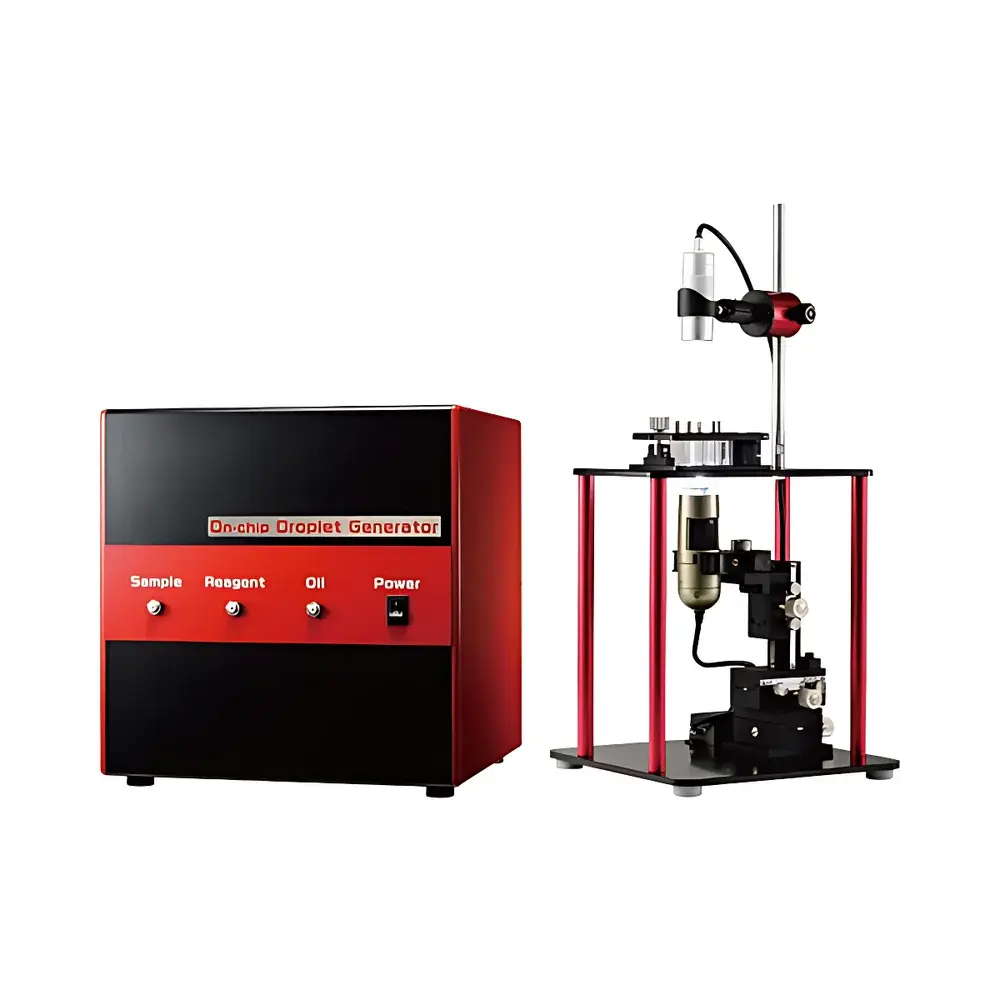
On-chip Droplet Generator Microfluidic Emulsion System
| Brand | On-chip |
|---|---|
| Origin | Japan |
| Model | On-chip Droplet Generator |
| Droplet Generation Rate | Up to 1 × 10⁶ droplets/min |
| Droplet Diameter Range | 20–220 µm |
| Chip Configurations | 3 standard microfluidic chip types |
| Emulsion Types | Water-in-Oil (W/O) and Gel-Microdroplet (GMD) |
| Compatibility | On-chip Sort, On-chip Droplet Selector |
Overview
The On-chip Droplet Generator is a precision-engineered microfluidic emulsion system designed for high-throughput, reproducible generation of monodisperse aqueous microdroplets in an immiscible carrier oil phase. Operating on the principle of hydrodynamic flow-focusing and shear-controlled breakup within microstructured channels, the system enables robust, continuous production of water-in-oil (W/O) and gel-microdroplet (GMD) formats at rates up to 1 million droplets per minute. Each droplet—ranging from 20 to 220 µm in diameter—functions as an isolated microreactor or single-cell compartment, supporting applications in digital PCR, single-cell transcriptomics, enzyme screening, and microbial phenotyping. The platform is engineered for integration into automated lab workflows and adheres to core principles of microfluidic stability, inter-run reproducibility, and low dead-volume fluid handling.
Key Features
- High-Throughput Monodisperse Generation: Achieves stable droplet formation at >10⁶ droplets/min with coefficient of variation (CV) <5% in diameter across runs—enabled by precisely fabricated glass/PDMS hybrid microfluidic chips and laminar flow control.
- Modular Chip Architecture: Three interchangeable chip configurations allow selection of optimal droplet size ranges: 20–50 µm (high-resolution single-cell encapsulation), 50–120 µm (balanced throughput and reagent volume), and 120–220 µm (enhanced nutrient retention for extended microbial culture).
- Real-Time Pressure-Based Sizing Control: Independent pneumatic pressure regulation of aqueous and oil phases permits fine-tuned adjustment of droplet diameter without hardware modification—enabling dynamic optimization during assay development.
- Integrated Optical Observation Unit: Built-in high-magnification objective lens and LED illumination support real-time visualization and validation of droplet morphology, frequency, and coalescence behavior directly at the chip outlet.
- Dual Emulsion Mode Support: Switchable operation between conventional W/O emulsions and GMD format—where aqueous phase contains thermoresponsive or UV-curable hydrogels—facilitating solid-phase immobilization post-encapsulation.
- Seamless Platform Integration: Designed for direct interfacing with On-chip Sort (for fluorescence-activated droplet sorting) and On-chip Droplet Selector (for targeted dispensing into 96-/384-well plates), enabling end-to-end droplet-based assay pipelines.
Sample Compatibility & Compliance
The system accommodates a broad range of aqueous phases—including cell suspensions (bacterial, yeast, mammalian), PCR master mixes, enzymatic reaction buffers, and hydrogel precursors—with viscosity tolerance up to 20 mPa·s. Carrier oils include standard fluorinated (e.g., HFE-7500) and silicone-based surfactant-stabilized formulations. All microfluidic chips are sterilizable via autoclaving or ethanol treatment and certified free of DNase/RNase and endotoxin contamination. The instrument architecture supports GLP-compliant operation through traceable pressure calibration logs and user-accessible chip lot tracking—fully compatible with ISO 13485-aligned quality management systems for IVD-related R&D.
Software & Data Management
Control is managed via a dedicated Windows-based interface supporting protocol storage, pressure ramping profiles, and time-stamped acquisition of droplet generation metrics (frequency, size drift, burst events). Export formats include CSV (for statistical analysis in Python/R), TIFF stacks (for image-based QC), and JSON (for integration with LIMS or ELN platforms). Audit trail functionality complies with FDA 21 CFR Part 11 requirements when deployed with network authentication and electronic signature modules. No cloud dependency—data remains local unless explicitly exported.
Applications
- Digital droplet PCR (ddPCR) and rare mutation detection
- Single-cell RNA sequencing library preparation via barcoded GMD encapsulation
- Ultra-high-throughput antimicrobial susceptibility testing (AST) using bacterial microcolonies
- Directed evolution of enzymes under compartmentalized selection pressure
- Encapsulated cell-free protein synthesis assays
- Microbial consortia screening for metabolic cross-feeding interactions
FAQ
What chip materials are used, and are they compatible with organic solvents?
All standard chips consist of borosilicate glass and plasma-bonded PDMS—chemically resistant to common fluorinated oils and silicone oils. PDMS swelling is minimized via surface passivation; prolonged exposure to chlorinated or aromatic solvents is not recommended.
Can droplet size be adjusted mid-experiment?
Yes—real-time pressure modulation of either the aqueous or continuous phase allows continuous, stepwise, or ramped droplet diameter tuning without interrupting flow or replacing chips.
Is the observation unit suitable for quantitative size measurement?
The integrated optical module supports calibrated pixel-to-micron conversion and basic morphometric analysis (diameter, circularity, spacing); for metrology-grade sizing, we recommend coupling with an external high-speed camera and ImageJ/Fiji-based particle analysis.
Does the system meet regulatory requirements for clinical assay development?
While the instrument itself is research-use-only (RUO), its design, documentation, and data integrity features align with early-stage IVD assay development under ISO 13485 and CLIA guidelines—particularly when paired with validated chip lots and SOP-driven operation.
How is cross-contamination prevented between runs?
Each chip is single-use and disposed of post-run. Fluidic pathways upstream of the chip employ non-return valves and programmable purge cycles with ethanol/water flush sequences to eliminate carryover.
Related Products




