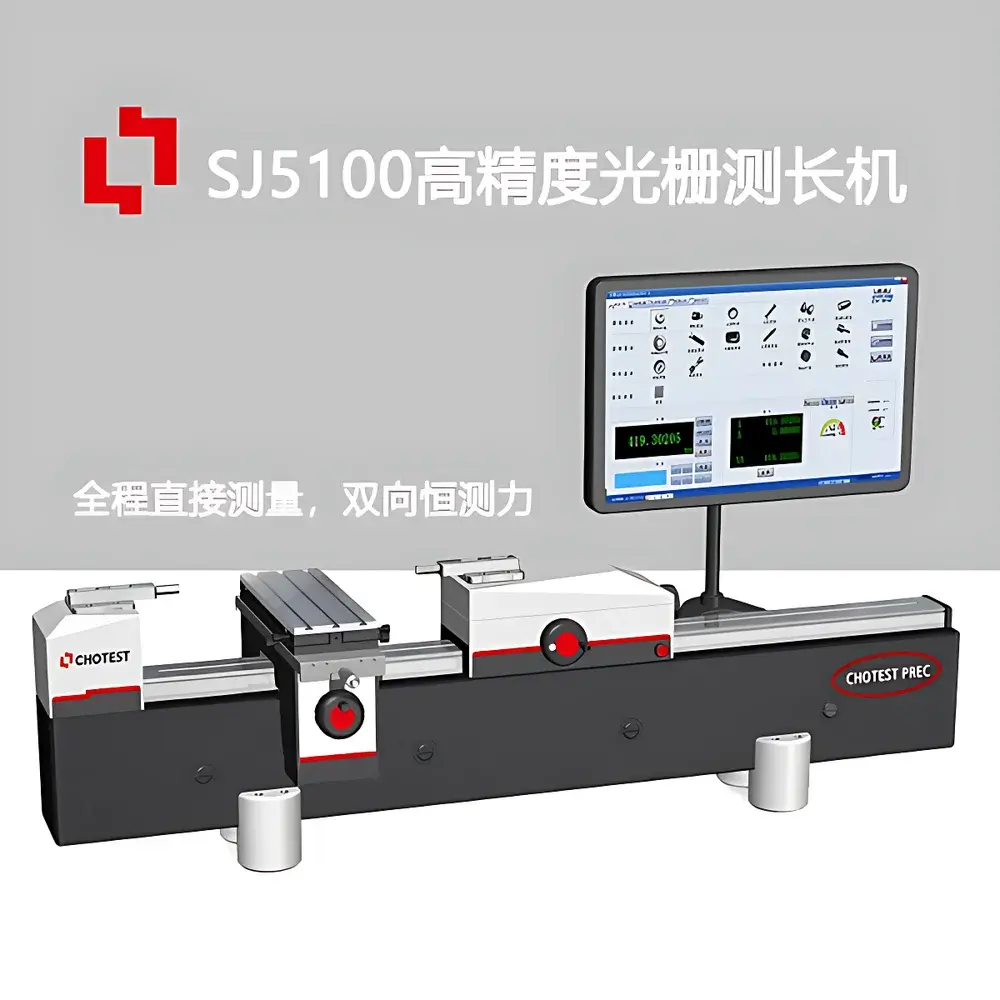
Chotest SJ5100-Prec300 Precision Length Measuring Machine
| Brand | Chotest |
|---|---|
| Origin | Guangdong, China |
| Model | SJ5100-Prec300 |
| Measurement Range | 0–340 mm (external), 5–200 mm (internal, with reference ring gauge) |
| Accuracy | ≤ ±(0.2 + L/1000) µm (L in mm, external dimension) |
| Repeatability (internal) | ≤ 0.1 µm (standard probe), ≤ 0.2 µm (hook probe), ≤ 0.3 µm (internal measuring assembly) |
| Measuring Force | 0.05/0.1/0.3/0.5 N (sensor-based internal force) |
| Environmental Requirement | 20 ± 2 °C, temp. stability ≤ 0.5 °C/h |
| Base Material | Granite |
| Resolution | 0.01 µm |
| Weight | 150 kg |
| Dimensions | 1400 × 400 × 450 mm |
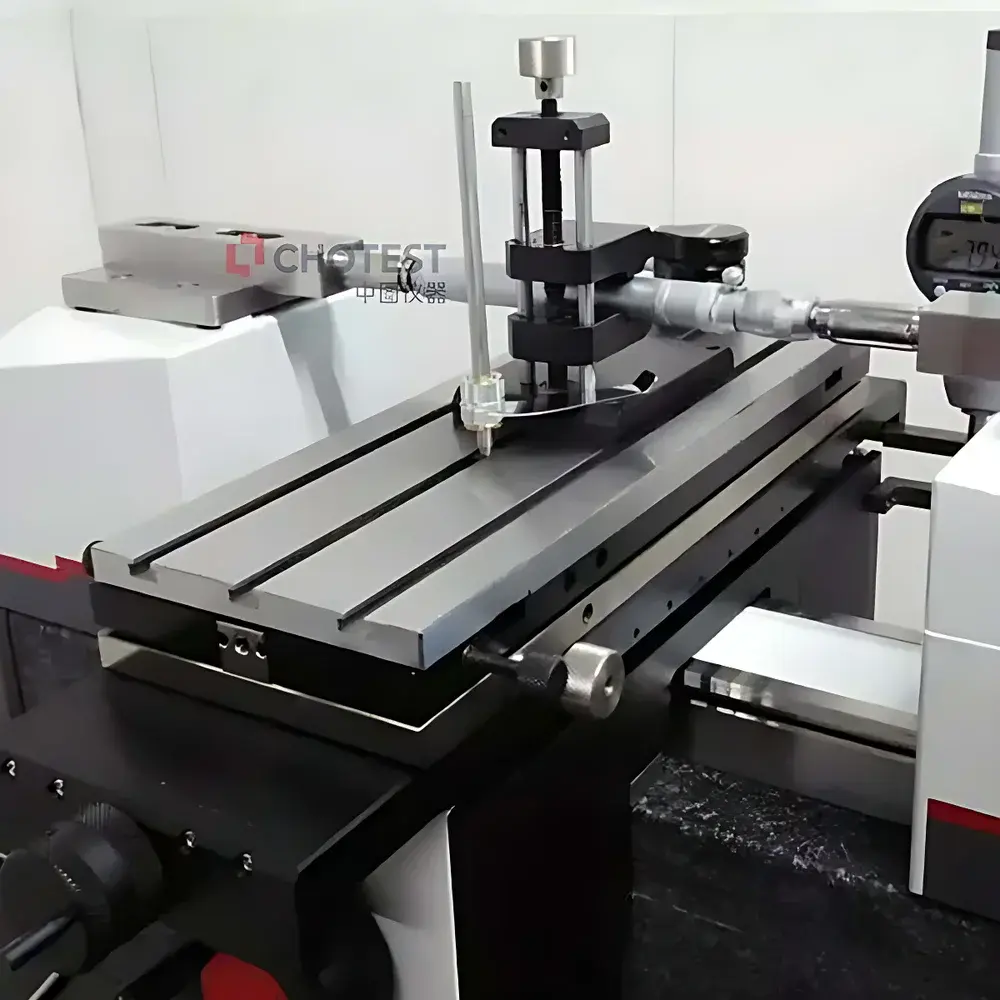
| Five-Axis Worktable (ST-30.1) | Z-axis 0–50 mm, Y-axis ±25 mm, X-axis floating ±10 mm, Z-rotation ±3°, Y-tilt ±3°, load capacity 50 kg, table size 350 × 25 mm |
Overview
The Chotest SJ5100-Prec300 is a high-precision, granite-based length measuring machine engineered for metrological-grade dimensional verification of mechanical components and precision gages. It operates on the principle of high-resolution optical grating interferometry combined with contact probing—where linear displacement is transduced via a thermally compensated, imported high-stability optical grating scale (0.01 µm resolution) mounted along a precision ground linear rail. The system employs bidirectional constant-force probing, minimizing elastic deformation during measurement while ensuring traceable, repeatable contact conditions. Designed for compliance with international calibration standards—including ISO 3650 (gauge blocks), ISO 1302 (geometric tolerancing), and ISO 17025-accredited laboratory environments—the SJ5100-Prec300 delivers sub-micrometer uncertainty performance across its full 0–340 mm external measurement range. Its rigid granite base—optimized via finite element analysis—is thermally inert and mechanically stable over decades, enabling long-term drift-free operation in controlled metrology labs.
Key Features
- Sub-micrometer accuracy: External dimension error ≤ ±(0.2 + L/1000) µm (L in mm), validated per ISO 230-2 and VDI/VDE 2617 Part 6.
- Thermally compensated optical grating system with 0.01 µm resolution and real-time temperature correction (via integrated Pt100 sensors).
- Five-axis motorized worktable (ST-30.1) supporting precise angular alignment: ±3° tilt/rotation, ±25 mm Y-travel, 0–50 mm Z-lift, and passive X-float for stress-free part positioning.
- Modular probe configuration: Interchangeable probes—including hook, internal measuring assembly, and three-point contact stylus—with selectable, calibrated forces (0.05 N to 10 N).
- Zero-drift granite base (150 kg mass, optimized stiffness-to-weight ratio) certified for long-term geometric stability under ISO 10360-1 environmental requirements.
- Full automation of measurement cycles: Typical routine calibration (e.g., gauge block or thread plug gauge) completes in <3 minutes, including auto-alignment, data acquisition, and report generation.
Sample Compatibility & Compliance
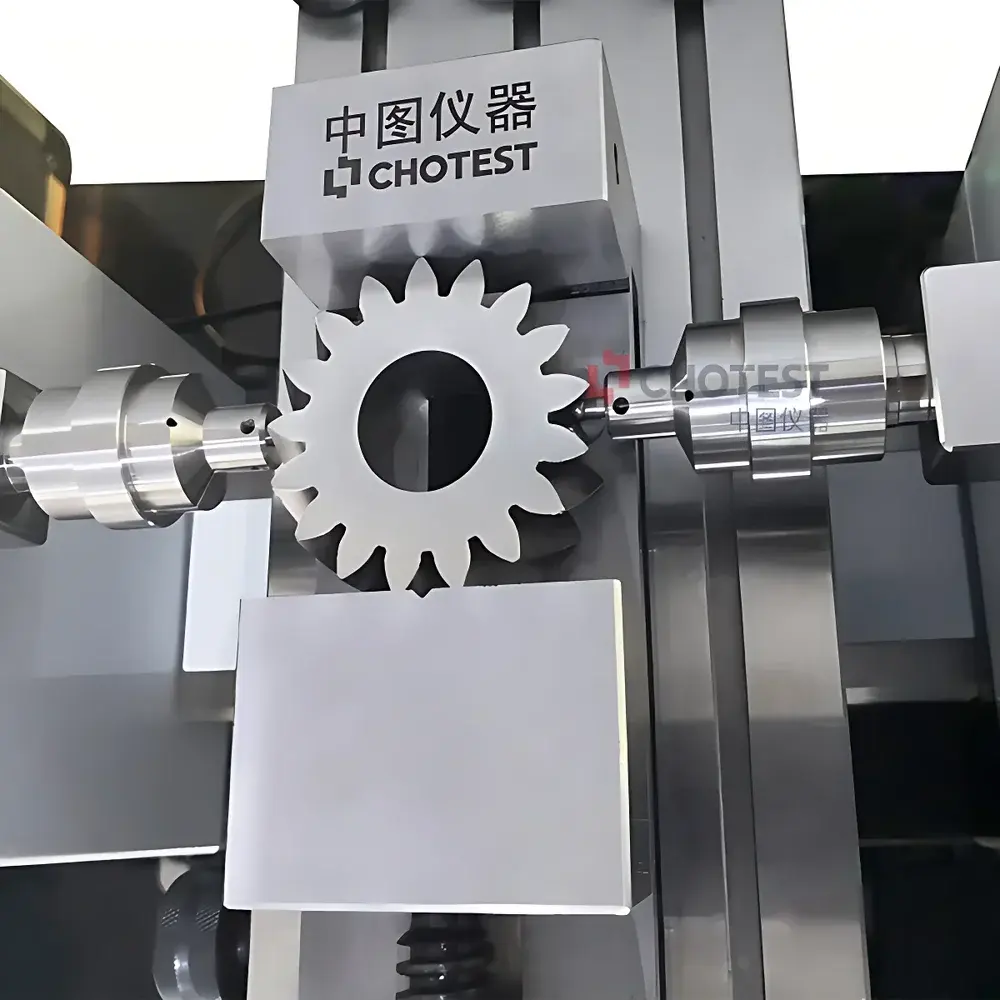
The SJ5100-Prec300 supports comprehensive dimensional metrology for both standard and non-standard artifacts. It is routinely used to calibrate and verify gauge blocks (0.1–300 mm), smooth ring and plug gauges (φ5–200 mm and φ1–220 mm), metric thread gauges (M1–M220, pitch 0.25–5.5 mm), spline gauges, gear span measurements, and precision shafts/bushings. Optional configurations extend capability to conical gauges, sawtooth/trapezoidal threads (M3–M400), radius gauges (R5–R700), and bearing raceway geometry (cone angle, groove diameter, and width). All measurement protocols align with national and international standards—including JJG 30–2012 (China), ISO 3650, ISO 7888, ISO 15510, and ANSI/ASME B89.1.13. The instrument’s mechanical design satisfies vibration immunity requirements per ISO 10360-1 (vibration velocity RMS ≤ 5 µm/s, 8–100 Hz), and its thermal management meets ISO 1.000–1 calibration environment specifications (20 ± 2 °C, ≤0.5 °C/h drift).
Software & Data Management
The SJ5100-Prec300 runs on a dedicated Windows-based metrology software platform compliant with GLP and GMP documentation principles. It includes built-in support for ASTM E29, ISO/IEC 17025 clause 7.7 (uncertainty evaluation), and FDA 21 CFR Part 11 audit trail functionality—ensuring electronic records are secure, time-stamped, and non-repudiable. The software automates data reduction per established norms (e.g., ISO 5725 for repeatability/reproducibility), generates customizable PDF reports conforming to national calibration certificate templates, and stores all raw and processed data in an encrypted SQL database with versioned backups. Features include real-time拐点 (inflection point) detection for edge-based measurements, automated tolerance band overlay, statistical process control (SPC) export (CSV/XLSX), and seamless integration with enterprise QMS platforms via OPC UA or REST API.
Applications
This instrument serves as a primary or secondary standard in accredited calibration laboratories, quality control departments of aerospace, automotive, and precision machining manufacturers, and R&D centers developing micro-mechanical systems. Typical use cases include: certification of working standards prior to shop-floor gage calibration; verification of thread form deviation (pitch diameter, flank angle, lead error); dimensional validation of gear tooth thickness and span measurement; calibration of dial indicators, digital calipers (75–300 mm), depth micrometers (0–75 mm), and internal micrometers (φ6–200 mm); and geometric assessment of bearing races, turbine blades, and medical implant components. Its modular architecture allows reconfiguration for specialized tasks—such as multi-point roundness sampling or taper error mapping—without hardware modification.
FAQ
What standards does the SJ5100-Prec300 comply with for calibration reporting?
It supports generation of certificates traceable to NIM (National Institute of Metrology, China) and aligned with ISO/IEC 17025, ISO 3650, and JJG 30–2012.
Is the system suitable for ISO 17025-accredited laboratories?
Yes—its software provides full audit trail, user access control, electronic signatures, and uncertainty budgeting per GUM (JCGM 100), meeting mandatory requirements for accreditation.
Can it measure tapered or conical parts?
With optional conical gauge modules and ST-30.1 worktable angular adjustment, it performs direct comparison measurement of cone angle, taper ratio, and effective diameter per ISO 5725 and ISO 1101.
What environmental conditions are mandatory for optimal performance?
A temperature-controlled metrology lab at 20 ± 2 °C (stability ≤ 0.5 °C/h), relative humidity 10–70 % RH, and floor vibration below 5 µm/s RMS (8–100 Hz) is required.
Does the system support automated uncertainty calculation?
Yes—the software computes combined standard uncertainty using Type A (repeatability) and Type B (grating error, thermal expansion, probe deformation) components, outputting expanded uncertainty (k=2) per GUM guidelines.