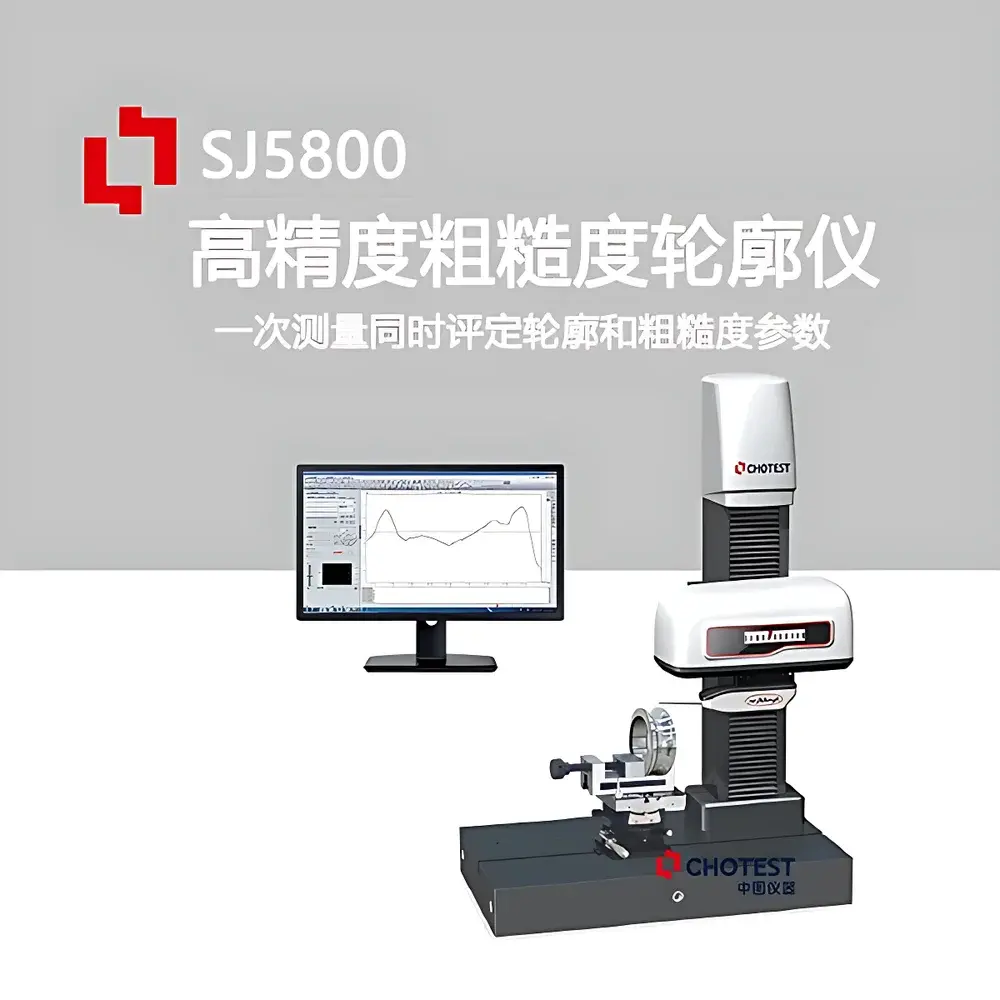
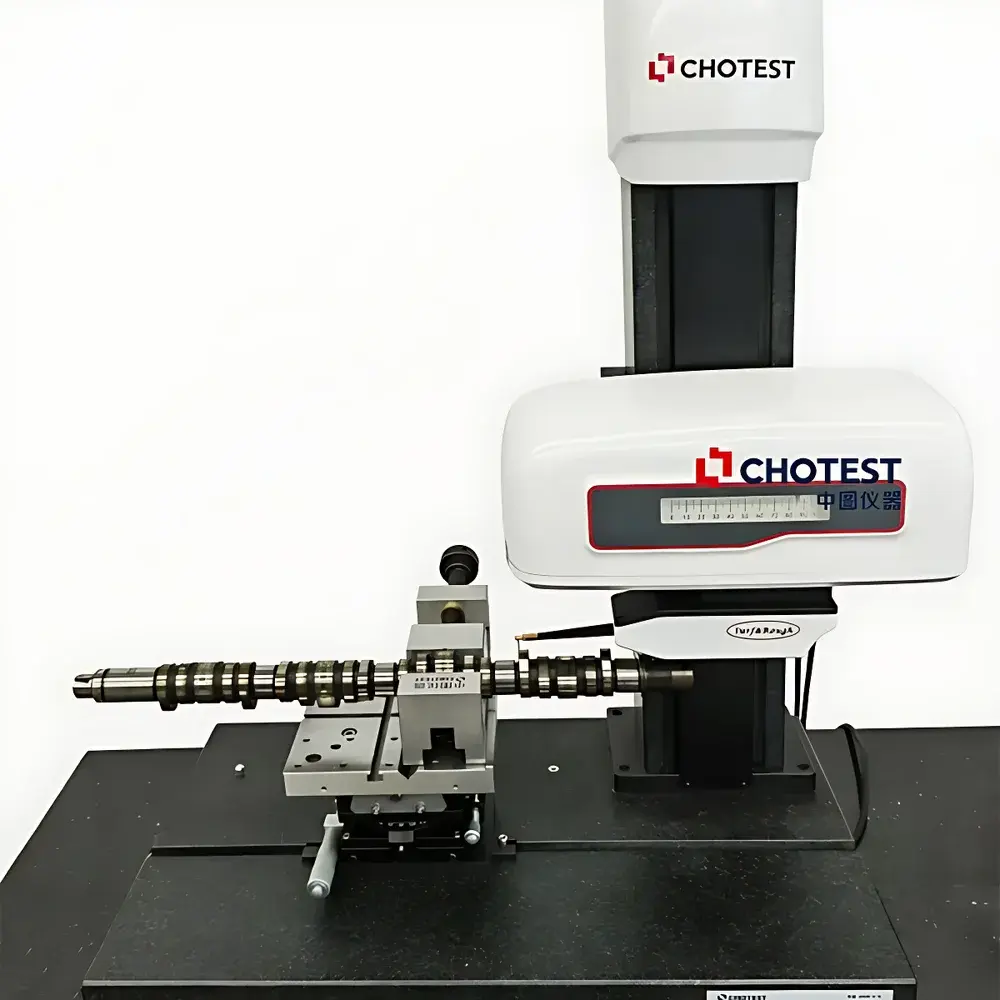
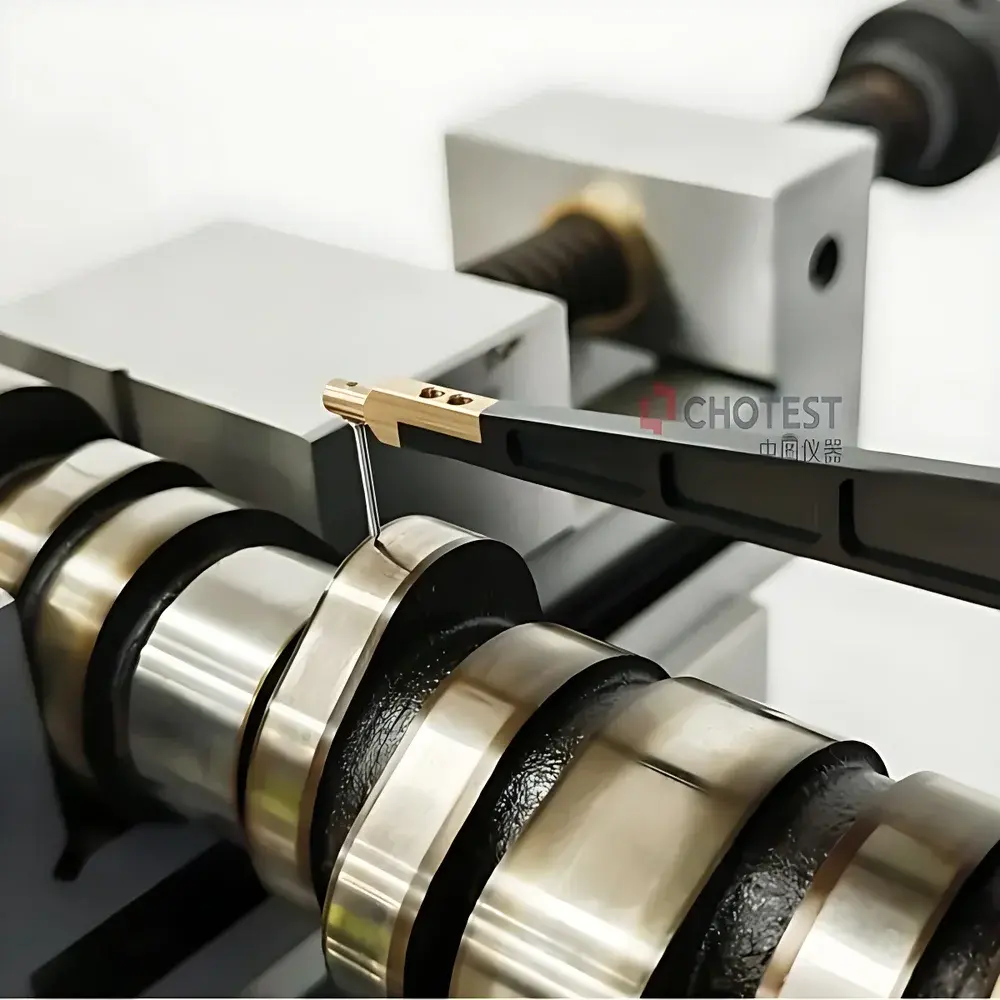
Chotest SJ5800 High-Precision Integrated Profilometer & Roughness Tester
| Brand | Chotest |
|---|---|
| Origin | Guangdong, China |
| Manufacturer Type | Authorized Distributor |
| Country of Origin | China |
| Model | SJ5800 |
| Price | USD 74,800 (FOB Shenzhen) |
| Operating Principle | Stylus Profilometry (Contact Tactile Method) |
| Measurement Mode | Contact |
| Sampling Lengths | 0.008, 0.08, 0.25, 0.8, 2.5, 8.0, 25 mm (selectable) |
| Evaluation Length | Automatically calculated as integer multiples of selected sampling length |
| Vertical Resolution | 0.001 µm (1 nm) |
| Measurement Repeatability | 1σ ≤ 1 nm |
Overview
The Chotest SJ5800 is a high-precision integrated profilometer and roughness tester engineered for metrological-grade characterization of surface topography in demanding industrial and R&D environments. It employs a contact-based stylus profilometry principle—compliant with ISO 4287, ISO 13565-2, ASME B46.1, and GB/T 3505—where a diamond-tipped probe traverses the surface under controlled, low-force conditions to generate high-fidelity elevation data. Unlike segmented or modular instruments, the SJ5800 performs simultaneous acquisition of profile, waviness, and roughness parameters from a single scan—eliminating repositioning errors and enabling traceable, repeatable assessment of complex curved geometries such as bearing raceways, roller profiles, and precision mold cavities. Its core architecture integrates a nanoscale optical encoder-based Z-axis sensor (0.001 µm resolution), a ground-grade frictionless granite guideway with sub-micron straightness (<0.3 µm/100 mm), and a closed-loop DC servo drive system delivering <10 nm positional jitter during scanning. This combination ensures metrological stability across extended measurement ranges (X: 0–100 mm; Z: ±6 mm standard, extendable to ±12 mm), making it particularly suited for large-radius arc surfaces, tapered rollers, and asymmetric bearing geometries where conventional instruments fail to maintain fidelity.
Key Features
- Nanoscale vertical resolution (0.001 µm) with system residual error < 3 nm—validated via NIST-traceable calibration artifacts.
- Modular stylus design with quick-release mechanism: no tools required; supports rapid interchange of 2 µm, 5 µm, and 12.5 µm radius diamond tips for varying surface hardness and curvature.
- Intelligent constant-force control: digitally regulated stylus load adjustable from 0.5 mN to 3 mN—minimizing plastic deformation on soft metals, polymers, and coated substrates while preserving signal integrity on hardened steels.
- Dual-axis CNC motion control (X and Z) with hardware- and software-enforced limit protection, including active deceleration on steep slope transitions to prevent stylus crash.
- Bearing-specific measurement suite: automated evaluation of groove geometry (depth, width, flank angle, symmetry), logarithmic roller convexity, spherical base radius, raceway curvature, and oil groove contour per ISO 15243 and ABMA standards.
- Integrated coordinate metrology engine supporting feature-based alignment (point-line, two-line, best-fit circle), GD&T evaluation (straightness, roundness, parallelism, position, profile of a line/surface), and multi-segment stitching for oversized parts.
Sample Compatibility & Compliance
The SJ5800 accommodates workpieces up to Ø250 mm diameter and 300 mm height (with optional rotary stage). Its contact methodology is compatible with metallic alloys (bearing steel, tool steel, aluminum), ceramics, hardened plastics, and thin-film-coated components—provided surface hardness exceeds 200 HV. All measurement algorithms conform to international standards including ISO 4287:2010 (roughness), ISO 13565-2:1996 (core roughness Rcore), ISO 12780-1:2020 (straightness), and ISO 1101:2017 (geometrical tolerancing). The instrument’s firmware and software support audit trails compliant with FDA 21 CFR Part 11 requirements when deployed in GLP/GMP-regulated environments—enabling electronic signatures, user access control, and immutable measurement log archiving.
Software & Data Management
The proprietary Chotest Metrology Suite (v6.2+) provides a unified interface for setup, acquisition, analysis, and reporting. Raw point-cloud data is stored in native .cmm format with embedded metadata (timestamp, operator ID, calibration status, environmental conditions). Export options include ASCII (.txt), CAD-compatible DXF (for reverse engineering), and XML-based CNC program files for automated replication. Advanced post-processing includes outlier suppression (manual or algorithmic), multi-scan alignment, reference contour overlay with deviation mapping, and statistical process control (SPC) chart generation (X̄–R, Cp/Cpk). All roughness parameters—R-, P-, W-, and Motif-family—are computed per ISO 25178-2 definitions, with customizable filtering (Gaussian, RC, PC-RC) and segmentation logic. Reports are exportable as PDF or Excel, embeddable with company logos, and configurable to match internal QA templates.
Applications
The SJ5800 serves critical quality assurance functions across multiple high-precision sectors:
- Bearing manufacturing: Full-form evaluation of inner/outer ring raceways, roller convexity profiling (logarithmic, parabolic), seal groove metrology, and flange angle verification.
- Automotive powertrain: Cylinder bore cross-hatch analysis, cam lobe profile validation, and turbocharger turbine blade edge rounding assessment.
- Precision machining & moldmaking: Mold cavity surface finish verification, EDM recast layer quantification, and micro-texture depth uniformity mapping.
- Aerospace components: Turbine disc dovetail slot geometry, landing gear spline root radius, and composite layup surface waviness screening.
- Medical device production: Orthopedic implant surface texture (Ra, Rz, Rpk/Rvk), dental abutment taper conformity, and stent strut edge radius verification.
FAQ
What standards does the SJ5800 comply with for roughness measurement?
The system implements algorithms fully aligned with ISO 4287:2010, ISO 13565-2:1996, ASME B46.1-2002, DIN EN ISO 4287:2010, and JIS B 0601:2013—including all R-, P-, W-, and Motif-family parameters.
Can the SJ5800 measure non-planar surfaces such as spherical or cylindrical parts?
Yes—the instrument supports full-profile scanning of convex, concave, and tapered surfaces up to 24 mm vertical range, with automatic curvature compensation enabled via built-in geometric fitting routines.
Is the software validated for regulated industries like pharmaceuticals or medical devices?
When configured with audit trail logging, electronic signature modules, and role-based access control, the Metrology Suite meets FDA 21 CFR Part 11 and ISO 13485 documentation requirements for design verification and process validation.
How is stylus wear compensated during long-term operation?
The system includes a dedicated calibration station for tip radius verification and vertical offset correction; software automatically applies wear compensation factors to raw Z-data based on periodic calibration results.
Does the SJ5800 support automated batch measurement for production floor deployment?
Yes—via CNC programming mode, users define fixed coordinate systems and measurement sequences; the system executes unattended scans, saves results to network drives, and generates pass/fail reports with configurable tolerance limits.