Chroma ET680sp Short-Pass Optical Filter
| Brand | Chroma |
|---|---|
| Model | ET680sp |
| Type | Hard-Coated Interference Short-Pass Filter |
| Substrate | Fused Silica or BK7 (Customizable) |
| Cut-On Wavelength | 680 nm (Nominal) |
| Transmission Range | 200–680 nm |
| Blocking Range | 700–3500 nm |
| Peak Transmission | ≥95% (Typical, Uncoated Substrate Dependent) |
| Optical Density (OD) in Blocking Region | OD6–OD8+ @ 750–3500 nm |
| Edge Steepness (10%–90% Transition) | <15 nm |
| Coating Technology | Ion-Assisted Magnetron Sputtering (IAD) |
| Layer Count | 200–300 Dielectric Layers |
| Environmental Durability | MIL-C-48497A Compliant |
| Surface Quality | 20–10 Scratch-Dig |
| Parallelism | <3 arcsec |
| Clear Aperture | ≥90% of Diameter |
| Customization Available | CWL, Slope, Size, Mounting, AR Coating on Back Surface |
Overview
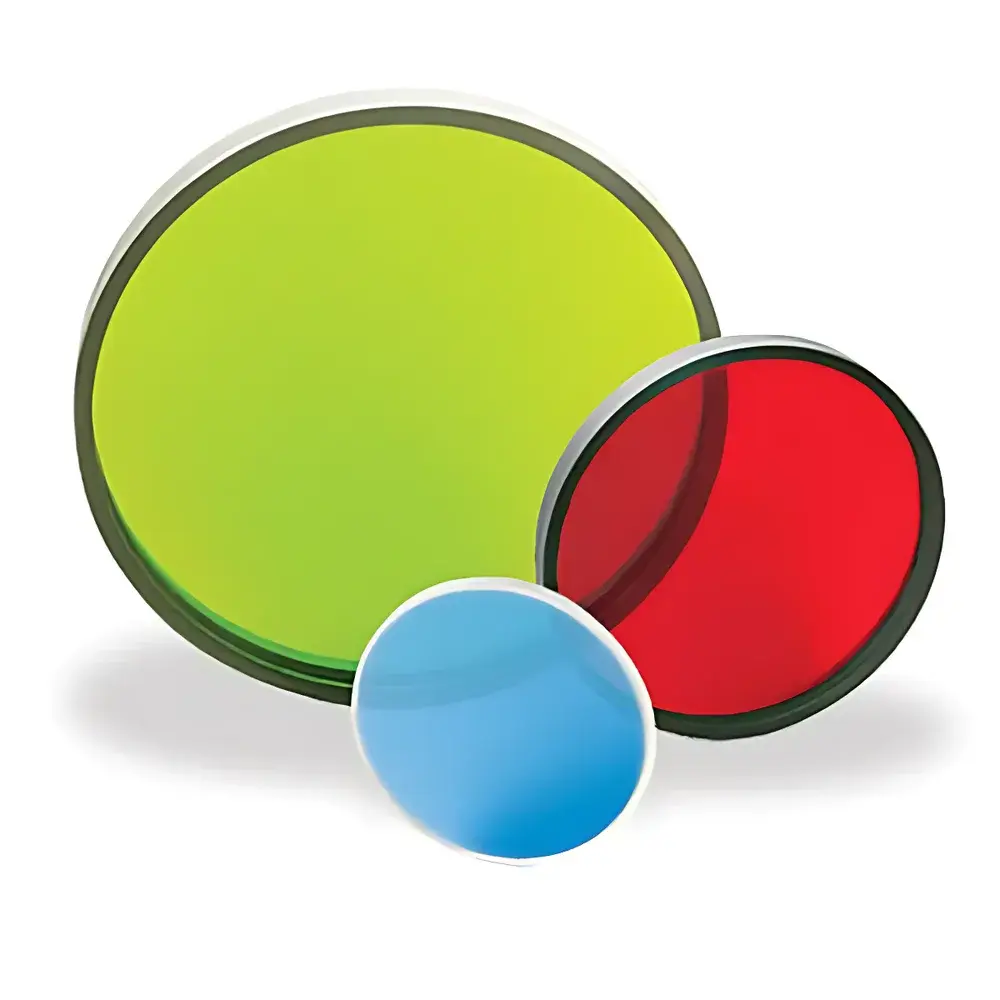
The Chroma ET680sp is a high-performance, hard-coated interference short-pass optical filter engineered for precision spectral separation in demanding scientific and industrial applications. Based on multilayer dielectric thin-film interference principles, it transmits wavelengths below a defined cutoff (680 nm nominal) while suppressing longer wavelengths with exceptional optical density. Its design leverages Chroma’s proprietary ion-assisted magnetron sputtering (IAD) process—employing argon-ion bombardment during deposition—to produce ultra-dense, stoichiometric, and thermally stable coatings exceeding 200 layers. Unlike adhesively bonded or soft-coated alternatives, the ET680sp features monolithic construction on fused silica or BK7 substrates, eliminating delamination risk and ensuring long-term spectral fidelity under thermal cycling (−40 °C to +85 °C), humidity exposure (95% RH), and mechanical vibration. The front-surface interference stack is complemented by an anti-reflection (AR) coating on the rear surface to minimize ghost images and maximize usable throughput—critical for confocal microscopy, fluorescence lifetime imaging (FLIM), and quantitative spectroscopic systems requiring high signal-to-noise ratio (SNR) and photometric linearity.
Key Features
- Peak transmission ≥95% across the passband (200–680 nm), optimized for common excitation sources including 405 nm, 488 nm, 561 nm, and 640 nm lasers
- Blocking performance of OD6 to OD8+ from 700 nm to 3500 nm—enabling deep suppression of Raman Stokes lines, autofluorescence, and thermal background in NIR-sensitive detection
- Sharp edge transition (10%–90% cut-on slope <15 nm), minimizing spectral crosstalk in multi-channel fluorescence assays
- Fully compliant with MIL-C-48497A environmental specifications for coating durability, including abrasion resistance, humidity soak, and thermal shock testing
- No epoxy or cement interfaces—single-substrate architecture ensures wavelength stability over time and eliminates outgassing concerns in vacuum or space-grade instrumentation
- Standard clear aperture ≥90% of physical diameter; custom diameters (Ø3 mm to Ø100 mm), thicknesses (1.0 mm to 6.0 mm), and mounting options (SM-threaded mounts, kinematic clips, or unmounted blanks) available
Sample Compatibility & Compliance
The ET680sp is compatible with standard optical breadboards, filter cubes (e.g., Chroma 31000 series), and OEM instrument platforms requiring ISO 10110–7 surface quality and RoHS-compliant materials. It meets stringent requirements for GLP/GMP-aligned analytical instruments, including fluorescence microplate readers (per ASTM E275–22), flow cytometers (ISO 13766–2), and clinical diagnostic analyzers subject to IEC 61010–1 safety standards. Its spectral performance is traceable to NIST-calibrated spectrophotometers, and batch-to-batch consistency is validated per ISO 9001:2015 manufacturing protocols. For aerospace and defense integration, the filter satisfies MIL-STD-810H environmental stress screening (vibration, shock, temperature/humidity cycling) and is rated for operation in Class 100 cleanroom environments.
Software & Data Management
While the ET680sp is a passive optical component, its spectral data—including measured transmission curves, OD spectra, and angular sensitivity profiles—is delivered in standardized ASCII and CSV formats compatible with MATLAB, Python (SciPy/NumPy), and commercial optical design software (Zemax OpticStudio, CODE V, FRED). Chroma provides full spectral characterization reports with each shipment, including ±0.3 nm center-wavelength tolerance verification at 23 °C ±0.5 °C. For OEM integration, spectral models (including angle-of-incidence dependence and polarization splitting effects) are available in Zemax .ZBF format. All calibration data supports audit trails compliant with FDA 21 CFR Part 11 when hosted on validated LIMS or instrument control platforms.
Applications
- Fluorescence microscopy: Excitation filtering in widefield, confocal, TIRF, and super-resolution modalities (STED, STORM)
- Flow cytometry: Excitation beam conditioning for multi-laser systems with simultaneous detection of FITC, PE, APC, and BV421 fluorophores
- Genomic analysis: Optical gating in next-generation sequencers (Illumina, PacBio) and digital PCR platforms
- Raman spectroscopy: Blocking laser line leakage while transmitting low-frequency Stokes shifts (e.g., 532 nm excitation → 600–1800 cm⁻¹)
- Aerospace remote sensing: Spectral pre-filtering in hyperspectral imagers (VNIR/SWIR) operating under thermal vacuum conditions
- Industrial machine vision: Contrast enhancement in automated defect inspection using UV-induced fluorescence or NIR reflectance
- Clinical POCT devices: Integrated optics in point-of-care fluorescence immunoassay readers complying with CLIA and IVDR regulatory frameworks
FAQ
What is the typical damage threshold for the ET680sp under continuous-wave laser illumination?
For fused silica substrates with standard AR coating, the LIDT is ≥5 J/cm² at 532 nm, 10 ns pulse width, 10 Hz repetition rate (ISO 21254–1). CW ratings depend on beam homogeneity and thermal management; consult Chroma’s application engineering team for system-specific modeling.
Can the ET680sp be used at non-normal incidence?
Yes—spectral shift scales predictably with angle (blue-shift ~0.5 nm per degree for s-polarized light at 680 nm); full polarization-resolved angular data is provided upon request.
Is custom center-wavelength adjustment possible without impacting edge steepness?
Yes—Chroma offers CWL tuning within ±5 nm of 680 nm while maintaining OD6+ blocking and <15 nm slope via process recalibration, subject to minimum order quantity.
How does humidity affect long-term spectral stability?
No measurable drift occurs after 1000-hour 85 °C/85% RH exposure per JEDEC JESD22–A101; coating porosity is <0.1%, eliminating water absorption pathways.
Do you provide mounting solutions for OEM integration?
Yes—standard SM1- and SM2-threaded mounts, kinematic flexure holders, and custom machined aluminum housings with black anodized finish and alignment fiducials are available.