
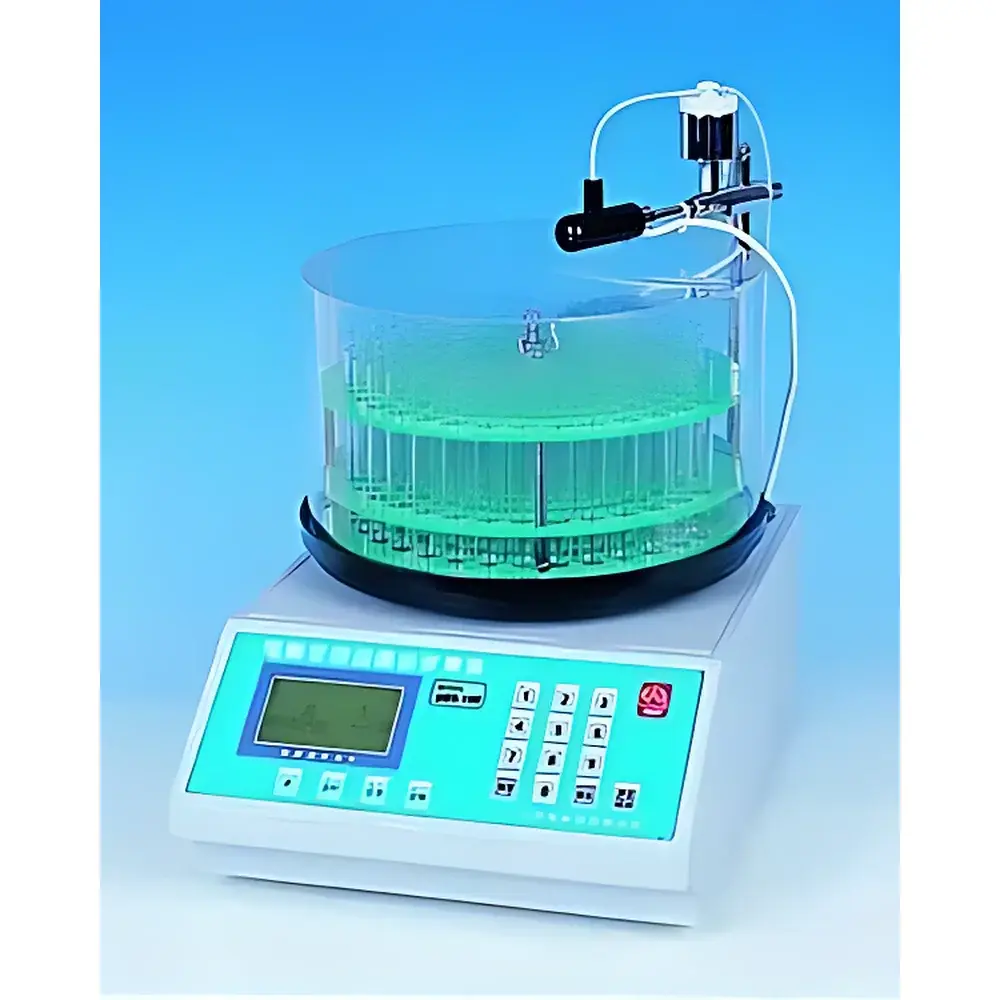
Chu Ding DBS-100 / DBS-160 Computer-Controlled Fraction Collector
| Brand | Chu Ding |
|---|---|
| Origin | Shanghai, China |
| Model | DBS-100 / DBS-160 |
| Tube Capacity | 100 × 12 mL (DBS-100) or 160 × 5 mL (DBS-160) |
| Timing Range | 1 s – 199 h 59 min 59 s (DBS-100) |
| Drop Counting Range | 1–9999 drops |
| Peak Detection Range | 0–100 mV |
| Power-Fail Data Retention | ≥10 years |
| Dimensions (W×D×H) | 260 × 250 × 340 mm |
Overview
The Chu Ding DBS-100 and DBS-160 Computer-Controlled Fraction Collectors are precision-engineered liquid handling instruments designed for automated, reproducible fraction collection in liquid chromatography (LC), gel filtration, ion exchange, and affinity chromatography workflows. These devices operate on a programmable logic controller (PLC) architecture with embedded microprocessor-based timing and signal acquisition modules, enabling precise synchronization with UV detectors, peristaltic pumps, and gradient mixers. Unlike manual or electromechanical collectors, the DBS series implements digital pulse counting, analog voltage threshold triggering (for peak-based collection), and non-volatile memory-backed parameter retention—ensuring continuity across power interruptions without loss of experimental configuration. The system is optimized for integration into standard column chromatography setups, particularly where consistent eluate partitioning into discrete fractions is critical for downstream analysis (e.g., SDS-PAGE, mass spectrometry sample prep, or enzymatic activity assays).
Key Features
- Two configurable models: DBS-100 supports up to 100 tubes at 12 mL capacity each; DBS-160 accommodates 160 tubes at 5 mL capacity—offering flexibility for high-resolution or high-throughput fractionation.
- Three independent collection modes: time-based (1 second to 199 hours 59 minutes 59 seconds on DBS-100; up to 9999 minutes on DBS-160), drop-counting (programmable 1–9999 drops per fraction), and peak-triggered collection via analog input (0–100 mV signal range, compatible with standard UV/Vis detectors).
- Non-volatile memory retains all user-defined parameters—including timing schedules, drop thresholds, and peak sensitivity settings—for ≥10 years without battery backup or external power.
- Rugged aluminum alloy chassis and corrosion-resistant internal components (standard on N-series variants) ensure long-term stability in environments exposed to organic solvents such as acetonitrile, methanol, and chloroform.
- Modular interface design allows seamless integration with HL-series constant-flow peristaltic pumps and TH-series gradient mixers, while maintaining standalone functionality via front-panel keypad and LCD display.
Sample Compatibility & Compliance
The DBS-100/160 series is validated for use with aqueous buffers, polar organic solvents, and mixed mobile phases commonly employed in preparative and analytical chromatography. N-model variants (DBS-100N/DBS-160N) feature enhanced chemical resistance through fluoropolymer-coated tubing paths and solvent-compatible gaskets, meeting ASTM D471 requirements for elastomer compatibility with aggressive eluents. While not certified under ISO 13485 or FDA 21 CFR Part 11, the instrument’s deterministic behavior, repeatable actuation timing (<±0.1% deviation over 24 h), and audit-ready parameter logging support GLP-compliant laboratory practices when deployed within documented SOPs. Tube rack geometry conforms to ANSI/SLAS standards for 12.5 mm and 13 mm diameter microcentrifuge tubes.
Software & Data Management
Operation is managed via an integrated 4-line alphanumeric LCD with tactile membrane keypad—eliminating reliance on external PCs for basic protocols. All collection events (start time, elapsed duration, trigger type, tube index) are timestamped and stored locally. Data export is supported via RS-232 serial interface for integration with LIMS or custom acquisition software. Firmware supports firmware-upgradable logic for future protocol expansion (e.g., multi-channel analog inputs, TTL synchronization). No proprietary drivers or cloud dependencies are required; ASCII-formatted log files can be parsed directly by Python, MATLAB, or Excel for post-run analysis.
Applications
- Protein purification workflows involving size-exclusion or ion-exchange columns, where fraction integrity directly impacts yield and purity assessment.
- Metabolite isolation from plant or microbial extracts using preparative HPLC or flash chromatography systems.
- Quality control of biopharmaceutical intermediates, including monoclonal antibody fragments and recombinant enzymes, requiring traceable, phase-aligned collection.
- Academic teaching labs performing classical column chromatography experiments—enabling students to focus on separation theory rather than manual timing errors.
- Environmental analysis labs fractionating pesticide residues or PAHs prior to GC-MS quantification.
FAQ
Can the DBS-100/160 interface with third-party UV detectors?
Yes—the analog input accepts 0–100 mV unipolar signals with 12-bit resolution, compatible with most commercial UV-Vis detectors featuring BNC or screw-terminal analog outputs.
Is calibration required before first use?
No routine calibration is needed; timing accuracy is factory-trimmed against quartz oscillator reference (±20 ppm tolerance). Drop counting assumes standard 1–2 drop/mL flow rates typical of 1–4 mm ID tubing at ≤5 mL/min.
What tube types are supported?
Standard 12.5 mm (DBS-100) and 13 mm (DBS-160) round-bottom or conical microcentrifuge tubes; custom racks are available upon request for specialty formats.
Does the unit meet electromagnetic compatibility (EMC) standards?
It complies with CISPR 11 Group 1 Class B emission limits and IEC 61326-1 for laboratory equipment, verified per manufacturer test reports.
How is data integrity maintained during extended runs?
All operational parameters and event logs reside in EEPROM with write-cycle endurance >1 million cycles; no volatile RAM is used for critical state storage.



