
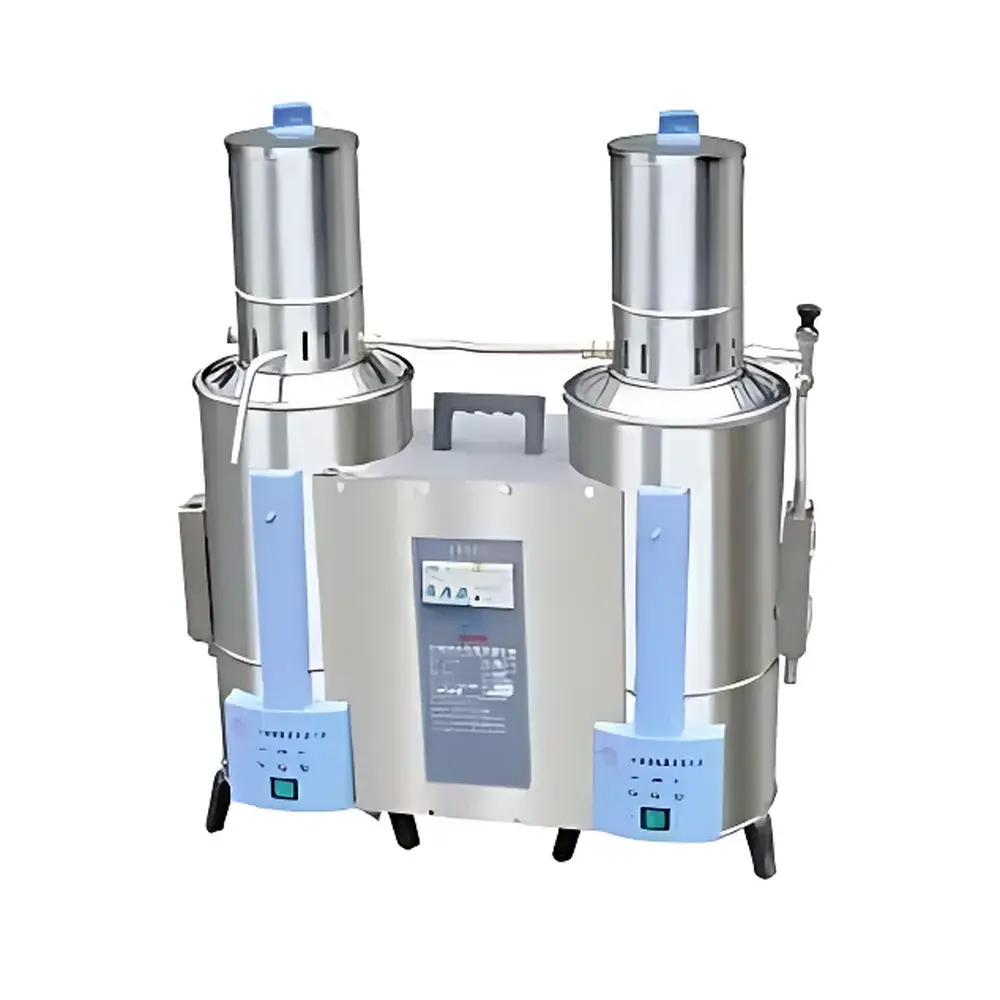
Chu Ding Technology ZLSC-5 Stainless Steel Electric Double-Distillation Water Purifier
| Brand | Chu Ding Technology |
|---|---|
| Origin | Shanghai, China |
| Manufacturer Type | Authorized Distributor |
| Country of Origin | China |
| Model | ZLSC-5 |
| Instrument Category | Fluoropolymer-Lined Distillation Apparatus |
| Output Capacity | 5 L/h |
| Power Supply | 380 V AC |
| Heating Power | 9 kW |
| Net Weight | 14 kg |
| Dimensions (W×D×H) | 770 × 380 × 860 mm |
| Construction Material | AISI 304 Stainless Steel |
| Safety Features | Dual-level dry-run protection, thermal cutoff, insulated control panel shield, adjustable dual-direction flow valve, internal分流-type condensate separation structure |
| Compliance | Designed for GLP-compliant laboratory water purification |
Overview
The Chu Ding Technology ZLSC-5 Stainless Steel Electric Double-Distillation Water Purifier is a benchtop-to-floor-standing laboratory-grade distillation system engineered for the continuous production of high-purity water via two-stage thermal vaporization and condensation. Unlike single-stage distillers, the ZLSC-5 integrates an integrated secondary distillation chamber that subjects primary distillate to a second evaporation–condensation cycle—effectively reducing residual volatile organic compounds (VOCs), dissolved ions, silica, and non-volatile contaminants to levels consistent with ASTM D1193 Type II reagent water specifications. The unit operates on resistive electric heating within a fully welded AISI 304 stainless steel vessel, ensuring long-term corrosion resistance against aggressive feedwater chemistries and eliminating leaching risks associated with glass or fluoropolymer-only systems. Feedwater inlet requires pre-treatment (e.g., deionized or softened water) to prevent scaling and extend heating element service life. Its compact footprint (770 × 380 × 860 mm) supports integration into QC labs, pharmaceutical preparation suites, and analytical support environments where space-constrained, reliable Type II water generation is required without reliance on centralized reverse osmosis/deionization infrastructure.
Key Features
- Double-distillation architecture with dedicated primary and secondary vapor chambers for enhanced removal of low-boiling-point impurities and trace organics
- AISI 304 stainless steel construction throughout all wetted surfaces—including boiler, condenser jackets, and collection reservoir—to ensure mechanical durability and compatibility with sterilization protocols
- Integrated dry-run protection system with dual-level float switches and thermal cut-off relays to prevent heater damage during low-feed or pump-failure conditions
- Adjustable bi-directional flow control valve enabling precise regulation of distillate flow rate and pressure balance between stages
- Thermally insulated control panel housing with anti-scald shielding to comply with IEC 61010-1 safety requirements for laboratory electrical equipment
- Internal分流-type condensate separation design minimizing carryover and improving phase separation efficiency between vapor and liquid phases
- Modular heater assembly (9 kW, 380 V AC) with redundant temperature monitoring for stable, reproducible distillation kinetics
Sample Compatibility & Compliance
The ZLSC-5 accepts pretreated feedwater with total dissolved solids (TDS) ≤ 50 ppm and hardness ≤ 10 ppm CaCO₃ equivalent. It is not intended for direct use with municipal tap water without upstream softening or RO prefiltration. Output water quality conforms to ASTM D1193 Type II specifications (resistivity ≥ 1.0 MΩ·cm at 25 °C; sodium ≤ 5 ppb; silica ≤ 50 ppb; TOC ≤ 50 ppb) when operated under validated conditions. The system’s mechanical design adheres to ISO 9001 manufacturing controls, and its operational documentation supports audit readiness for GLP and GMP environments. While not FDA 21 CFR Part 11–validated out-of-the-box, the instrument’s manual logbook capability and deterministic process parameters facilitate integration into Part 11–compliant data governance workflows when paired with qualified electronic lab notebooks (ELNs).
Software & Data Management
The ZLSC-5 operates as a standalone analog-controlled system with no embedded microprocessor or digital interface. All operational parameters—including power status, heating cycle initiation, and dry-run alarm activation—are monitored via front-panel LED indicators and electromechanical relays. Process logs must be maintained manually using standardized laboratory record templates. For laboratories requiring automated data capture, optional external data loggers (e.g., Omega OM-DAQPRO-5300 series) may be connected to the unit’s auxiliary voltage output terminals to record heater current draw and thermal relay state transitions over time. Calibration records, maintenance logs, and daily output verification (conductivity/resistivity testing per USP ) are recommended for IQ/OQ documentation packages.
Applications
- Preparation of solvent-grade water for HPLC mobile phase formulation and GC rinse solvents
- Feedstock water for ultrapure water (UPW) systems in semiconductor metrology labs
- Reagent preparation in clinical chemistry analyzers and ELISA assay development
- Media sterilization support in microbiology core facilities where pyrogen-free water is not required but ion-free performance is critical
- Calibration standard dilution in atomic absorption spectroscopy (AAS) and ICP-OES laboratories
- Continuous supply of Type II water in teaching laboratories performing titration, pH calibration, and electrochemical experiments
FAQ
What feedwater quality is required for optimal operation?
Feedwater must be softened or deionized with TDS ≤ 50 ppm and hardness ≤ 10 ppm CaCO₃ to prevent scale formation on heating elements and condenser surfaces.
Can the ZLSC-5 produce USP Purified Water?
No—it does not meet USP requirements for bacterial endotoxin limits or microbial enumeration; it is suitable only for ASTM Type II applications.
Is the unit compatible with 220 V single-phase power?
No—the ZLSC-5 requires a dedicated 380 V three-phase AC supply; voltage conversion is not supported.
How often should the condenser be cleaned?
Visual inspection and citric acid descaling are recommended every 200 operating hours or quarterly, whichever occurs first.
Does the system include a water storage tank?
No—distillate is delivered continuously via gravity-fed outlet tubing; external storage vessels must be supplied by the user.



