
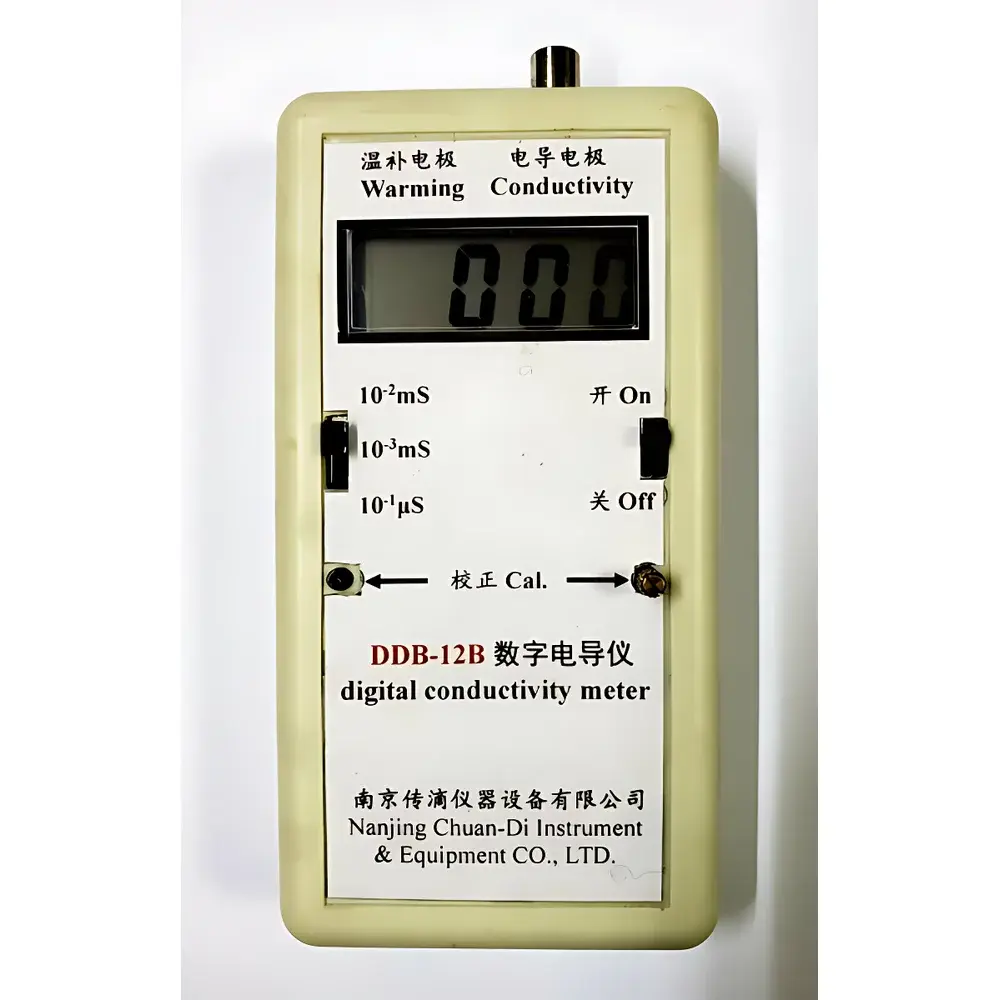
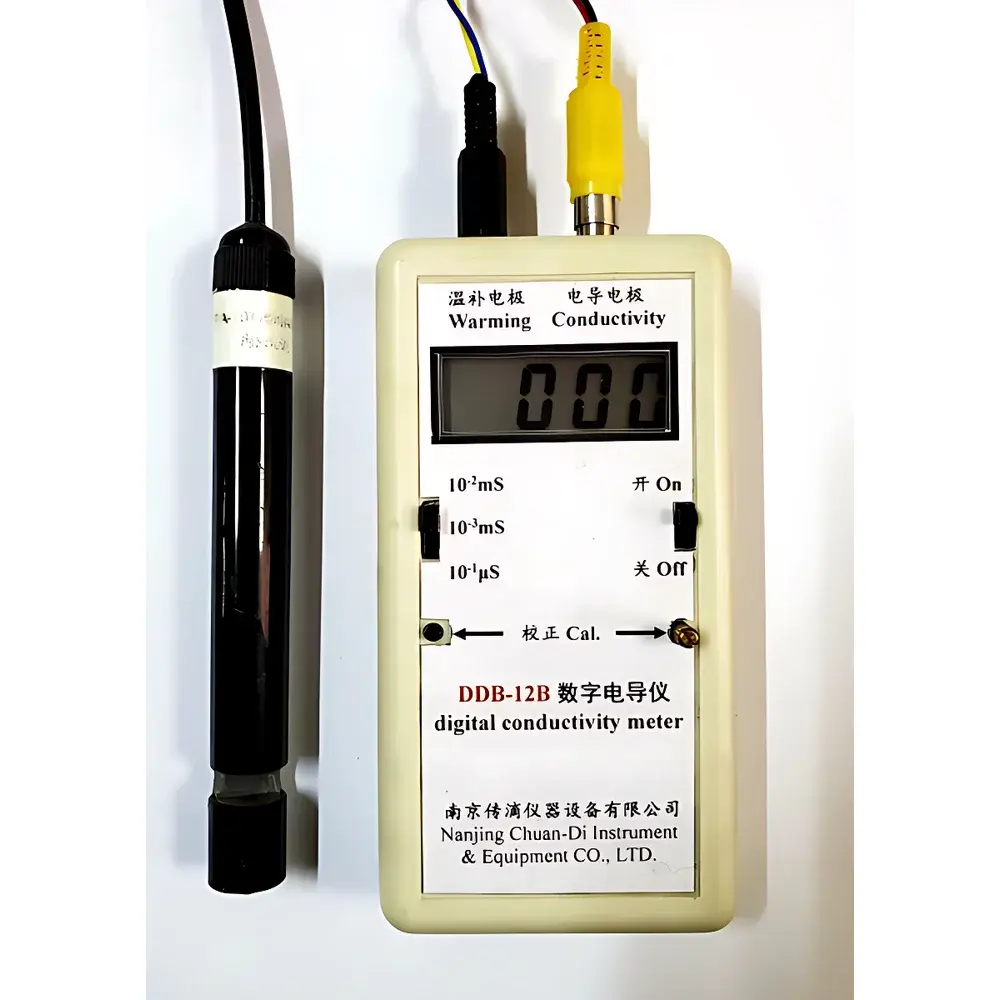
Chuandi DDB-12B Portable Digital Conductivity Meter
| Brand | Chuandi |
|---|---|
| Model | DDB-12B |
| Type | Portable Conductivity Meter |
| Measurement Parameter | Single-parameter (Conductivity) |
| Conductivity Range | 0–20 mS/cm |
| Resistivity Range | 0–1 MΩ |
| Salinity Range | 0.01–0.3 mol/L |
| Temperature Compensation Range | 5–40 °C |
| Accuracy | <1% FS |
| Minimum Resolution | 0.1 µS/cm |
| Electrode Constant Input | User-configurable (for automatic conductivity calculation) |
| Power Supply | Two AA (1.5 V) batteries |
| Operating Ambient | −10 to +60 °C, RH <90% |
| Dimensions | 135 × 65 × 24 mm |
| Weight | <0.16 kg |
| Linearity (Voltage vs. Conductance) | ≥98% |
| Compliance | Designed for field-deployable soil salinity and aqueous solution monitoring in accordance with standard electrochemical measurement practice |
Overview
The Chuandi DDB-12B Portable Digital Conductivity Meter is a field-optimized electrochemical instrument engineered for direct, temperature-compensated measurement of electrical conductivity in soils, natural waters, irrigation solutions, and industrial process streams. It operates on the fundamental principle of two-electrode conductometric measurement: when an alternating current is applied across a pair of electrodes immersed in a conductive medium, the resulting conductance (G, in siemens) is linearly proportional to the solution’s conductivity (κ, in S/m or mS/cm), scaled by the cell’s geometric electrode constant (K, in cm⁻¹). The DDB-12B accepts input from standardized conductance transducers—including the FJA-10 temperature-compensated soil salinity sensor—and converts raw conductance signals into calibrated voltage outputs. Critically, it applies automatic temperature compensation (ATC) within the 5–40 °C range using an integrated thermistor, reporting all values normalized to the reference temperature of 25 °C—enabling direct comparability across time and location without manual correction.
Key Features
- True field-portable architecture: compact housing (135 × 65 × 24 mm), sub-160 g mass, and dual-AA battery operation ensure extended deployment in remote or unpowered environments.
- Automatic temperature compensation (ATC) with real-time normalization to 25 °C, eliminating post-measurement thermal correction and reducing operator error.
- Configurable electrode constant entry, enabling compatibility with multiple probe types (e.g., FJA-10 soil sensors, standard immersion electrodes) and accurate conversion from measured conductance to conductivity (κ = K × G).
- High dynamic range: supports measurement across two overlapping scales—0–20 mS/cm and 0–200 µS/cm—with 0.1 µS/cm minimum resolution and <1% full-scale accuracy.
- Linear analog signal output (voltage proportional to conductance) with ≥98% linearity, suitable for integration with data loggers or SCADA systems.
- Ruggedized design rated for ambient operation between −10 °C and +60 °C at ≤90% relative humidity—validated for long-term use in agricultural fields, pipeline corrosion monitoring sites, and ecological survey zones.
Sample Compatibility & Compliance
The DDB-12B is validated for use with aqueous electrolyte solutions, saturated soil extracts, and low-viscosity field-collected water samples. Its two-electrode configuration is optimized for media with conductivity >10 µS/cm; for ultrapure water (<1 µS/cm), alternative four-electrode or inductive sensors are recommended. While not certified to ISO/IEC 17025 or ASTM D1125 (Standard Test Method for Electrical Conductivity of Water), its measurement methodology aligns with the foundational principles outlined in those standards. The instrument supports GLP-aligned workflows through stable zero-point repeatability, documented calibration traceability (via user-entered K-value), and non-volatile parameter storage. It meets general-purpose environmental monitoring requirements under China’s HJ/T 51–2019 (Technical Specifications for Environmental Monitoring of Soil Salinization) and serves as a primary tool in salinity mapping per FAO Irrigation and Drainage Paper No. 60.
Software & Data Management
The DDB-12B is a standalone analog-output meter with no embedded firmware or digital connectivity. All configuration—including electrode constant (K), unit selection, and salinity conversion coefficients—is performed manually via front-panel controls. Measured values are displayed on a high-contrast LCD with fixed decimal resolution. For data capture, users integrate the analog voltage output (0–2.5 V DC, linear with conductance) with external recording devices compliant with IEC 61000-4-5 (surge immunity) and IEC 61326-1 (EMC for laboratory equipment). Though lacking native USB or Bluetooth, its analog interface ensures compatibility with legacy logging platforms used in long-term agronomic or corrosion-monitoring networks. Calibration verification logs may be maintained manually or via spreadsheet-based QA/QC templates aligned with ISO/IEC 17025 Clause 7.7 (Uncertainty of Measurement).
Applications
- Soil salinity assessment in arid-zone agriculture and reclaimed coastal farmland, supporting irrigation scheduling and leaching requirement calculations.
- Corrosion potential monitoring of buried pipelines (oil, gas, water), where elevated soil conductivity correlates with increased electrochemical corrosion risk per NACE SP0169.
- Field validation of desalination plant effluent and brine discharge compliance prior to environmental release.
- Ecological studies of wetland conductivity gradients, groundwater-surface water interaction, and saltwater intrusion mapping.
- Educational laboratories requiring robust, low-maintenance instrumentation for teaching fundamental electrochemical concepts including Kohlrausch’s law and temperature dependence of ionic mobility.
FAQ
Does the DDB-12B support TDS measurement?
No. This model is configured exclusively for conductivity and resistivity measurement. TDS calculation requires user-defined conversion factors (e.g., 0.64–0.71 × conductivity) and is not implemented internally.
Can it be used with standard laboratory conductivity cells?
Yes—provided the cell’s electrode constant (K) is known and entered manually. The instrument does not auto-detect K but relies on user input for accurate κ calculation.
What is the maximum salinity concentration it can resolve?
The validated upper limit is 0.3 mol/L NaCl-equivalent, with resolution to 0.01 mol/L. Accuracy degrades above 0.25 mol/L without recalibration due to nonlinearity in high-ionic-strength media.
Is the temperature sensor replaceable or field-calibratable?
The integrated thermistor is factory-trimmed and not user-serviceable. Field verification against a NIST-traceable thermometer is recommended before critical deployments.
How is calibration performed?
Using certified KCl standard solutions (e.g., 0.01 M KCl, κ = 1.413 mS/cm at 25 °C), users adjust the display to match the expected value while entering the known K-value of the connected electrode. No software-based calibration routine is available.



