
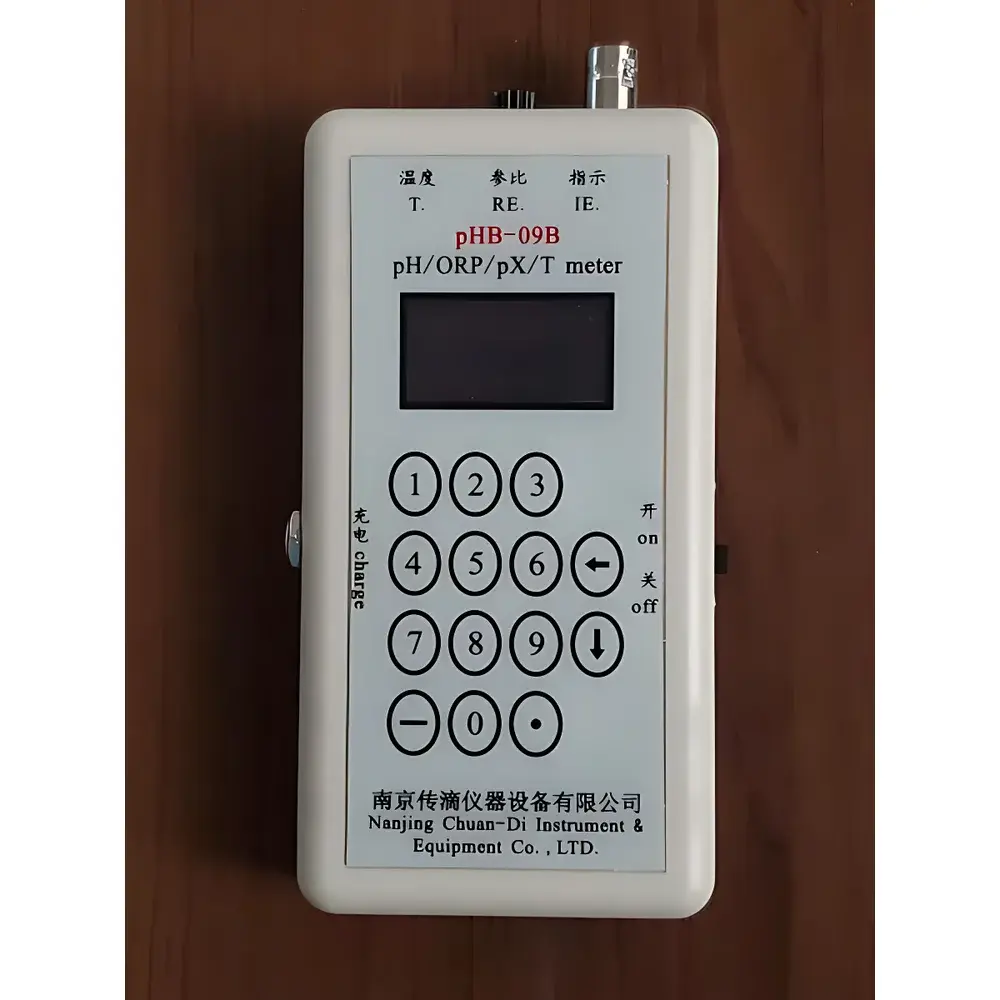
Chuandi pHB-09B Smart Portable pH/ORP/pX/T Meter
| Brand | Chuandi |
|---|---|
| Origin | Jiangsu, China |
| Manufacturer Type | Authorized Distributor |
| Product Origin | Domestic (China) |
| Model | pHB-09B |
| Price | Upon Request |
| Measurement Range | pH 0–14 (0.01 resolution, ±0.02 pH ±1 digit) |
| ORP | ±1999 mV (0.1 mV resolution) |
| pX | Ion-selective electrode standard curve method |
| Temperature | 0–100 °C (operational limit: 60 °C |
| Input Impedance | ≥1 × 10¹² Ω |
| Power Supply | 3.7 V rechargeable Li-ion battery |
| Dimensions | 13.5 × 7 × 2.5 cm |
| Weight | 130 g |
Overview
The Chuandi pHB-09B is a compact, field-deployable electrochemical meter engineered for high-fidelity measurement of pH, oxidation-reduction potential (ORP), ion activity (pX), and temperature in diverse analytical environments. It operates on potentiometric principles: pH and pX measurements rely on Nernstian response from glass or ion-selective electrodes, while ORP is determined via direct potential difference between a noble metal indicator electrode (e.g., Pt or Au) and a stable reference electrode (Ag/AgCl). The instrument implements automatic temperature compensation (ATC) using an integrated thermistor sensor, and its firmware applies standardized thermodynamic correction tables—ensuring traceable, temperature-normalized ORP values without manual interpolation. Designed for compliance with routine QC workflows and field-based environmental monitoring, the pHB-09B meets fundamental requirements for electrochemical data integrity under ISO/IEC 17025-aligned laboratory practices.
Key Features
- True portable architecture: 130 g mass and palm-sized footprint (13.5 × 7 × 2.5 cm) enable handheld operation in remote sampling sites, wastewater treatment plants, aquaculture facilities, and teaching laboratories.
- High-input-impedance circuitry (≥1 × 10¹² Ω) minimizes loading error when interfacing with high-impedance pH and ion-selective electrodes—critical for stable readings with aged or low-capacitance sensors.
- Digital ORP calibration suite: supports both solution-based calibration (using certified quinhydrone or Zobell’s solutions) and instrument-level offset correction—enabling verification of electrode drift and system baseline stability prior to field deployment.
- Software-driven pH calibration: eliminates mechanical trimmer pots; calibration coefficients (slope, asymmetry potential, isopotential point) are computed and stored digitally during 1–3 point buffer calibration (e.g., pH 4.01/7.00/10.01).
- pX mode implements the standard addition or external calibration curve method per IUPAC recommendations, supporting quantitative analysis of F⁻, Cl⁻, Na⁺, NO₃⁻, NH₄⁺, Cu²⁺, and other monovalent/divalent ions when paired with appropriate ISEs.
- Rechargeable 3.7 V Li-ion battery provides >12 hours of continuous operation under typical sampling intervals (measurement every 30 s), with low-battery warning and USB-C charging interface.
Sample Compatibility & Compliance
The pHB-09B interfaces with industry-standard BNC-input electrodes—including double-junction pH electrodes, combination ORP electrodes, and solid-state or polymer-membrane ISEs. Its input stage accommodates electrode asymmetry potentials up to ±500 mV and tolerates electrolyte leakage rates typical of field-grade reference junctions. While not certified to IEC 61000-6-3 (EMC) or IP67, the unit complies with basic safety requirements per GB/T 18268.1–2010 (equivalent to IEC 61326-1) for laboratory electrical equipment. Data output adheres to GLP documentation conventions: timestamped readings include electrode type ID (manually entered), calibration history flag, and ATC status—supporting audit-ready recordkeeping in regulated environments.
Software & Data Management
Measurements are displayed in real time on a high-contrast monochrome LCD with backlight. The embedded firmware stores up to 500 data points with metadata (date/time, parameter, unit, electrode ID, temperature). Data export is supported via USB-C connection to PC, generating CSV files compatible with LIMS integration or post-processing in Excel, MATLAB, or Python (pandas). No proprietary software installation is required—device appears as a CDC ACM serial device. Firmware updates are delivered via signed .bin files and validated through CRC-32 checksum verification. All calibration parameters and user settings persist across power cycles and firmware upgrades.
Applications
- Environmental fieldwork: monitoring redox conditions in sediments, wetlands, and anaerobic digesters using ORP as a proxy for microbial metabolic state.
- Water quality assurance: rapid verification of disinfection efficacy (via free chlorine residual correlation with ORP) in municipal distribution systems and swimming pools.
- Soil testing labs: extracting and analyzing fluoride or nitrate concentrations in agricultural leachates using selective electrodes and pX curve fitting.
- Educational use: demonstrating Nernst equation derivation, junction potential effects, and temperature dependence of electrode response in undergraduate analytical chemistry courses.
- Food & beverage QA: verifying pH stability in fermented products (e.g., yogurt, kimchi) and tracking acidification kinetics during production.
FAQ
Does the pHB-09B support automatic electrode recognition?
No. Electrode type must be manually selected in the setup menu to ensure correct Nernst slope application and unit scaling.
Can it store calibration data for multiple electrodes?
Yes—up to three independent calibration profiles (pH, ORP, pX) can be saved, each tagged with date, buffer IDs, and slope efficiency.
Is the temperature sensor interchangeable?
No. The thermistor is integrated into the electrode input jack and calibrated as part of the main PCB assembly; external PT100 probes are not supported.
What is the recommended recalibration frequency for field use?
Daily two-point pH calibration and ORP verification against a fresh Zobell’s solution (225 ± 5 mV at 25 °C) are advised when operating outside controlled lab conditions.
Does the device meet FDA 21 CFR Part 11 requirements?
It does not provide electronic signatures or audit-trail encryption; however, exported CSV logs contain immutable timestamps and operator-assigned sample IDs—sufficient for non-GMP documentation where Part 11 is not mandated.



