
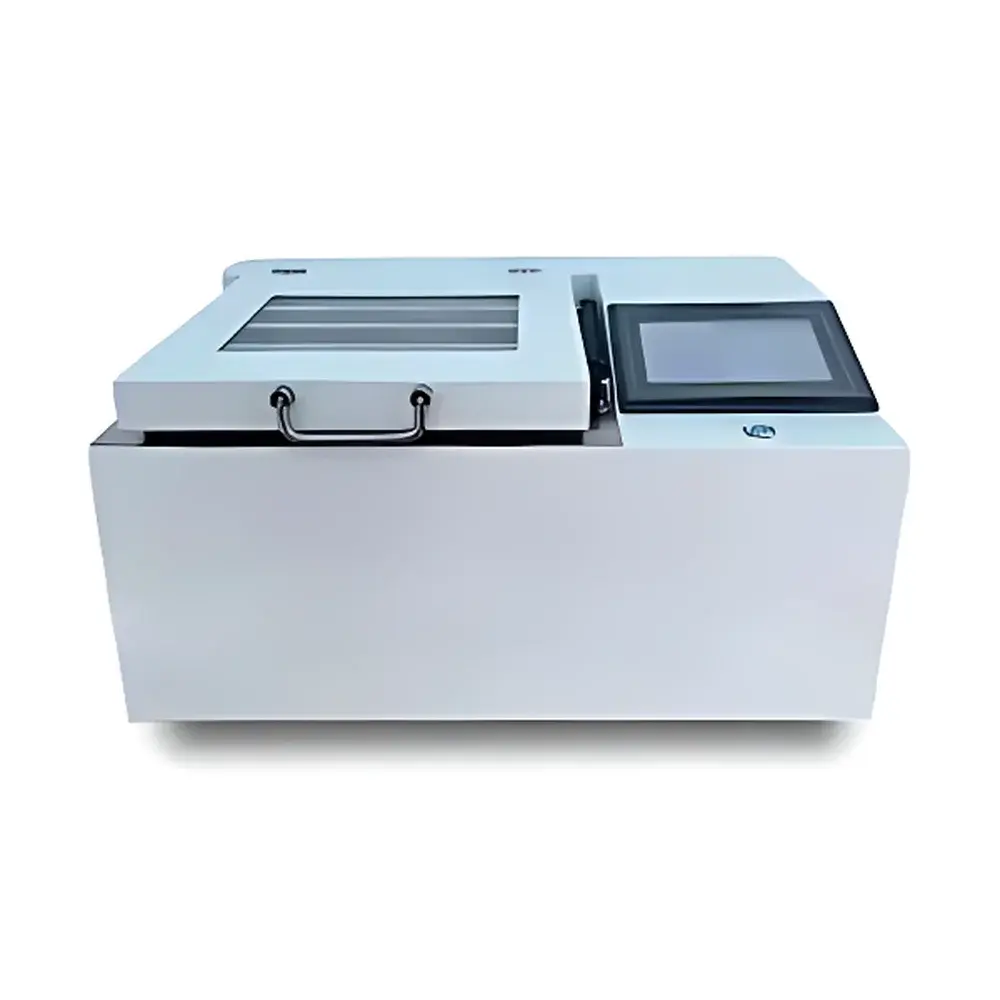
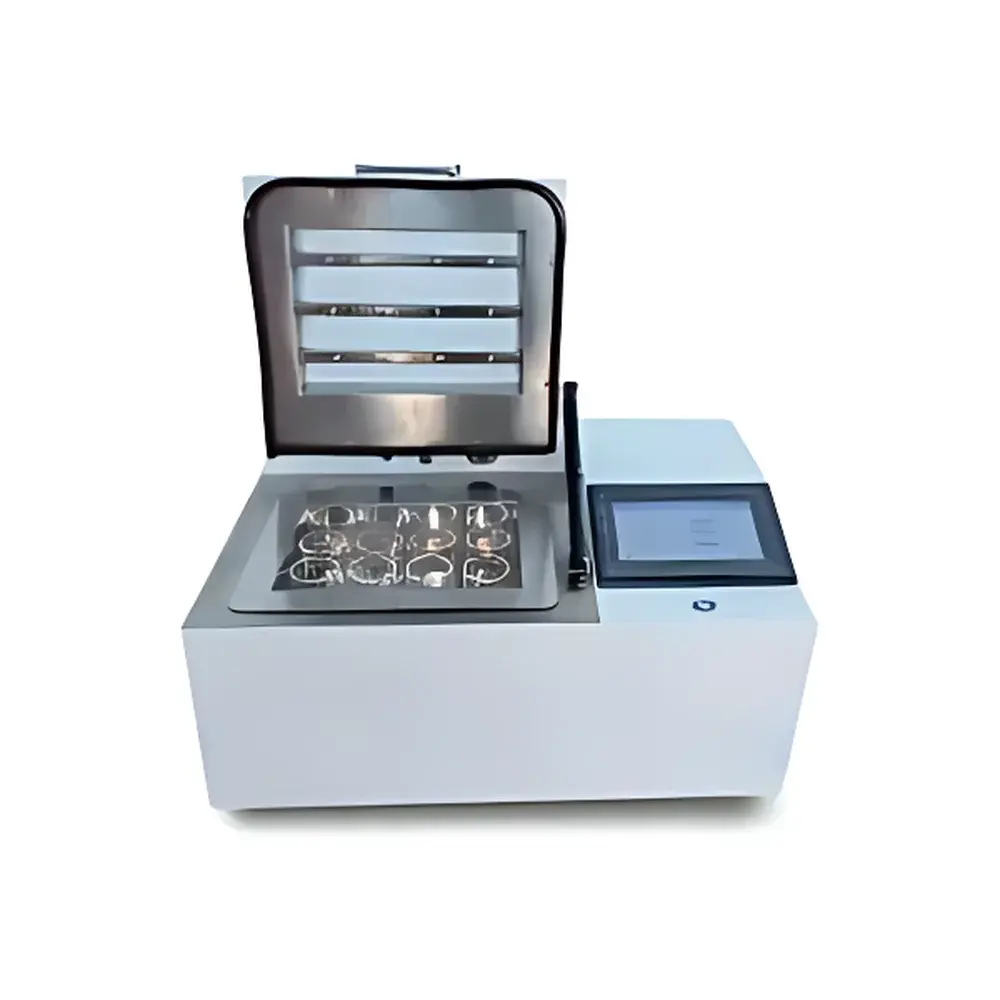
Chuanheng APNE-12 Automated Parallel Dry-Block Nitrogen Evaporator
| Brand | Chuanheng Instrument |
|---|---|
| Origin | Zhejiang, China |
| Manufacturer Type | Direct Manufacturer |
| Model | APNE-12 |
| Heating Method | Dry-block (aluminum block) |
| Temperature Range | Ambient to 100 °C |
| Temperature Uniformity | ±0.5 °C |
| Sample Capacity | 12 or 24 positions |
| Tube Compatibility | 50 mL, 100 mL, 150 mL, and 200 mL vessels |
| Nitrogen Flow Rate | 0–15 L/min |
| Endpoint Detection Sensitivity | 10-level adjustable optical sensing (for 1.0 mL, 0.5 mL, or near-dry ~0.1 mL termination) |
| Pressure Control | Built-in auto-regulation (0–0.1 MPa, 0.01 MPa increments) |
| External N₂ supply range | 0.2–0.8 MPa (max allowable: 1.0 MPa) |
| Dimensions | 620 × 400 × 330 mm |
| Weight | 20 kg |
Overview
The Chuanheng APNE-12 is an automated parallel dry-block nitrogen evaporator engineered for high-throughput, reproducible solvent removal in analytical laboratories. It operates on the principle of inert gas-assisted evaporation—using precisely regulated nitrogen flow directed over heated sample surfaces to accelerate solvent volatilization while minimizing thermal degradation and cross-contamination. Unlike water-bath systems, the APNE-12 employs a solid aluminum heating block with uniform thermal conductivity and rapid heat-up response, eliminating risks associated with water vapor intrusion, microbial growth, or bath fluid contamination. Its optical endpoint detection system monitors individual sample channels in real time, terminating nitrogen flow upon reaching user-defined residual volumes (1.0 mL, 0.5 mL, or near-dry conditions), thereby ensuring consistent concentration endpoints across heterogeneous sample sets. Designed for integration into regulated workflows, the instrument supports unattended operation for up to 999 minutes and complies with fundamental requirements for method robustness in sample preparation prior to GC, HPLC, LC-MS, and residue analysis.
Key Features
- Independent optical endpoint detection per channel: 10-level sensitivity adjustment enables reliable termination for solvents with varying refractive indices and chromatic properties—including colored extracts and turbid matrices.
- 12-position dry-block heating module with ±0.5 °C temperature stability across the full 20–100 °C operating range; optional 24-position configuration available.
- Individual pneumatic control via 12 precision needle valves with replaceable spiral-tip gas nozzles—optimized for laminar, low-turbulence nitrogen delivery to prevent splashing and maximize evaporation efficiency.
- Integrated pressure regulation system maintains constant nitrogen flow despite dynamic channel activation/deactivation, eliminating pressure fluctuations during multi-sample runs.
- Sealed dual-gasket door with hydraulic assist mechanism and internal recirculating fan—prevents volatile organic compound (VOC) leakage and ensures operator safety during extended runs.
- 7-inch capacitive touchscreen interface with intuitive parameter configuration: set nitrogen pressure (0–0.1 MPa), block temperature, run duration, and endpoint volume independently per batch.
- Auto-refill function for integrated condensate management; alarm triggers for lid open, endpoint completion, and low nitrogen supply pressure.
Sample Compatibility & Compliance
The APNE-12 accommodates standard cylindrical glass or borosilicate tubes (50 mL, 100 mL, 150 mL, and 200 mL), supporting common formats used in pesticide residue testing (e.g., AOAC 2007.01), veterinary drug analysis (EU 2021/808), and environmental contaminant quantification. All wetted components—including gas manifolds, valve bodies, and sample holders—are constructed from chemically inert, non-leaching materials validated for trace-level organic analysis (e.g., USP Class VI compliant polymers and electropolished stainless steel). The system meets general design criteria aligned with ISO/IEC 17025:2017 for laboratory equipment used in accredited testing, and its programmable logic controller (PLC)-based architecture supports audit-ready operation logs when integrated with LIMS environments. While not inherently 21 CFR Part 11 compliant out-of-the-box, the device’s deterministic endpoint logic and timestamped event logging provide foundational traceability for GLP/GMP-aligned sample prep workflows.
Software & Data Management
Operation is fully managed through an embedded Linux-based HMI with local data retention. Each run generates a timestamped log file (.CSV) containing start/stop times, setpoints (temperature, pressure, duration), detected endpoint events, and system alarms—exportable via USB port. No cloud connectivity or proprietary software installation is required, minimizing IT validation burden. For laboratories requiring electronic record integrity, the APNE-12 can be interfaced with third-party ELN/LIMS platforms via RS-232 or optional Ethernet module (firmware v2.3+), enabling remote status monitoring and batch-level metadata capture. All parameter changes are logged with operator ID (if configured via external authentication), satisfying basic ALCOA+ principles for raw data attribution and retention.
Applications
The APNE-12 is routinely deployed in regulatory and research laboratories performing multi-residue analysis of pesticides in food commodities (e.g., QuEChERS extracts), pharmaceutical impurity profiling (ICH Q5A), environmental water and soil extract cleanup (EPA 525.3, 8081B), and clinical toxicology specimen preparation (e.g., urine drug screening by GC-MS/MS). Its dry-block architecture makes it especially suitable for labs handling moisture-sensitive analytes (e.g., labile mycotoxins, thermolabile APIs) or operating under strict contamination control protocols (e.g., cleanroom-adjacent prep areas). The ability to co-process samples in different tube sizes—without recalibration—enhances flexibility in method development and routine QC/QA workflows where extraction volumes vary across analyte classes.
FAQ
What sample tube sizes are supported?
The APNE-12 accepts 50 mL, 100 mL, 150 mL, and 200 mL round-bottom or conical tubes; adapters are not required as the aluminum block features modular well inserts calibrated for each diameter.
Does the system require external nitrogen gas supply?
Yes—a regulated external nitrogen source (0.2–0.8 MPa inlet pressure) is mandatory; the unit includes an integrated pressure-reducing regulator and digital readout for inlet and working pressure.
Can the APNE-12 be validated for GMP use?
While the base unit does not include IQ/OQ documentation, its deterministic endpoint logic, stable thermal performance (±0.5 °C), and event-logged operation support qualification under internal SOPs; optional factory-provided DQ/IQ templates are available upon request.
Is maintenance of the optical sensors required?
No scheduled calibration is needed; however, periodic cleaning of sensor windows with lint-free isopropyl alcohol wipes is recommended every 200 runs to maintain detection accuracy across solvent types.
How is safety ensured during unattended operation?
Hardware interlocks disable heating and gas flow when the access door is opened; redundant thermal cutoffs (dual independent thermostats) and real-time pressure monitoring trigger immediate shutdown if deviations exceed preset thresholds.



