
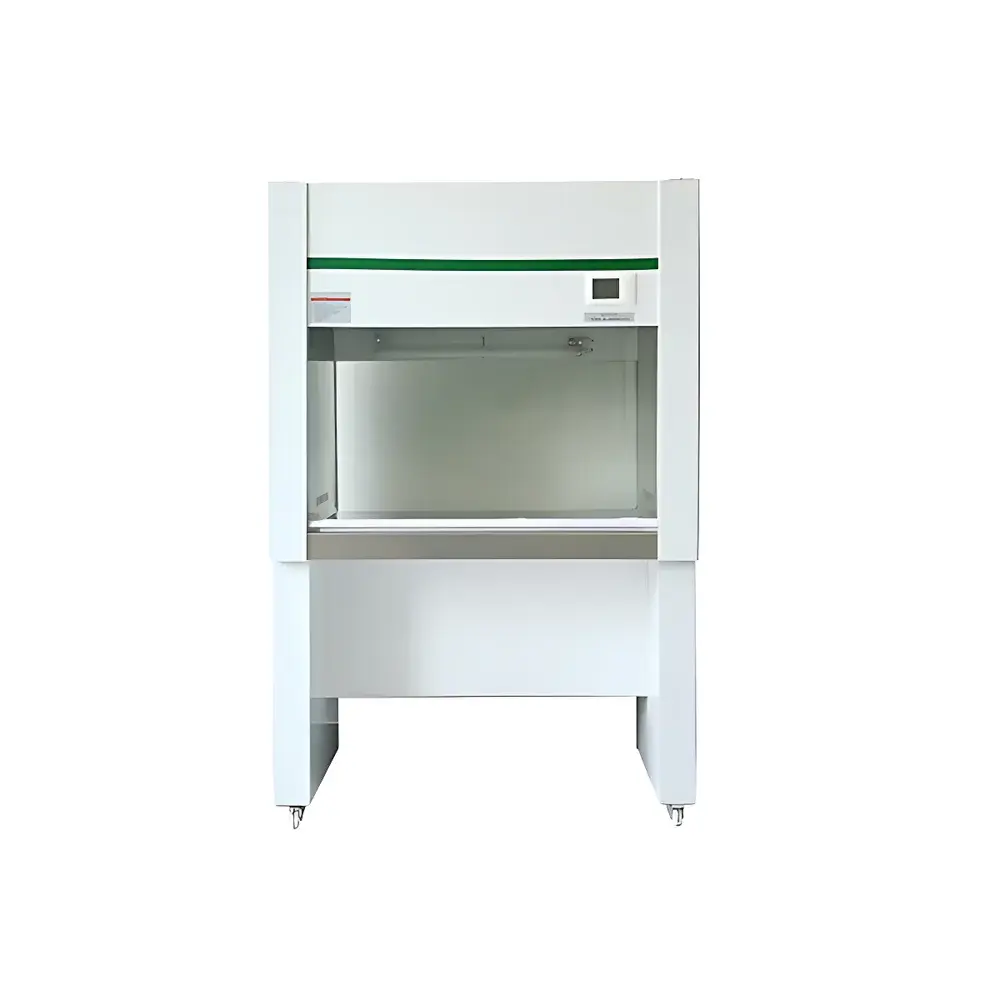
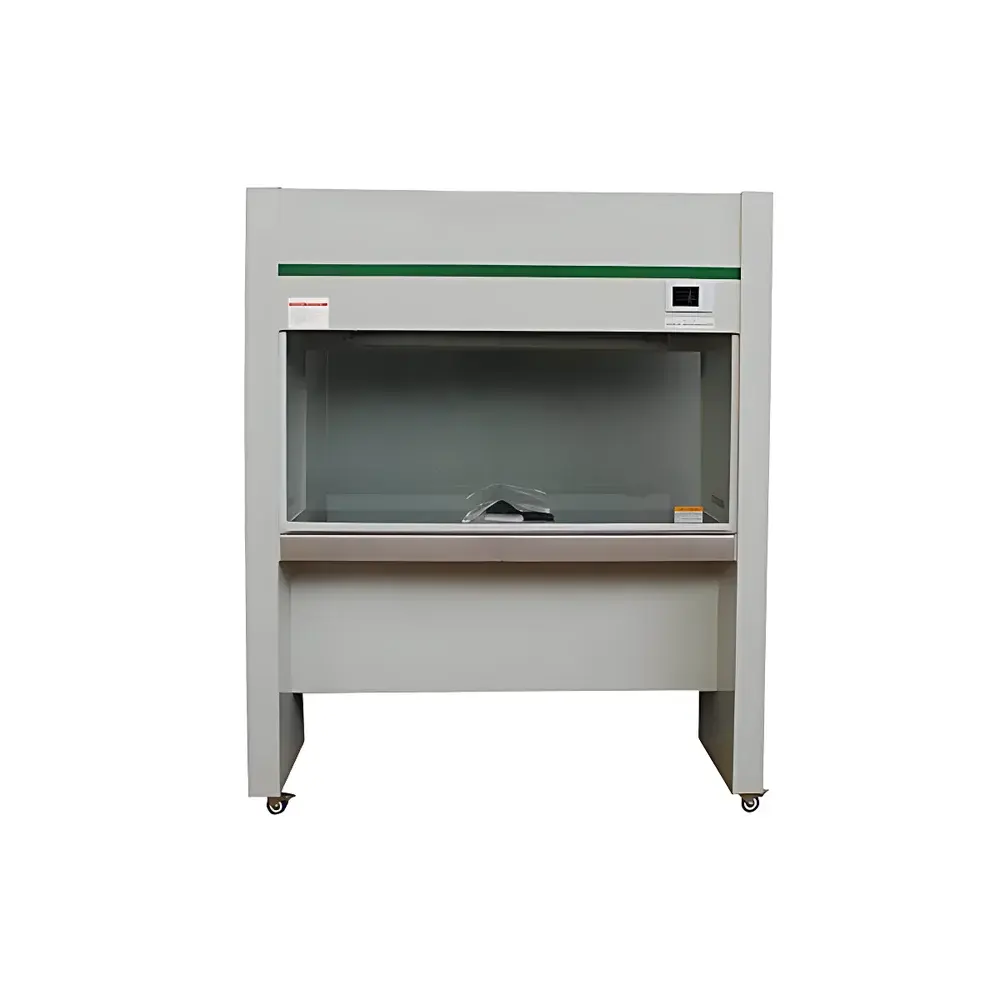
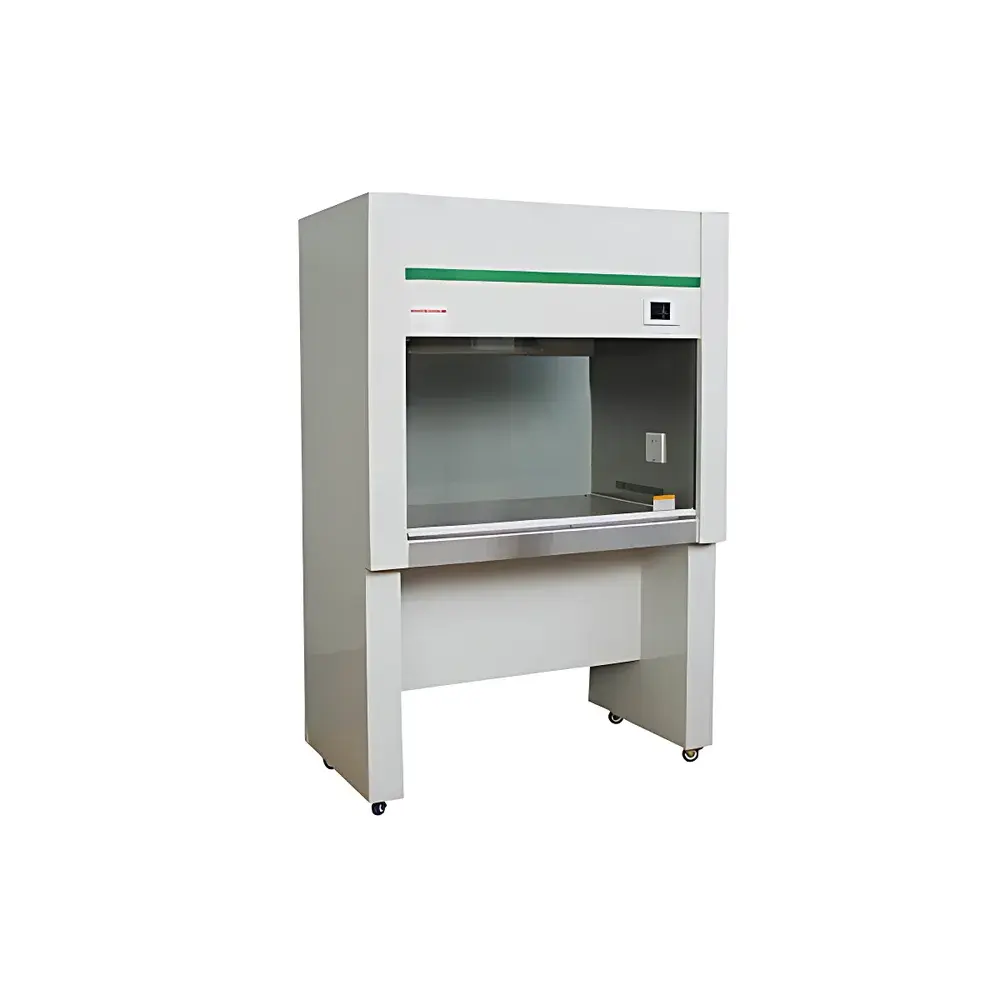
Chuanheng SW-CJ-1D Vertical Laminar Flow Clean Bench
| Brand | Chuanheng Instrument |
|---|---|
| Origin | Zhejiang, China |
| Manufacturer Type | Direct Manufacturer |
| Equipment Category | Vertical Laminar Flow Clean Bench |
| Model | SW-CJ-1D |
| Cleanliness Class | ISO Class 5 (100 @ ≥0.5 µm, per US Federal Standard 209E) |
| Average Air Velocity | 0.25–0.45 m/s (dual-speed control) |
| Noise Level | ≤62 dB(A) |
| User Configuration | Single-user, front-access |
| Airflow Pattern | Vertical downward laminar flow |
| Work Area Dimensions | 700 × 500 × 520 mm |
| Overall Dimensions | 850 × 580 × 1550 mm |
| Power Supply | AC 220 V, 50 Hz |
| Rated Power | 0.3 kW |
| HEPA Filter | 695 × 460 × 38 mm, single unit |
| Lighting | 15 W fluorescent lamp + 15 W UV germicidal lamp |
| Control | Infrared remote (fan speed high/low, lighting, UV sterilization, power on/off) |
Overview
The Chuanheng SW-CJ-1D is a vertically oriented laminar flow clean bench engineered for reliable local particle control in non-sterile but particle-sensitive laboratory environments. Unlike biological safety cabinets, this unit does not provide personnel or environmental protection against biohazards; rather, it delivers unidirectional, HEPA-filtered airflow from top to work surface to maintain ISO Class 5 (100-level) cleanliness—verified at ≥0.5 µm particles per cubic foot per US Federal Standard 209E. Its vertical laminar flow architecture ensures consistent velocity profiles across the entire work area, minimizing turbulence-induced contamination and supporting reproducible handling of sterile media, sensitive optics, microelectronic components, and pharmaceutical preparations where ambient particulate load must be suppressed.
Key Features
- Vertically aligned HEPA filtration system (695 × 460 × 38 mm, ≥99.99% efficiency at 0.3 µm) with pre-filter stage for extended service life and reduced maintenance frequency.
- Dual-speed electronically controlled blower delivering adjustable average face velocity between 0.25 and 0.45 m/s—optimized for both low-energy operation and rapid particle clearance during setup or intervention.
- Front-mounted tempered glass sash with semi-enclosed design minimizes lateral air infiltration while permitting ergonomic access and visual monitoring of procedures.
- Infrared remote control interface (A/B/C/D/ON-OFF keys) enables hands-free activation of high/low fan modes, fluorescent illumination, and UV-C germicidal irradiation—reducing cross-contamination risk during workflow transitions.
- Stainless steel 304 work surface (700 × 500 × 520 mm internal dimensions) offers chemical resistance, non-porosity, and ease of decontamination via ethanol or approved disinfectants.
- Integrated 15 W fluorescent lamp (cool white, 4000 K CCT) and 15 W UV-C lamp (254 nm) support both routine operation and periodic surface decontamination—UV interlocked to prevent accidental exposure during active use.
Sample Compatibility & Compliance
The SW-CJ-1D is suitable for non-hazardous sample manipulation across disciplines including cell culture media preparation, reagent dispensing, optical lens assembly, semiconductor component handling, and analytical standard preparation. It complies with core environmental control benchmarks referenced in ISO 14644-1 (Cleanrooms and associated controlled environments), and its performance validation aligns with USP <797> environmental monitoring expectations for non-aseptic compounding areas. While not certified to NSF/ANSI 49 or EN 12469, the unit meets functional requirements for ISO Class 5 localized containment when installed in a background environment rated ISO Class 8 (100,000) or better—typically achieved in dedicated prep rooms with basic HVAC filtration. Users are advised to conduct periodic particle count verification (e.g., using ISO 21501-4 compliant handheld counters) and filter integrity testing (e.g., DOP/PAO challenge) per institutional SOPs.
Software & Data Management
This clean bench operates as a standalone mechanical-electrical system without embedded firmware, network connectivity, or digital data logging capabilities. All operational parameters—including fan speed selection, lighting state, and UV exposure duration—are managed manually via infrared remote. For laboratories operating under GLP or GMP frameworks, manual logbook entries documenting daily startup/shutdown, UV cycle timing, and visual inspection of filter seals and sash integrity are recommended. No electronic audit trail or 21 CFR Part 11 compliance is provided; integration with facility-wide environmental monitoring systems requires external sensors and third-party data acquisition hardware.
Applications
- Preparation of microbiological growth media and dilution blanks in quality control labs serving food, beverage, and cosmetic industries.
- Assembly and inspection of precision optical elements (e.g., lenses, filters, laser diodes) requiring sub-10 µm particulate exclusion.
- Handling of hygroscopic or oxidation-prone chemicals in synthetic chemistry workflows where ambient humidity and airborne contaminants compromise reaction fidelity.
- Non-sterile compounding of ophthalmic solutions and topical formulations under ISO Class 5 conditions, as permitted by regional pharmacopeial guidelines.
- Electronics manufacturing support—including PCB soldering station shielding and MEMS device packaging—where electrostatic discharge (ESD)-safe variants may be requested separately.
FAQ
Does the SW-CJ-1D provide protection against biological agents or hazardous vapors?
No. This is a laminar flow clean bench—not a biosafety cabinet. It protects only the sample from ambient particulates; it does not protect the operator or environment from aerosols, volatile organics, or pathogens.
What is the recommended room classification for optimal performance?
Installation in an ISO Class 8 (100,000) or cleaner ambient space is required. A dedicated anteroom with basic particulate filtration significantly improves long-term HEPA service life and reduces frequency of recertification.
Can the UV lamp be used while the fan is running?
No. The UV lamp is mechanically interlocked with the sash position and automatically de-energizes when the front glass is opened beyond 50 mm—preventing operator exposure during active airflow.
How often should the HEPA filter be replaced?
Under typical usage (8 hrs/day, ISO Class 8 background), replacement is recommended every 18–24 months—or sooner if differential pressure across the filter exceeds 250 Pa or particle counts exceed ISO Class 5 thresholds during routine monitoring.
Is stainless steel grade 304 sufficient for aggressive solvent exposure?
Grade 304 resists common alcohols, acetone, and aqueous buffers. For prolonged contact with halogenated solvents (e.g., chloroform, DCM) or strong acids/bases, optional electropolished 316L stainless steel work surfaces are available upon request.



