
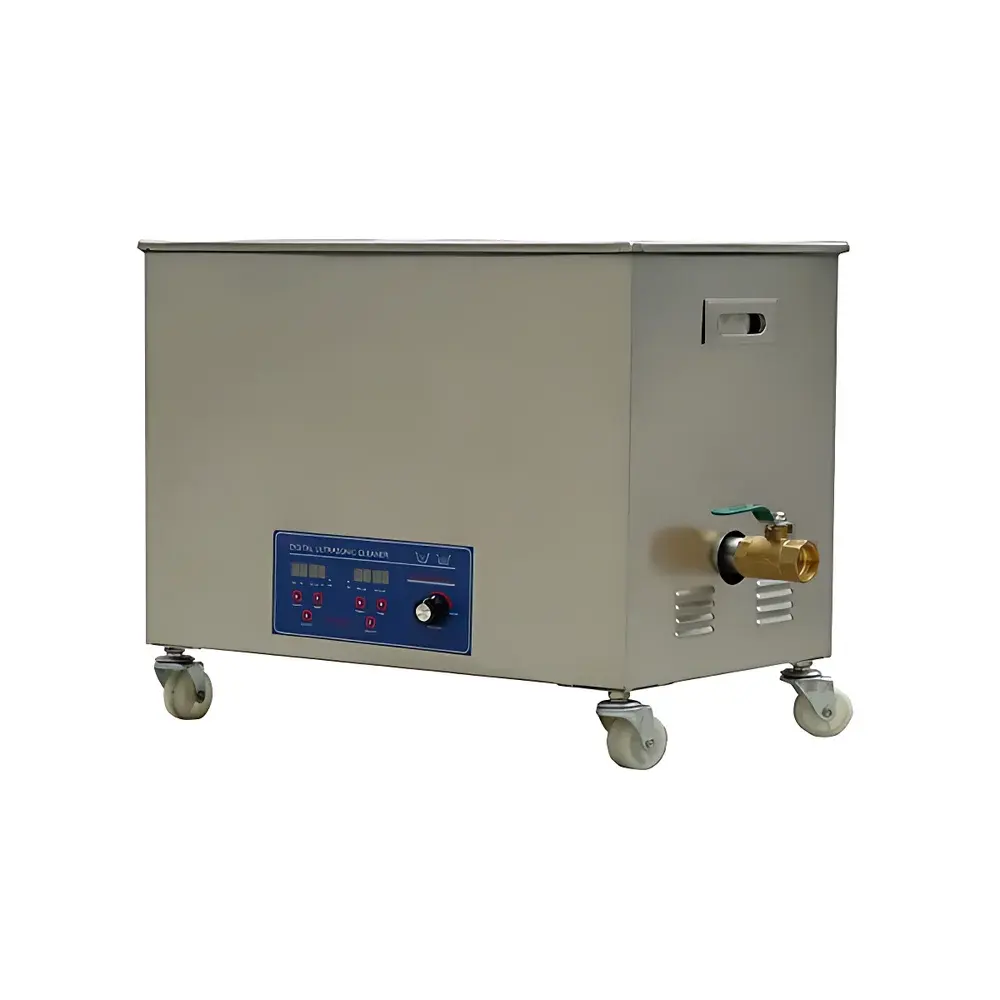
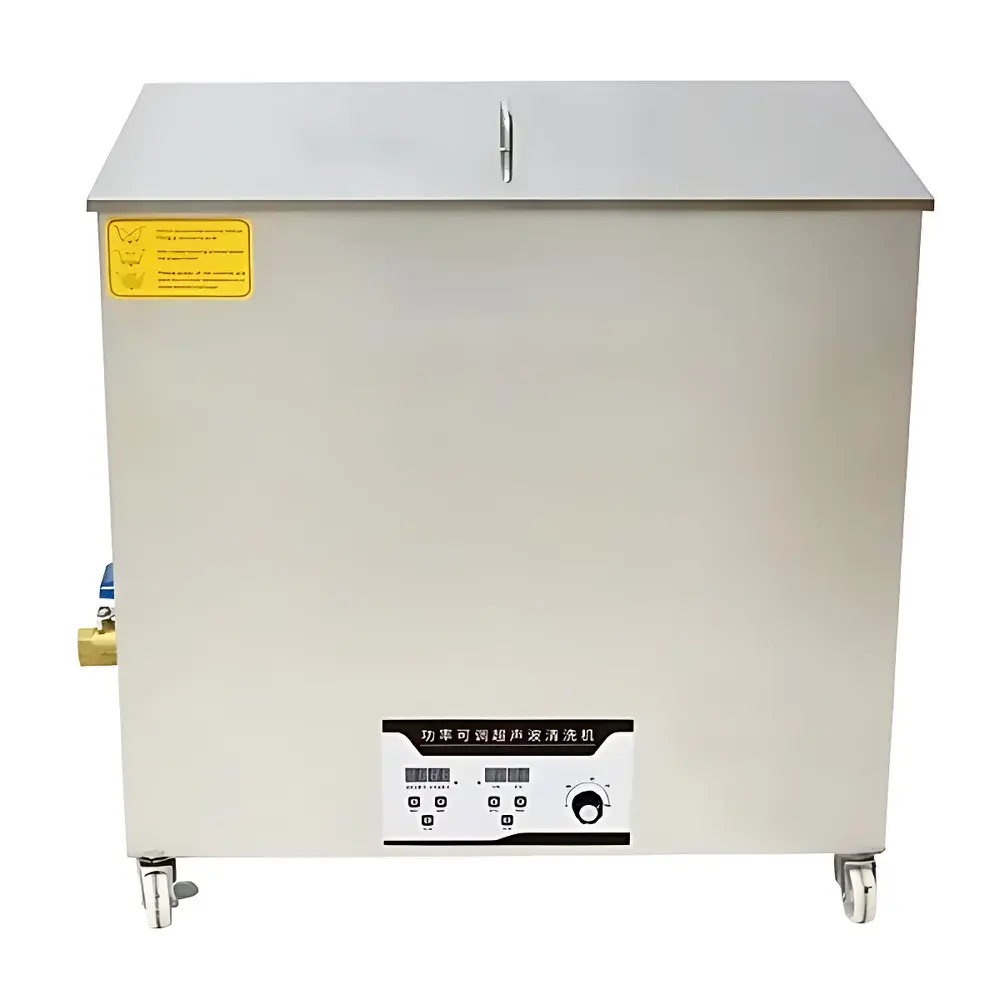
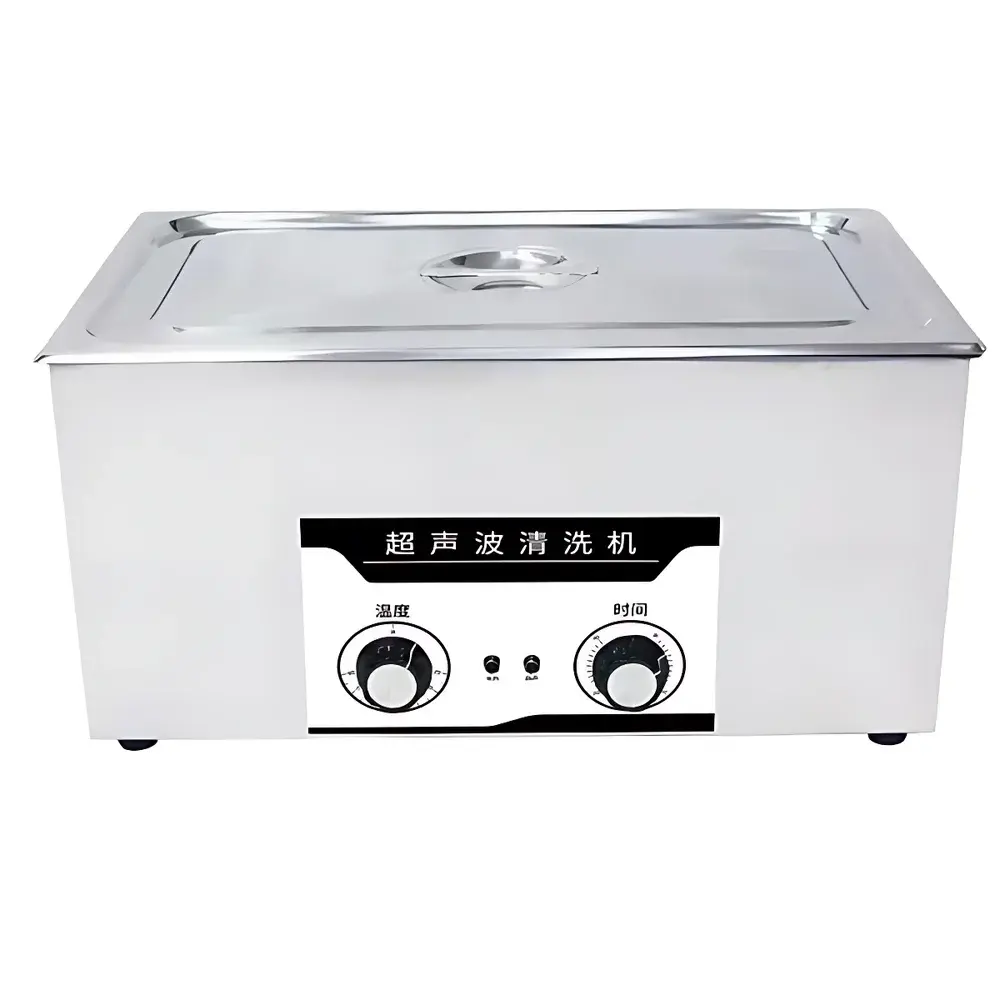
Chuanna Instrument CH-130AL Large-Capacity Ultrasonic Cleaner
| Brand | Chuanna Instrument |
|---|---|
| Origin | Zhejiang, China |
| Manufacturer Type | Authorized Distributor |
| Product Category | Domestic |
| Model | CH-130AL |
| Instrument Type | General-Purpose Ultrasonic Cleaner |
| Tank Capacity | 130 L |
| Ultrasonic Frequency | 28 kHz or 40 kHz (selectable single frequency) |
| Ultrasonic Power Output | 2160 W |
| Power Adjustment | Yes, 40–100% continuous digital control |
| Heating Temperature Range | Ambient to 80 °C (adjustable) |
| Timer Range | 1–30 min (digital preset) |
| Sound-Dampening Lid | Included |
| Drain/Inlet | Manual valve-controlled |
Overview
The Chuanna Instrument CH-130AL is a large-capacity, general-purpose ultrasonic cleaner engineered for high-throughput laboratory, industrial maintenance, and quality assurance environments requiring consistent, non-destructive cleaning of complex geometries. It operates on the principle of acoustic cavitation—generating controlled microbubbles in aqueous or solvent-based cleaning media via high-frequency mechanical vibrations transmitted through piezoelectric transducers bonded to the tank bottom. At either 28 kHz or 40 kHz (user-selectable), the system balances penetration depth and cavitation intensity: lower frequency (28 kHz) delivers greater energy per bubble for robust removal of tenacious particulates and oils from heavy-duty components; higher frequency (40 kHz) offers finer, more uniform cavitation suitable for delicate optics, semiconductor wafers, and precision instrumentation. With a 130 L stainless-steel tank (650 × 450 × 450 mm internal dimensions), the CH-130AL supports batch processing of large assemblies—including surgical instrument trays, automotive fuel injectors, printed circuit board racks, and glassware sets—without compromising acoustic field homogeneity.
Key Features
- Monolithic 304 stainless-steel construction: Both inner tank and outer chassis fabricated from ASTM A240 304 stainless steel, with 2.0 mm thick transducer mounting plate for structural integrity and long-term resistance to corrosion and thermal fatigue.
- Digital microprocessor control system: Fully programmable interface enabling independent adjustment of ultrasonic power (40–100% in 1% increments), heating temperature (ambient to 80 °C ±1 °C), and cycle duration (1–30 min in 1-min steps); retains last-used parameters in non-volatile memory for repeatable operation.
- Thyristor-based power regulation: Enables precise, linear control of ultrasonic output without harmonic distortion—critical for maintaining stable cavitation thresholds across variable load conditions and fluid temperatures.
- Integrated sound-dampening lid: Reduces airborne noise to ≤65 dB(A) at 1 m distance while minimizing solvent evaporation and enhancing operator safety during heated operation.
- Modular heater assembly: 3000 W immersion-type heating element with PID feedback loop ensures rapid, uniform temperature ramping and minimal thermal overshoot—essential for temperature-sensitive cleaning protocols compliant with ISO 15883-5 and ASTM F3127.
- Manual drain valve with quick-connect fitting: Facilitates complete tank evacuation without disassembly; compatible with standard 1/2″ NPT drainage hoses for integration into centralized lab waste management systems.
Sample Compatibility & Compliance
The CH-130AL accommodates a broad range of sample types—including metal, ceramic, polymer, and composite substrates—provided they are chemically compatible with aqueous alkaline, neutral, or mild acidic cleaning solutions. Its open-tank architecture permits immersion of irregularly shaped parts up to 600 mm in height. The unit meets CE marking requirements for electromagnetic compatibility (EN 61326-1) and low-voltage safety (EN 61010-1). While not certified to UL 61010-1 or IEC 61000-6-4 for North American markets, its design aligns with GLP-aligned laboratory practices: all parameter settings are digitally logged with timestamped records accessible via front-panel display, supporting audit-ready documentation under FDA 21 CFR Part 11 when integrated with validated external data capture software.
Software & Data Management
The CH-130AL operates as a standalone instrument with no proprietary software dependency. All operational parameters are configured and monitored via an intuitive LED-backlit membrane keypad and dual-line LCD display. No USB, RS-232, or Ethernet connectivity is provided; however, the device supports manual logging of cycle parameters (time, temperature, power level) in laboratory notebooks or LIMS-compatible spreadsheets. For facilities requiring electronic record retention, third-party serial-to-USB adapters may be used to capture real-time status outputs (e.g., active temperature, elapsed time) via ASCII protocol—though such configurations fall outside factory validation scope and require user-defined IQ/OQ protocols.
Applications
- Pre-analytical sample preparation: Removal of organic residues from HPLC vials, autosampler needles, and GC inlet liners prior to trace-level analysis.
- Medical device reprocessing: Cleaning of reusable endoscopic components, orthopedic implants, and dental handpieces in accordance with AAMI ST91 and EN ISO 15883-1 guidelines.
- Electronics manufacturing: Decontamination of PCBs post-soldering, flux residue removal from SMT stencils, and cleaning of MEMS sensors prior to packaging.
- Materials science labs: Degreasing of metallographic specimens before polishing, removal of cutting fluids from machined test coupons, and preparation of catalyst substrates for BET surface area analysis.
- Academic research facilities: Routine cleaning of volumetric flasks, burettes, and centrifuge rotors across chemistry, biology, and engineering departments.
FAQ
Is the CH-130AL suitable for cleaning delicate optical lenses or coated surfaces?
Yes—when operated at 40 kHz with low power (40–60%), using deionized water or low-surfactant formulations, and avoiding prolonged exposure (>10 min). Always verify material compatibility with your substrate manufacturer’s specifications.
Does the unit include automatic degassing functionality?
No. Degassing must be performed manually by running the unit at elevated temperature (60–70 °C) without load for 5–10 minutes prior to introducing samples.
Can the ultrasonic frequency be switched during operation?
No. Frequency selection (28 kHz or 40 kHz) is fixed at time of manufacture and requires hardware modification—not supported in the field.
What maintenance intervals are recommended for optimal performance?
Inspect transducer bonding integrity every 6 months; clean tank interior weekly with citric acid solution to prevent scale buildup; replace drain valve O-rings annually or after 500 cycles.
Is the heater thermostatically protected against dry-run conditions?
Yes. An embedded PT100 sensor triggers automatic shutdown if liquid level falls below the minimum fill line (30 L), preventing heater element damage.



