
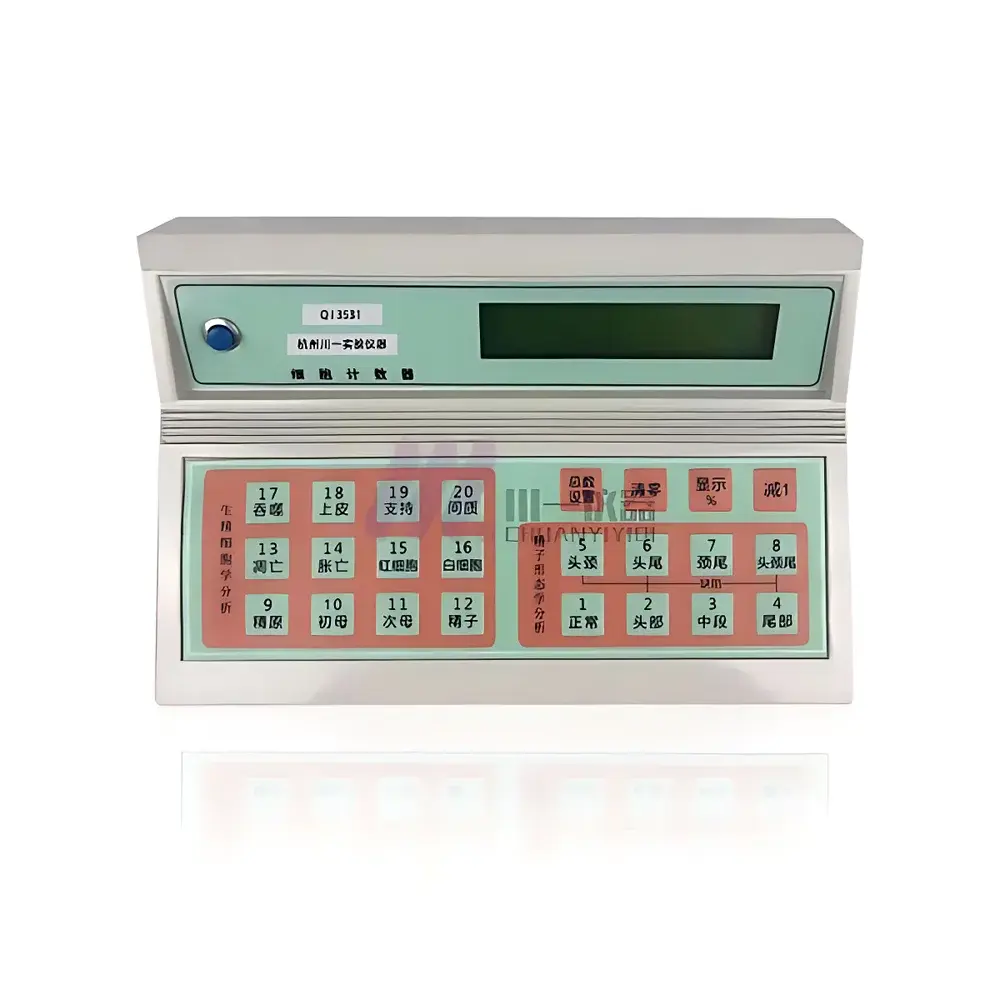
Chuanyi Qi3531 Sperm and Hematological Cell Classification Counter
| Brand | Chuanyi Instruments |
|---|---|
| Origin | Zhejiang, China |
| Manufacturer Type | OEM Manufacturer |
| Country of Origin | China |
| Model | Qi3531 |
| Price Range | USD 1,400 – 7,000 (FOB) |
| Sample Throughput | Up to 20 cell types per analysis session |
| Power Supply | Dual-mode (AC adapter + internal rechargeable battery) |
| Display | Integrated LCD screen with real-time classification summary |
Overview
The Chuanyi Qi3531 Sperm and Hematological Cell Classification Counter is a dedicated manual-assisted digital cytology counter engineered for clinical hematology laboratories and andrology units requiring rapid, standardized enumeration and morphological classification of spermatozoa and peripheral blood cells. Unlike fully automated flow-based analyzers, the Qi3531 operates on a human-in-the-loop visual identification paradigm: users view stained smears under a microscope and press preassigned membrane keys corresponding to defined cell categories—enabling traceable, auditable, and operator-controlled classification without image capture or AI inference. Its design adheres to the operational logic of WHO-recommended manual differential counting protocols (e.g., WHO Laboratory Manual for the Examination and Processing of Human Semen, 6th ed.) and supports compliance with ISO 15189:2022 requirements for documented analyst intervention in morphology-based assays. The instrument does not perform optical imaging, cell segmentation, or machine learning–driven classification; instead, it functions as a calibrated input terminal synchronized with standardized hematopoietic and spermatogenic nomenclature.
Key Features
- Dedicated 20-cell classification matrix aligned with WHO and ICSH (International Council for Standardization in Haematology) morphological taxonomy—including sperm motility grades (progressive, non-progressive, immotile), sperm morphology subtypes (normal, head defects, midpiece abnormalities, tail defects), and hematopoietic lineages (myeloblast, promyelocyte, myelocyte, metamyelocyte, band neutrophil, segmented neutrophil, lymphocyte, monocyte, eosinophil, basophil, plasma cell, megakaryocyte, etc.)
- Real-time cumulative display on integrated monochrome LCD screen showing absolute counts, relative percentages, and running totals per category
- Dual-power architecture: AC-powered operation via regulated 12 V DC adapter (input: 100–240 V AC, 50/60 Hz); automatic fallback to internal sealed-lead-acid battery (backup ≥8 hours) upon adapter disconnection
- Compact benchtop footprint (220 × 160 × 65 mm) suitable for laminar flow hoods, microscopy workstations, or mobile lab carts
- Physical tactile keypad with 20 labeled membrane switches—engineered for glove-compatible actuation and long-term mechanical reliability (>1 million keystrokes per switch)
- No embedded storage or network interface; all data export requires manual transcription or optional RS-232 serial output (configurable baud rate up to 115,200 bps) to external PCs or LIS systems
Sample Compatibility & Compliance
The Qi3531 accepts standard glass microscope slides (75 × 25 mm) prepared using conventional staining methods including Wright-Giemsa, Papanicolaou, or Diff-Quik for semen or blood smears. It supports quantification workflows compliant with CLSI H20-A3 (Clinical and Laboratory Standards Institute) guidelines for manual differential leukocyte counts and WHO 2021 criteria for semen analysis. While the device itself is not FDA-cleared or CE-IVD marked, its usage falls within the scope of laboratory-developed test (LDT) frameworks where manual classification remains the reference method. Institutions implementing the Qi3531 in GLP- or GCP-regulated environments must document operator training, daily verification of key functionality (e.g., button responsiveness, display accuracy), and maintain audit logs of count sessions per ISO/IEC 17025:2017 clause 7.7.
Software & Data Management
The Qi3531 operates without embedded firmware-based software. All classification logic resides in hardwired microcontroller logic—eliminating OS dependencies, cybersecurity vulnerabilities, or version update requirements. Count records are not stored internally; however, optional RS-232 connectivity enables integration with third-party laboratory information systems (LIS) or custom Excel macros for automated CSV logging. When used in regulated settings, institutions may configure the serial output to append timestamps, operator IDs, and sample IDs via external trigger signals—supporting 21 CFR Part 11-compliant audit trails when paired with validated host software and access controls.
Applications
- Clinical andrology labs performing WHO-standard semen analysis (concentration, motility distribution, morphology scoring)
- Hematology departments conducting manual white blood cell differentials on peripheral blood and bone marrow aspirates
- Research laboratories studying spermatogenesis kinetics or drug-induced cytotoxicity in rodent models
- Medical education facilities training residents in morphologic recognition and differential counting discipline
- Resource-limited settings where robustness, low power dependency, and minimal maintenance outweigh automation needs
FAQ
Does the Qi3531 perform automated image analysis or AI-based cell recognition?
No. It is a manual classification aid only—users visually identify cells under microscopy and press corresponding keys.
Is the device compatible with electronic medical record (EMR) systems?
Yes—via optional RS-232 serial interface; integration requires middleware configuration by the end-user’s IT team.
What is the warranty coverage and service support model?
One-year limited warranty covering manufacturing defects; lifetime technical support and repair services available directly from Hangzhou Chuanyi Electronics Co., Ltd.
Can the key layout be customized for institution-specific cell nomenclature?
No—the 20-key mapping is fixed per ICSH/WHO consensus terminology and cannot be reprogrammed.
Does the Qi3531 meet ISO 13485 or FDA 510(k) requirements?
It is not certified to either standard; it is classified as a general-purpose laboratory counter—not an in vitro diagnostic (IVD) device under current regulatory definitions.




