
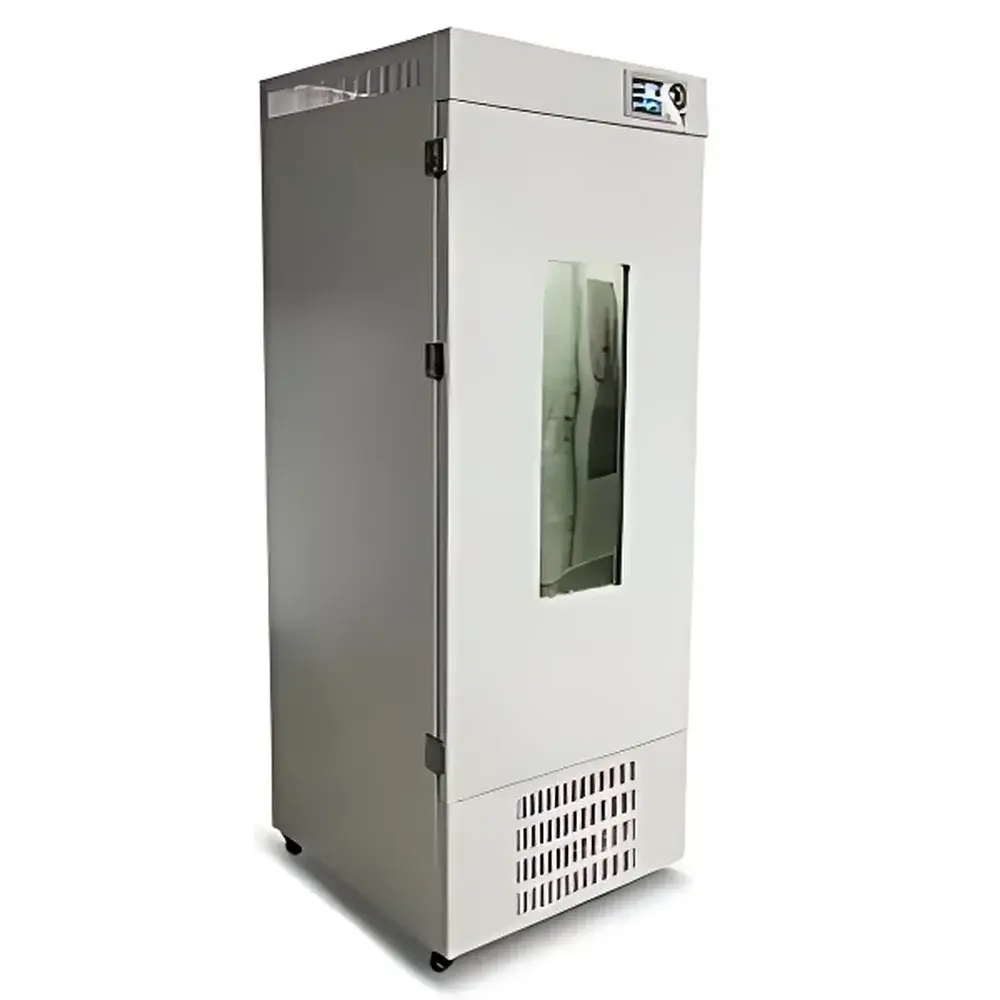
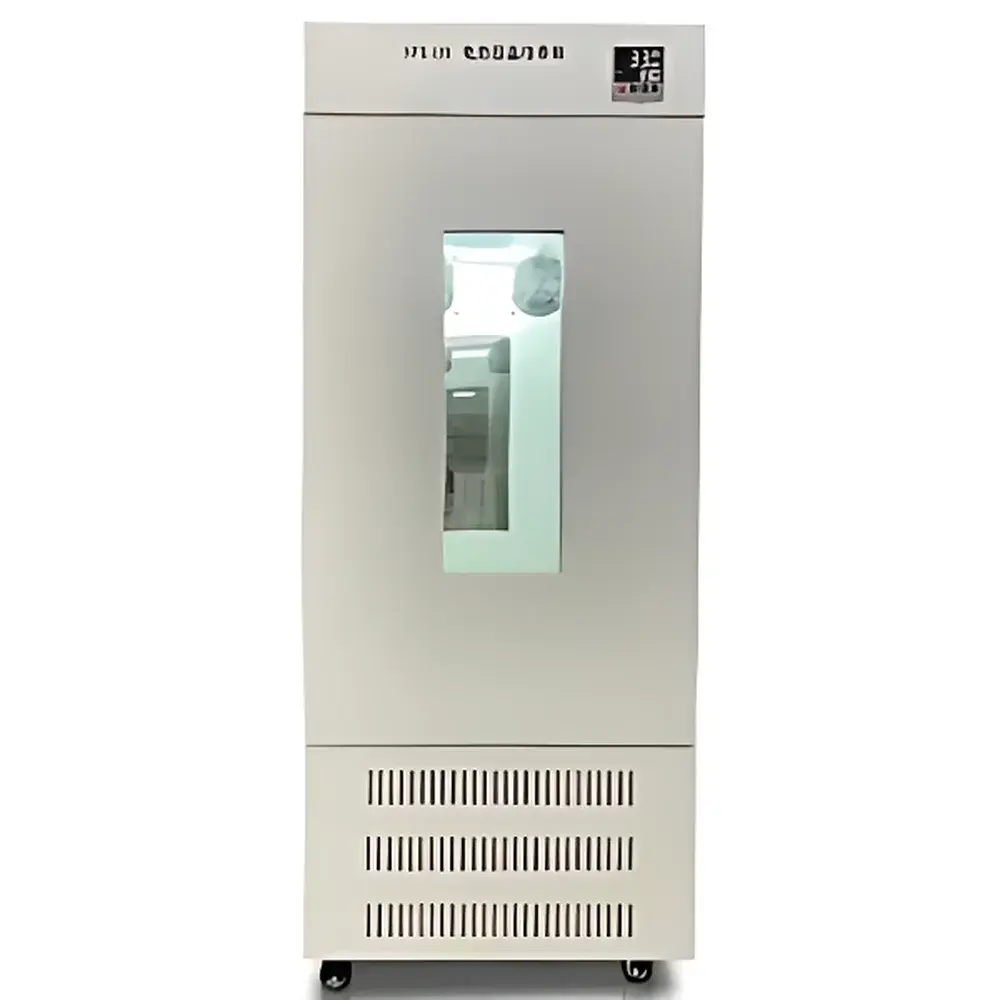
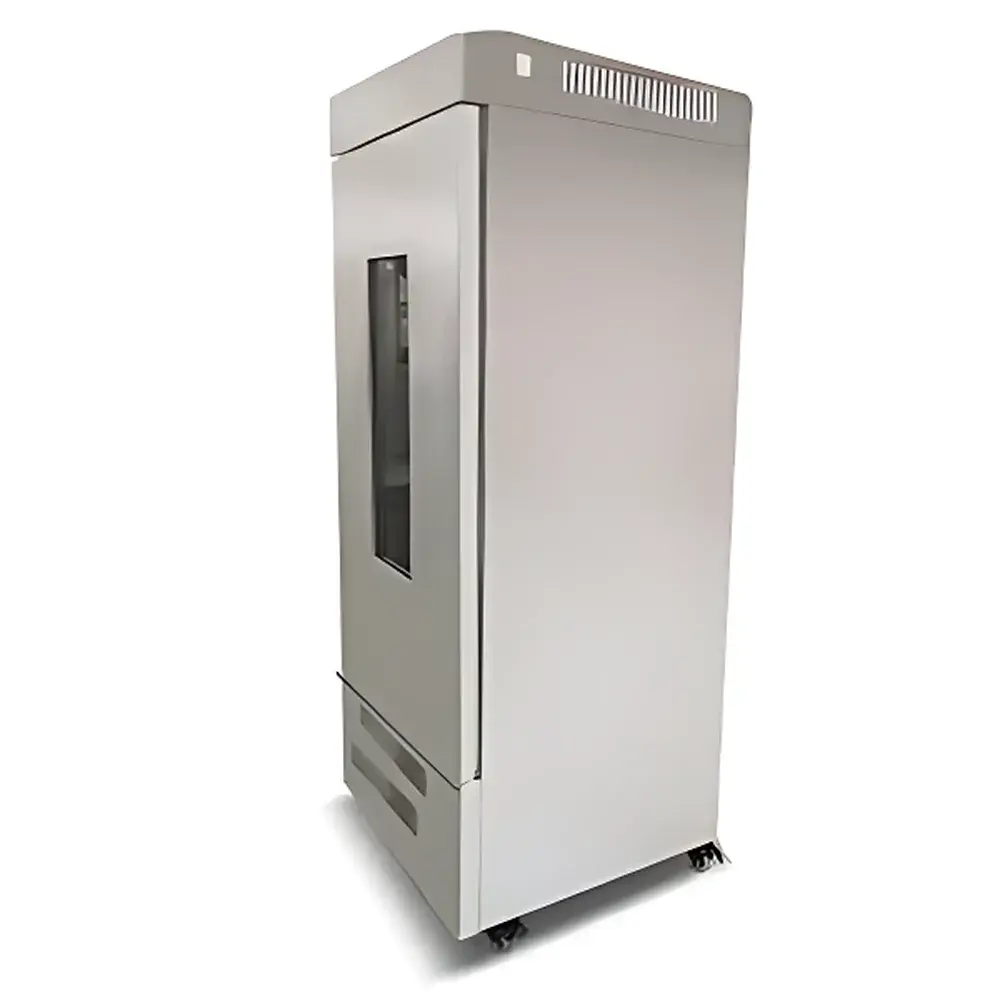
Chuanyu Instruments SPX-350B Biochemical Incubator
| Brand | Chuanyu Instruments |
|---|---|
| Origin | Shanghai, China |
| Model | SPX-350B |
| Temperature Range | 0–60 °C |
| Internal Dimensions (W×D×H) | 500 × 560 × 1280 mm |
| External Dimensions (W×D×H) | 600 × 670 × 1918 mm |
| Temperature Uniformity | ±1 °C |
| Temperature Stability | ±0.5 °C |
| Control System | PID-controlled digital microprocessor with dual LED display (set & actual temperature) |
| Sensor | PT100 platinum resistance thermometer |
| Refrigeration | Eco-friendly R134a compressor-based cooling module with high/low pressure protection and delayed start |
| Air Circulation | Forced convection via stainless steel duct system |
| Interior Material | Mirror-finish 304 stainless steel chamber with adjustable, removable shelves |
| Viewing Window | Large-angle tempered glass observation window with interior LED lighting |
| Safety Features | Over-temperature alarm, timer function, auto cut-off protection |
Overview
The Chuanyu Instruments SPX-350B Biochemical Incubator is a precision-engineered, forced-air convection incubator designed for stable, uniform thermal control across a broad operational range of 0–60 °C. It employs a closed-loop PID temperature regulation system paired with a high-accuracy PT100 platinum resistance sensor to ensure long-term thermal stability (±0.5 °C) and spatial uniformity (±1 °C) throughout its 350 L working volume. Unlike natural-convection models, the SPX-350B integrates a dedicated stainless steel air circulation duct system that actively redistributes conditioned air—minimizing vertical and horizontal gradients and enabling reproducible growth conditions essential for microbial cultivation, cell line maintenance, BOD testing, and enzymatic assays. Its refrigeration architecture utilizes an R134a-compliant hermetic compressor with multi-stage safety protocols—including high/low pressure monitoring, thermal overload protection, and programmable startup delay—to sustain reliable low-temperature operation without compromising mechanical longevity or environmental compliance.
Key Features
- Mirror-finish 304 stainless steel interior chamber with corrosion-resistant construction and seamless welds for enhanced cleanability and bio-contamination control.
- Adjustable, tool-free shelving system with multiple height positions to accommodate varied vessel configurations—from Petri dishes and flasks to multi-well plates and culture bottles.
- Dual-digit LED microprocessor controller featuring real-time setpoint and actual temperature display, user-configurable timer function, and automatic over-temperature cutoff with audible alarm.
- Forced-air convection design utilizing a low-turbulence stainless steel duct network ensures rapid thermal equilibration (<30 min from ambient to 37 °C) and minimal cross-zone deviation.
- Large-format, anti-fog tempered glass observation window with integrated LED illumination enables non-invasive visual monitoring without thermal disturbance or door opening.
- Compressor-based refrigeration subsystem engineered for continuous duty at sub-ambient temperatures, compliant with international ozone-safe refrigerant standards (R134a).
Sample Compatibility & Compliance
The SPX-350B supports standard laboratory sample formats including microbiological agar plates, liquid culture tubes, T-flasks, roller bottles, and multi-layer cell stacks. Its chamber geometry (500 × 560 × 1280 mm internal) permits vertical stacking of up to six full-size shelves while maintaining ≥80 mm clearance between levels—ensuring adequate airflow per ICH Q5D and ISO 20387 biobanking guidelines. The unit operates within ambient conditions of 5–32 °C and ≤80% RH, meeting typical laboratory HVAC constraints. While not certified to UL 61010-1 or EN 61010-1 out-of-box, its electrical architecture—including grounded chassis, fused power input, and reinforced insulation—provides foundational safety alignment with GLP-compliant facility requirements. Documentation packages support IQ/OQ validation protocols when deployed in regulated environments (e.g., pharmaceutical QC labs performing USP <61> microbial enumeration).
Software & Data Management
The SPX-350B operates via embedded firmware without external PC dependency; however, its analog voltage output (0–5 V DC proportional to chamber temperature) is compatible with third-party data loggers (e.g., Omega OM-DAQPRO, Testo 176 T4) for time-stamped traceability. Optional RS-485 Modbus RTU interface kits enable integration into centralized building management systems (BMS) or LIMS platforms for automated event logging—including temperature excursions, door-open duration, and alarm triggers. All parameter settings are retained during power interruption, and the controller maintains audit-ready configuration history for up to 30 days. For FDA 21 CFR Part 11 compliance, external validation-grade loggers with electronic signature capability must be employed in conjunction with documented SOPs.
Applications
- Microbial culture propagation under controlled aerobic/anaerobic conditions for clinical diagnostics, food safety testing (ISO 6579, AOAC 990.12), and water quality assessment (APHA 9215B).
- Biochemical oxygen demand (BOD5) incubation per EPA Method 405.1 and ISO 5815-1, leveraging precise 20 °C stabilization for standardized respirometric measurement.
- Plant tissue culture and seed germination studies requiring diurnal temperature cycling (via external timer relay) and photoperiod synchronization.
- Short-term storage of temperature-sensitive reagents, antibodies, and primary cell isolates prior to cryopreservation or assay execution.
- Environmental simulation for accelerated stability testing of biologics packaging components under ICH Q1A(R2) guidance.
FAQ
What is the minimum operating temperature and how is sub-ambient cooling achieved?
The SPX-350B achieves stable operation down to 0 °C using a hermetically sealed R134a refrigeration circuit with adaptive expansion valve modulation and condenser fan speed control.
Is the incubator suitable for CO₂-dependent cell cultures?
No—this model lacks gas mixing, humidification, and CO₂ concentration control; it is intended for ambient-air applications only.
Can the unit be validated for GxP use?
Yes—when equipped with calibrated external sensors and operated under documented IQ/OQ protocols, it meets baseline requirements for non-sterile process support in GMP environments.
What maintenance intervals are recommended for optimal performance?
Compressor oil inspection every 24 months; condenser coil cleaning quarterly; PT100 calibration verification annually using NIST-traceable reference thermometers.
Does the incubator include data export functionality?
Not natively—the controller supports analog output for external logging; digital export requires optional RS-485 interface hardware and compatible SCADA software.




