
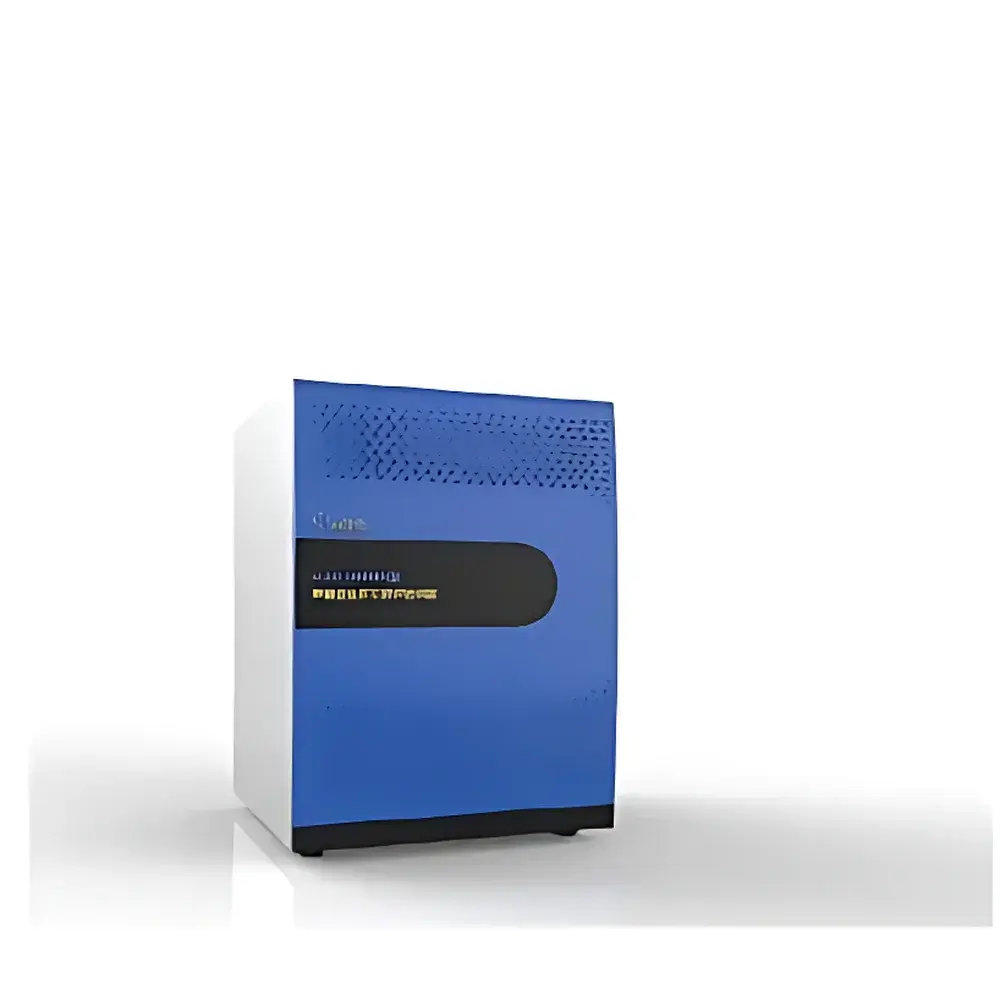
Chunhua ELSD-5000KS Preparative Evaporative Light Scattering Detector
| Brand | Chunhua |
|---|---|
| Origin | Shanghai, China |
| Model | ELSD-5000KS |
| Detection Principle | Evaporative Light Scattering (ELSD) + Diode Array Detection (DAD) |
| Gas Flow Range | 0–5 L/min |
| Nebulizer Pressure | 0–150 psi |
| Drift Tube Temperature | Ambient to 200 °C (±1 °C control accuracy) |
| Mobile Phase Flow Rate Compatibility | 0–200 mL/min |
| Light Source | Standard 650 nm laser + D₂/W lamp combination |
| Spectral Range | 200–800 nm (standard), optional 200–400 nm or 200–1100 nm |
| Wavelength Modes | Full-spectrum, multi-wavelength, dual-wavelength, single-wavelength |
| Fraction Capacity | 160 positions |
| Collection Mechanism | X-Y-Z three-axis robotic arm |
| Gas Supply | Compressed air or nitrogen |
| Software | ELSD-5000KS Preparative Chromatography Workstation |
| Compliance | Designed for GLP-compliant environments |
Overview
The Chunhua ELSD-5000KS Preparative Evaporative Light Scattering Detector is an integrated, multi-detection preparative chromatography platform engineered for high-throughput compound isolation and comprehensive component characterization. Unlike conventional single-mode detectors, the ELSD-5000KS combines evaporative light scattering detection (ELSD) with diode array detection (DAD) in a single, synchronized architecture. ELSD operates on the principle of nebulization, solvent evaporation, and light scattering measurement of non-volatile analytes—making it universally responsive to compounds lacking chromophores, including lipids, carbohydrates, polymers, and natural product aglycones. The integrated DAD module (200–800 nm) provides simultaneous UV-Vis spectral acquisition across all eluting peaks, enabling real-time peak purity assessment, spectral library matching, and wavelength-optimized fraction triggering. This dual-detection strategy eliminates detection bias inherent in UV-only systems and overcomes refractive index limitations associated with refractive index detectors (RID), particularly under gradient elution conditions.
Key Features
- Simultaneous dual-channel detection: Independent yet time-synchronized ELSD and DAD signals ensure no component is missed—especially critical for complex matrices such as herbal extracts or combinatorial libraries.
- Preparative-grade fraction collection: X-Y-Z three-axis robotic arm enables precise positioning across 160 receptacle locations—including test tubes, round-bottom flasks, and 96-well microplates—with programmable triggers based on peak apex, threshold voltage, elapsed time, or external TTL signal.
- Thermally stable drift tube: Temperature-controlled evaporation chamber (ambient to 200 °C, ±1 °C precision) ensures reproducible aerosol formation and minimizes baseline drift during extended runs.
- Modular gas delivery system: Adjustable nebulizer gas flow (0–5 L/min) and pressure (0–150 psi) support optimization for diverse mobile phase compositions—including high-water-content or high-viscosity solvents.
- Integrated solvent recovery valve: Automatically diverts clean rinse solvent to a dedicated recovery line, reducing hazardous waste volume and supporting green laboratory practices.
- Full-system computer control: All modules—including DAD, ELSD, fraction collector, and flow splitter—are governed by a unified workstation with deterministic timing synchronization and hardware-level interlock logic.
Sample Compatibility & Compliance
The ELSD-5000KS accommodates a broad range of analyte classes without derivatization: non-chromophoric small molecules (e.g., sugars, glycosides), synthetic intermediates, peptides, oligonucleotides, and synthetic polymers. Its universal response profile makes it especially suitable for natural product isolation, pharmaceutical impurity profiling, and food authenticity testing where UV-inactive components dominate. The system is designed to operate within GLP and GMP-aligned workflows: software includes configurable user roles, electronic signatures, audit trail logging, and data integrity safeguards compliant with FDA 21 CFR Part 11 when deployed with validated configurations. It meets mechanical and electrical safety standards per IEC 61010-1 and electromagnetic compatibility per IEC 61326-1.
Software & Data Management
The ELSD-5000KS Preparative Chromatography Workstation is a Windows-based application supporting method development, real-time monitoring, and post-run analysis. It displays overlaid ELSD and DAD chromatograms with synchronized spectral overlays, enabling direct correlation between scattering intensity and UV absorption profiles. The 3D chromatographic view renders retention time, wavelength, and signal intensity simultaneously—facilitating deconvolution of co-eluting species. Fraction collection status is visualized via dynamic grid mapping, with color-coded occupancy and collection history. Raw data are stored in vendor-neutral formats (e.g., .CDF-compatible binary) and support export to third-party chemometric tools (e.g., MATLAB, SIMCA). Method templates, calibration curves, and instrument maintenance logs are centrally managed with version control and timestamped backups.
Applications
- Natural product purification: Isolation of saponins, terpenoids, and flavonoid glycosides from crude botanical extracts where UV absorption is weak or masked.
- Pharmaceutical process development: Monitoring of reaction mixtures and purification of synthetic APIs with variable chromophore expression across synthetic steps.
- Food and beverage quality control: Quantification of non-UV-absorbing adulterants (e.g., maltodextrins, starch hydrolysates) and low-UV-response additives.
- Polymers and macromolecules: Molecular weight distribution analysis of PEGs, polysaccharides, and dendrimers using SEC-ELSD coupling.
- Toxicology screening: Detection of non-chromophoric toxins (e.g., aflatoxin B2, ochratoxin A derivatives) in biological matrices without derivatization.
- Combinatorial chemistry: High-speed parallel fractionation of compound libraries with orthogonal detection confirmation.
FAQ
Does the ELSD-5000KS support gradient elution?
Yes—the ELSD module is inherently compatible with gradient mobile phases, unlike refractive index detectors which suffer from baseline instability under changing solvent composition.
Can the system be retrofitted to existing preparative HPLC systems?
Yes—it features universal fluidic interfaces and TTL/RS-232 connectivity, enabling integration with any preparative LC platform regardless of manufacturer.
Is the DAD module capable of spectral library searching?
Yes—the workstation supports user-defined spectral libraries and performs automated match scoring against reference spectra using correlation coefficient algorithms.
What is the minimum detectable mass for typical organic analytes?
Detection sensitivity is analyte-dependent; for sucrose under standard conditions (2 mL/min flow, 50 °C drift tube), the limit of detection is approximately 0.5 µg on-column.
Does the software support 21 CFR Part 11 compliance out-of-the-box?
The software architecture supports Part 11 requirements—including electronic signatures, audit trails, and role-based access—but formal validation must be performed by the end user per their internal SOPs.





