
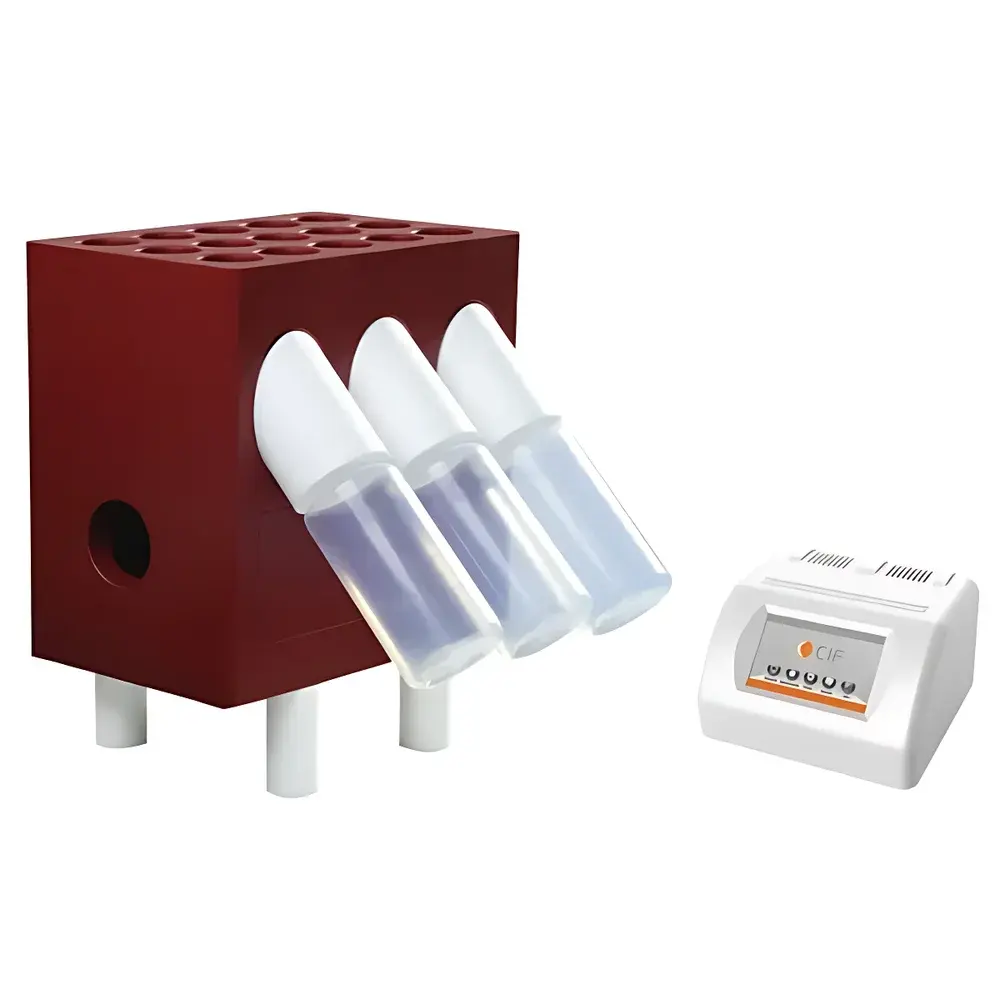
CIF AP-3.500mL High-Purity Acid Purification System
| Brand | CIF |
|---|---|
| Origin | Beijing, China |
| Model | AP-3.500mL |
| Digestion Type | Graphite Heating |
| Automation Level | Semi-Automatic |
| Digestion Positions | 31 |
| Max Heating Temperature | 260 °C |
| Temperature Control Accuracy | ±1 °C |
| Heating Principle | Graphite Block Heating |
| Reagent Channels | Graphite Heating槽 (Note: “Graphite Heating槽” is a mistranslation in source |
| Material Contacting Acids | PFA and PTFE Only |
| Pure Acid Output Capacity | 1200 mL/24h |
| Sample Vessel Diameter | Φ44 mm |
| Dimensions (W×D×H) | 300×200×380 mm |
| Power Supply | 220 V / 50 Hz |
| Rated Power | 1.8 kW |
| Control Interface | 5-inch Full-Color Touchscreen |
| Temperature Calibration | Yes |
| Programmable Segments | Up to 100 (10 methods × 10 gradients each) |
| Safety Features | Dry-run Protection, Over-Temperature Alarm, Auto Shut-off, Delayed & Scheduled Start |
Overview
The CIF AP-3.500mL High-Purity Acid Purification System is an integrated, semi-automated laboratory instrument engineered for the distillation-based purification of high-purity mineral acids—including HNO₃, HCl, HF, H₂O₂, and aqua regia—as well as organic solvents and alkaline reagents. It operates on the principle of fractional sub-boiling distillation under controlled inert conditions, leveraging precisely regulated graphite-block heating to achieve thermal stability and minimal vapor-phase contamination. Unlike conventional reflux or open-vessel boiling methods, this system maintains full containment throughout the purification cycle: acid feed enters a high-purity PFA boiling chamber, vaporizes at optimized sub-boiling temperatures, travels through a PTFE elbow condenser designed with hydrodynamic geometry to suppress backflow and condensate carryover, and condenses into ultra-clean PFA collection vials. The absence of metal, quartz, or glass components in the fluid path eliminates leachable cations (e.g., Fe, Cr, Ni, Al, Na), making it suitable for trace-element analysis by ICP-MS, ICP-OES, and HR-CS AAS where blank levels must remain below 0.1 ppt.
Key Features
- Full PFA/PTFE fluidic pathway: Boiling flask, elbow condenser, receiver vials, and vapor transfer lines are constructed exclusively from ASTM D4894-compliant perfluoroalkoxy alkane (PFA) and polytetrafluoroethylene (PTFE), certified for ≤0.01 ng/mL metal extractables.
- Graphite heating block with uniform thermal distribution: 31 independent digestion/purification wells (Φ44 mm), each thermally isolated to prevent cross-contamination and ensure reproducible heating profiles.
- Intelligent 5-inch touchscreen controller: Supports up to 10 user-defined methods, each configurable with up to 10 temperature gradient segments (100 total programmable steps); real-time graphical display of setpoint vs. actual temperature curves.
- Dry-run protection via integrated liquid-level sensing: Optical detection prevents heater activation when boiling chamber volume falls below safe threshold, eliminating risk of PFA degradation or thermal runaway.
- Sub-boiling distillation architecture: Operates below atmospheric boiling points (e.g., ~118 °C for HNO₃ at 1 atm) to minimize volatile impurity co-distillation and maximize H⁺ selectivity.
- Multi-function capability: Simultaneously supports acid purification, closed-vessel sample digestion (with optional Teflon-lined vessels), post-digestion acid evaporation (“赶酸”), and low-contamination labware rinsing—reducing instrument footprint and procedural complexity.
Sample Compatibility & Compliance
The AP-3.500mL accommodates standard PFA digestion tubes (up to 50 mL capacity) and custom-fit 500 mL PFA boiling flasks. It is validated for use with nitric, hydrochloric, hydrofluoric, sulfuric, and perchloric acids—provided appropriate ventilation and HF-handling protocols are observed. All wetted materials comply with USP Class VI biocompatibility standards and meet ISO 15190:2020 requirements for laboratory safety. The system’s closed-loop design satisfies EPA Method 3050B and 3052 prerequisites for low-blank acid preparation in environmental solid digestions. For regulated environments, audit-trail-capable data logging (via optional USB export) supports GLP/GMP documentation workflows aligned with FDA 21 CFR Part 11 principles when paired with validated SOPs.
Software & Data Management
The embedded firmware records time-stamped temperature profiles, method execution logs, and alarm events (e.g., over-temperature, dry-run trigger, power interruption). Data are exportable in CSV format via USB interface for integration into LIMS or ELN platforms. No proprietary software installation is required; method files can be edited externally using standard text editors and reloaded. Firmware supports firmware version tracking and calibration certificate import (temperature sensor offset values). Remote monitoring is achievable via RS-485 Modbus RTU protocol (optional module), enabling centralized control in multi-instrument labs compliant with ISO/IEC 17025 Clause 5.9.
Applications
- Preparation of ≤0.05 ppq HNO₃ blanks for semiconductor-grade silicon wafer etch validation.
- Generation of low-metal HCl for geological sample dissolution prior to REE quantification by MC-ICP-MS.
- Routine purification of HF used in zircon U–Pb geochronology to suppress ZrF₄ polymer formation.
- Post-digestion concentration of biological digests (e.g., NIST SRM 1577c) without borosilicate contamination.
- Cleaning of quartz ICP torch injectors and PFA nebulizer chambers using purified HNO₃/H₂O₂ mixtures.
FAQ
What acid types can be purified using the AP-3.500mL system?
Nitric acid (HNO₃), hydrochloric acid (HCl), hydrofluoric acid (HF), sulfuric acid (H₂SO₄), hydrogen peroxide (H₂O₂), and aqua regia—subject to compatibility verification per ASTM D4894 Annex A1.
Is cooling water required for condensation?
No. The PTFE elbow condenser relies on ambient-air passive cooling; no external chiller or tap-water connection is needed.
Can multiple acid types be purified simultaneously?
Yes—up to six independent PFA vessels may be loaded and operated under distinct temperature programs using the multi-zone heating logic.
How is temperature accuracy verified and maintained?
Each unit ships with NIST-traceable calibration certificate; field recalibration is performed via the touchscreen interface using a certified reference thermometer (e.g., Fluke 1523) inserted into designated port.
Does the system support 21 CFR Part 11 compliance?
Out-of-the-box, it provides electronic audit trails and user-access controls; full Part 11 compliance requires documented SOPs, role-based access configuration, and third-party validation per your organization’s quality system.



