
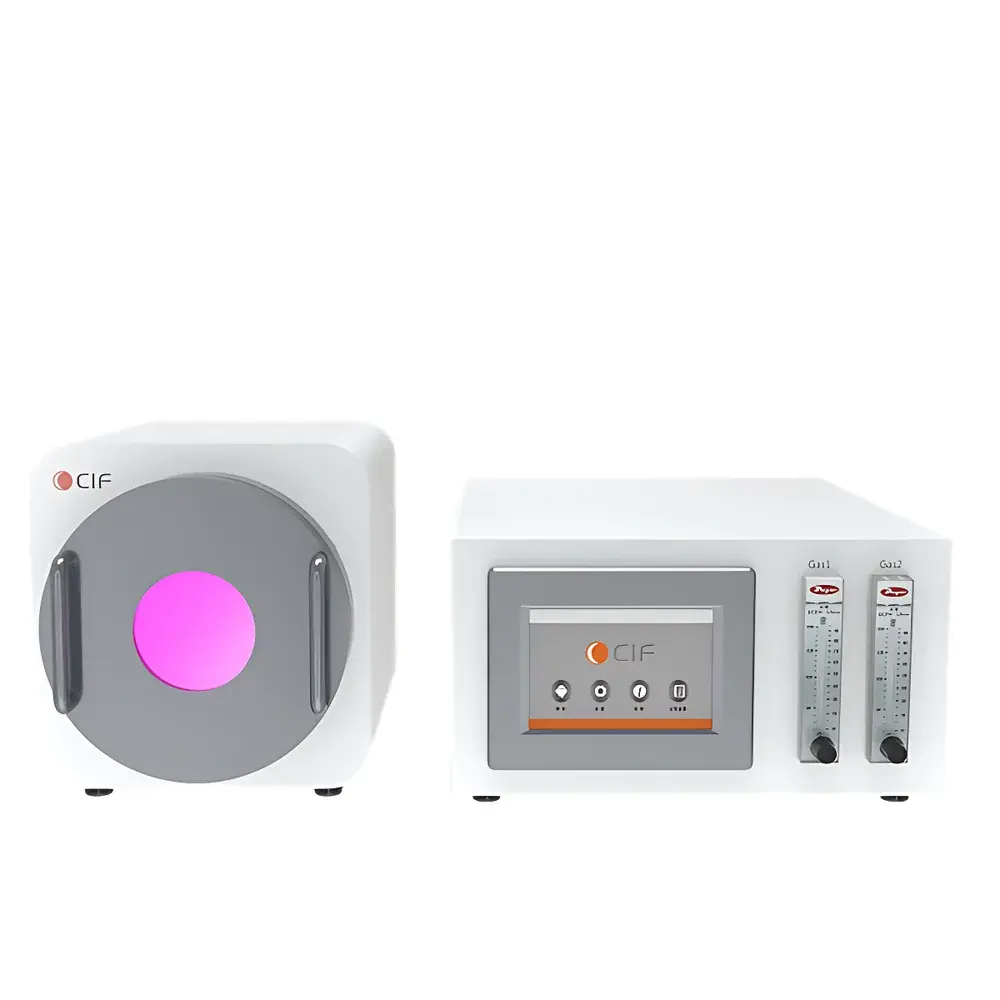
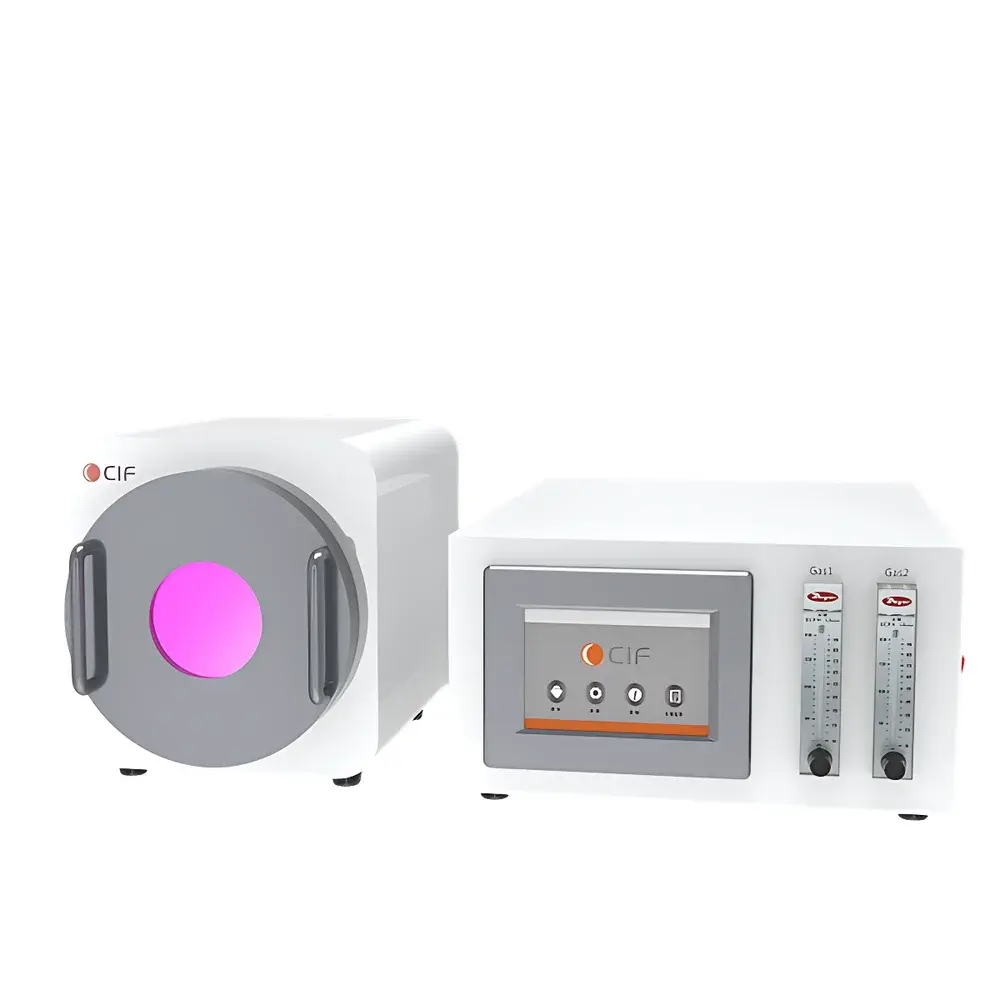
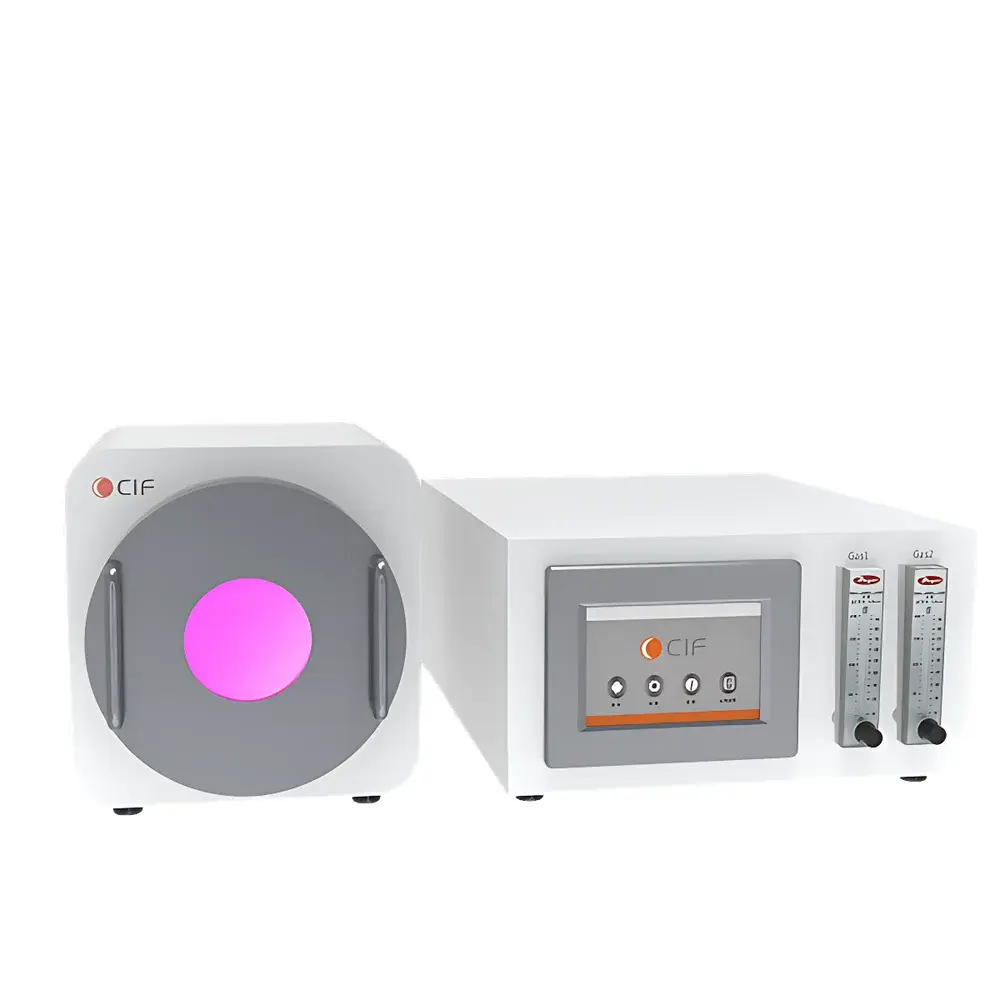
CIF VGB-P Series Glovebox-Integrated Plasma Surface Treater
| Brand | CIF |
|---|---|
| Origin | Hebei, China |
| Manufacturer Type | Authorized Distributor |
| Country of Manufacture | China |
| Model | VGB-P |
| Instrument Category | Domestic Plasma Surface Treater |
| RF Frequency | 40 kHz / 13.56 MHz |
| Power Range | 0–500 W |
| Dimensions (L×W×H) | 330 × 490 × 190 mm |
| Chamber Volume | 3.8 L |
| Chamber Material | Stainless Steel (AISI 304) |
| Gas Inlets | 2 Independent Mass Flow-Controlled Channels |
| Control Mode | Manual Knob Adjustment + Programmable Auto-Mode with Preset Sequencing |
Overview
The CIF VGB-P Series Glovebox-Integrated Plasma Surface Treater is an engineered solution for in-situ surface activation, cleaning, and functionalization of substrates under inert or controlled-atmosphere conditions. Designed explicitly for integration into nitrogen- or argon-purged gloveboxes (ISO Class 4–5), this system employs low-pressure radiofrequency (RF) plasma generated via either 40 kHz or 13.56 MHz excitation to dissociate process gases—such as O₂, Ar, H₂, N₂, or forming gas—into reactive species (ions, electrons, radicals, and UV photons). The resulting plasma interacts with surface contaminants (hydrocarbons, oxides, adsorbed water) and modifies surface energy without bulk heating or substrate damage. Its compact footprint (330 × 490 × 190 mm) and modular feedthrough-compatible design enable direct mounting onto glovebox antechambers or internal workstations, eliminating the need for sample transfer and preserving atmospheric integrity during critical handling of air-sensitive materials—including lithium battery electrodes, organometallic catalysts, perovskite precursors, and moisture-sensitive MOFs.
Key Features
- Glovebox-native mechanical architecture: Front-access chamber door with magnetic sealing gasket and integrated vacuum interlock; compatible with standard KF-25 or CF-35 glovebox flanges.
- Dual-frequency RF generator (40 kHz / 13.56 MHz): Enables selection between high-density ion bombardment (low-frequency mode) for aggressive decontamination and uniform radical-dominated treatment (high-frequency mode) for delicate polymer functionalization.
- Stainless steel (AISI 304) vacuum chamber (3.8 L volume) with electropolished interior surface—minimizes outgassing and supports UHV-compatible base pressure ≤5 × 10⁻² mbar when paired with a dry scroll pump.
- Two independently regulated gas inlets with precision mass flow controllers (MFCs), supporting sequential or simultaneous gas dosing for multi-step surface engineering protocols.
- Programmable auto-mode with up to 10 user-defined treatment recipes (power, time, gas ratio, frequency), each with real-time logging of RF forward/reflected power and chamber pressure.
- Manual override capability via front-panel analog knobs—ensures operational continuity during software initialization or remote-control interface downtime.
Sample Compatibility & Compliance
The VGB-P accommodates planar and low-aspect-ratio 3D samples up to Ø150 mm × 25 mm height, including silicon wafers, glass slides, metal foils, ceramic substrates, and flexible polymer films. Chamber geometry ensures uniform plasma distribution across the electrode area (Ø120 mm parallel-plate configuration). All wetted materials comply with ASTM F2476-22 (Standard Guide for Biocompatibility Evaluation of Plasma-Treated Surfaces) and meet ISO 10993-5 cytotoxicity screening prerequisites when operated within validated parameter envelopes. System construction adheres to IEC 61000-6-3 (EMC emission limits) and IEC 61010-1 (safety requirements for laboratory equipment). Vacuum and gas line interfaces conform to ISO-KF standards; optional integration with glovebox PLC systems supports GLP/GMP audit trails via RS485 Modbus RTU protocol.
Software & Data Management
The embedded controller runs a deterministic real-time OS with local recipe storage and timestamped event logging (treatment start/end, power ramp profiles, gas flow deviations >±2%). Data export is supported via USB-C to CSV or SQLite format. Optional PC-based software (CIF PlasmaSuite v2.1) provides graphical monitoring of plasma impedance harmonics, calculates etch rate equivalents using quartz crystal microbalance (QCM) calibration curves, and generates PDF reports compliant with FDA 21 CFR Part 11 requirements—including electronic signatures, audit logs, and role-based access control (admin/operator modes). All firmware updates are digitally signed and verified prior to installation.
Applications
- Pretreatment of lithium-ion battery cathode/anode foils to remove residual binders and enhance electrolyte wettability.
- Surface hydrophilization of PDMS microfluidic chips prior to plasma bonding—reducing delamination risk in long-term operation.
- Inert-atmosphere activation of graphene oxide films for subsequent electrochemical deposition without ambient reoxidation.
- Removal of adventitious carbon layers from TEM grids used in cryo-EM sample preparation.
- Functionalization of implant-grade titanium surfaces with amine or carboxyl groups for biomolecule immobilization under sterile glovebox conditions.
FAQ
Can the VGB-P operate continuously inside a nitrogen-filled glovebox without compromising atmosphere purity?
Yes—the system uses sealed RF feedthroughs, metal-sealed gas lines, and zero-leak-rate vacuum valves. Integrated pressure differential monitoring triggers automatic shutdown if glovebox overpressure exceeds ±10 Pa.
Is remote operation possible via Ethernet or Wi-Fi?
Standard configuration includes RS485 Modbus RTU; optional Ethernet/IP gateway module enables SCADA integration and secure TLS-encrypted web interface (HTTPS) for off-site monitoring.
What maintenance intervals are recommended for sustained performance?
Electrode surface inspection every 200 operating hours; MFC recalibration annually or after 500 gas-switch cycles; RF matching network tuning advised following chamber cleaning or gas chemistry changes.
Does CIF provide IQ/OQ documentation packages for GMP-regulated environments?
Yes—validated qualification protocols (including sensor traceability to NIST standards, repeatability testing at 5%, 50%, and 100% power setpoints) are available upon order with optional third-party certification (TÜV SÜD or SGS).



