
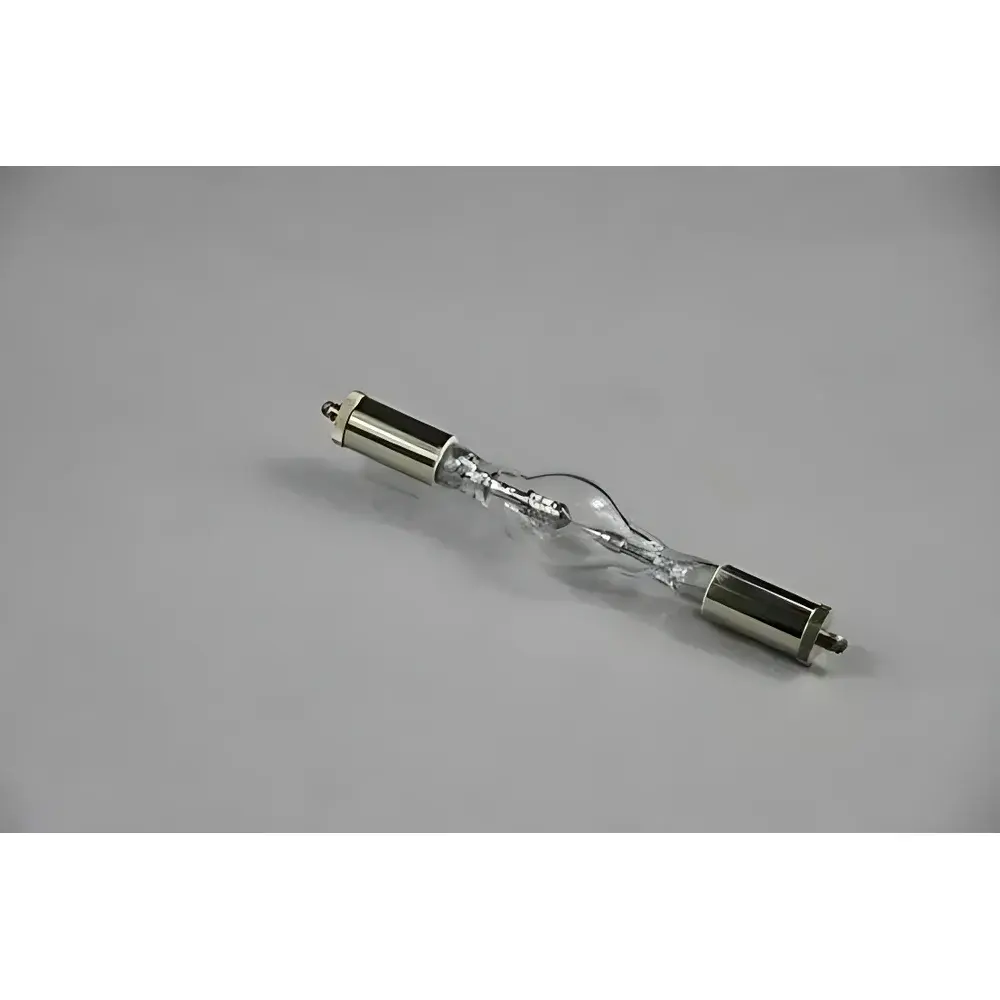
Cilas UV Mercury Arc Lamp (500W / 350W / 150W) – High-Intensity Spherical Quartz Discharge Lamp
| Brand | Cilas |
|---|---|
| Power Rating | 500W / 350W / 150W |
| Lamp Type | Spherical Quartz Mercury Vapor Arc Lamp |
| Operating Voltage | 220–240 V AC, 50/60 Hz |
| Arc Gap | ≤ 2.5 mm |
| UV Output Spectrum | 254 nm (strong line), 365 nm (main UVA peak), 405 nm, 436 nm, 546 nm, 578 nm |
| Envelope Material | Fused Silica (UV-Grade Quartz) |
| Cooling Requirement | Forced-air or water-cooled (model-dependent) |
| Lifetime | ≥ 1,000 hours (at rated power, proper cooling) |
| Compliance | IEC 62471 (Photobiological Safety), RoHS 2011/65/EU |
Overview
The Cilas UV Mercury Arc Lamp is a high-intensity, spherical quartz discharge lamp engineered for precision ultraviolet and visible spectral irradiation in scientific and industrial applications. Based on low-pressure mercury vapor discharge physics, it generates discrete spectral lines across the UV-C (254 nm), UV-A (365 nm), and visible (405–578 nm) ranges with exceptional radiometric stability and spatial uniformity. Its spherical envelope geometry ensures isotropic emission and optimal coupling into optical systems—including monochromators, collimators, and photoreactor chambers—making it a preferred excitation source for photochemistry, fluorescence microscopy calibration, UV curing validation, and accelerated weathering test instrumentation. Designed for continuous-duty operation under controlled thermal management, the lamp operates within strict thermal and electrical tolerances to maintain spectral fidelity and arc stability over extended service life.
Key Features
- Spherical fused silica envelope with high UV transmittance (>90% at 254 nm; >95% at 365 nm) and thermal shock resistance up to 800°C.
- Precision-matched electrode geometry ensuring stable arc ignition, minimal wandering, and reproducible radiant flux output across power variants (150W, 350W, 500W).
- Integrated ceramic base with standardized G12 socket interface compatible with universal UV lamp power supplies meeting IEC 61347-2-3 requirements.
- Optimized thermal design enabling forced-air cooling (for 150W/350W models) or optional water-jacketed housing (500W variant) to sustain junction temperature below 350°C during steady-state operation.
- Pre-aligned filament-to-envelope centering tolerance ≤ ±0.15 mm, minimizing beam divergence and improving coupling efficiency into fiber-optic or lens-based delivery systems.
Sample Compatibility & Compliance
This lamp is compatible with standard UV-grade optical components including MgF₂ lenses, CaF₂ windows, and reflective aluminum-coated mirrors. It is routinely deployed in ASTM G154 Cycle 1–4 UV exposure testing, ISO 4892-3 xenon-arc comparative irradiance calibration, and USP photostability chamber qualification protocols. The lamp conforms to IEC 62471 (Risk Group 3 for UV-C exposure), EN 62471:2008, and EU RoHS Directive 2011/65/EU regarding hazardous substance restrictions. Full traceable calibration certificates (NIST-traceable spectral irradiance at 254 nm and 365 nm) are available upon request for GLP-compliant laboratories.
Software & Data Management
While the lamp itself is a passive radiation source, its integration into automated test platforms is supported via analog 0–10 V intensity control inputs and digital RS-485 communication interfaces (optional). When paired with Cilas-compatible power supplies (e.g., LPS-500UV series), real-time monitoring of lamp voltage, current, arc impedance, and cumulative operating hours is logged via embedded firmware compliant with FDA 21 CFR Part 11 audit trail requirements. Data export supports CSV and XML formats for traceability in quality management systems adhering to ISO 9001:2015 and ISO/IEC 17025:2017 standards.
Applications
- Photochemical reactor illumination for TiO₂ photocatalysis, advanced oxidation processes (AOPs), and solar fuel synthesis studies.
- Calibration of UV radiometers, spectroradiometers, and broadband UV sensors per ISO/IEC 17025-accredited procedures.
- Accelerated aging tests of polymers, coatings, and adhesives per ASTM D4329 and ISO 4892-3 protocols.
- Fluorescence excitation source for lifetime measurement setups (TCSPC) and quantum yield determination.
- UV lithography mask alignment systems requiring stable 365 nm (i-line) irradiance.
FAQ
What is the recommended warm-up time before spectral stabilization?
Typically 10–15 minutes at nominal power to achieve ±2% radiometric drift; full spectral line intensity stabilization occurs within 20 minutes.
Can this lamp be operated dimmed below rated power?
Yes, but only within ±10% of nominal rating using constant-current regulated supplies; undervolting may cause arc instability and premature electrode sputtering.
Is ozone generation a concern during operation?
At 254 nm, ozone is generated in ambient air; operation requires ventilation or ozone-scrubbing enclosures per OSHA PEL guidelines (0.1 ppm 8-hr TWA).
How often should the lamp be replaced for metrological accuracy?
For photometric applications requiring 15% relative to baseline calibration.
Does the lamp include integrated safety interlocks?
No—external interlocks (e.g., door switches, coolant flow sensors) must be implemented per IEC 60204-1 to meet Class 1 laser product safety equivalency for UV hazard mitigation.



