
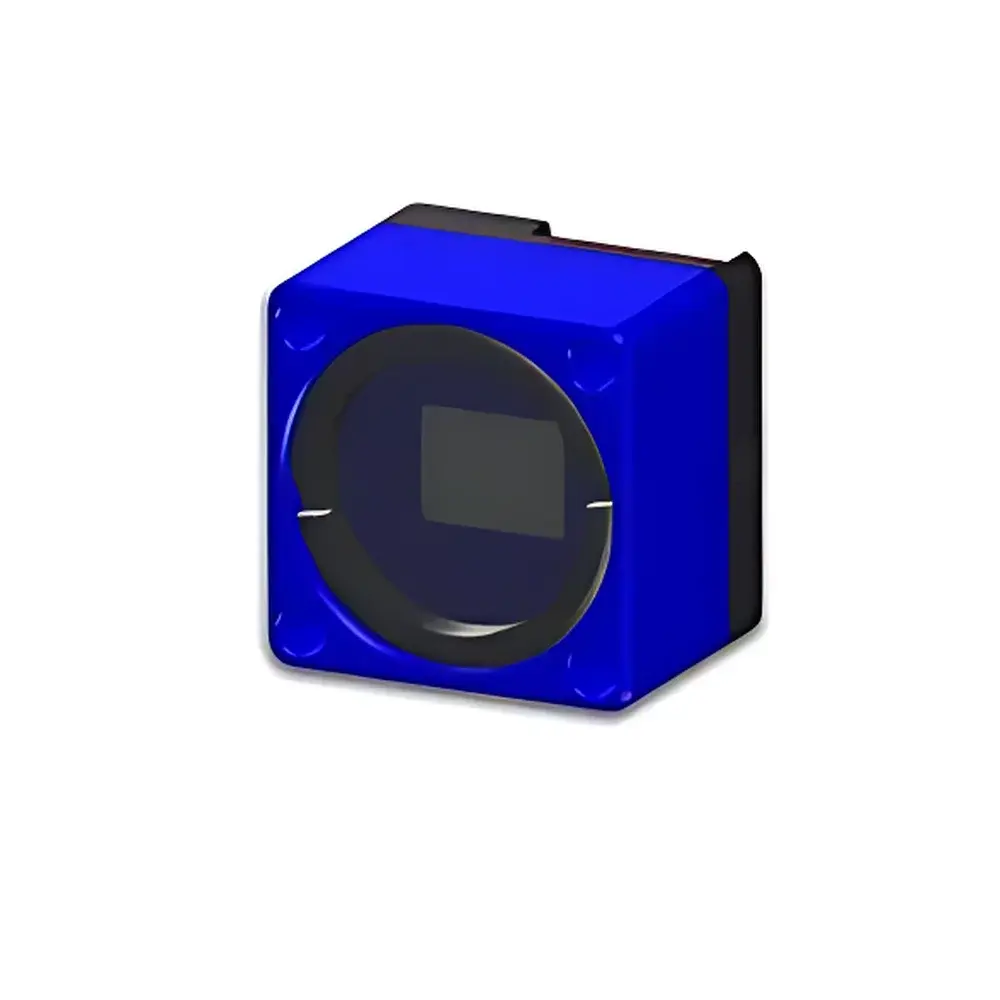
Cinogy CinCam Pico Series Ultra-Compact Beam Profiler
| Brand | auniontech (Distributor) |
|---|---|
| Origin | Germany |
| Manufacturer | Cinogy GmbH |
| Model | CinCam Pico CMOS-1201-Pico |
| Sensor Type | CMOS |
| Active Area | 5.7 mm × 4.3 mm |
| Pixel Count | 2560 × 1920 |
| Pixel Size | 2.2 µm × 2.2 µm |
| Spectral Range (Standard) | 400–1150 nm |
| Optional Ranges | 150–1150 nm (UV), 240–1150 nm (OM), 320–1150 nm (RT), 400–1320 nm + 1470–1605 nm (IR) |
| Dynamic Range | 70 dB |
| Mechanical Dimensions | 15 mm × 15 mm × 11.5 mm |
| Interface | USB 2.0 |
| Mount | C-mount / F-mount compatible |
| Software | RayCi-Lite / Standard / Pro |
| Data Export Formats | TIFF, PNG, PDF, Excel, AVI, MP4 |
| Compliance | CE, RoHS, ISO 9001 manufacturing environment |
Overview
The Cinogy CinCam Pico Series Ultra-Compact Beam Profiler is an engineered solution for high-fidelity spatial characterization of laser beams in space-constrained and integration-critical optical systems. Based on the proven CinCam algorithm architecture developed by Cinogy GmbH in Germany, this series leverages optimized quantum efficiency across ultraviolet (UV), visible (VIS), and near-infrared (NIR) spectral bands—enabling accurate beam parameter extraction—including beam width (D4σ, knife-edge), centroid position, ellipticity, M² estimation (when used with appropriate collimation and focusing optics), and intensity distribution uniformity. Its core measurement principle relies on direct imaging of the irradiance profile using a back-illuminated CMOS sensor with high fill factor and low read noise, operating under linear response conditions calibrated per ISO 11146-1:2005 and ISO 13694:2000 standards. The device is not a scanning slit or knife-edge profiler; rather, it delivers full 2D beam profiles in real time without mechanical movement—making it suitable for both continuous-wave (CW) and pulsed laser sources with repetition rates up to 60 Hz at full resolution.
Key Features
- Sub-centimeter form factor: 15 mm × 15 mm × 11.5 mm mechanical envelope—comparable to a standard coin—while retaining a 5.7 mm × 4.3 mm active sensor area, enabling integration into OEM laser heads, fiber coupling stages, and compact diagnostic modules.
- High spatial resolution: 2560 × 1920 pixels with 2.2 µm pitch provides Nyquist-limited sampling for beams down to ~10 µm waist diameter (subject to diffraction and optical relay design).
- Multi-spectral configurability: Interchangeable optical path options—including UV-enhanced coatings (150–1150 nm), broadband VIS-NIR (240–1150 nm), and extended NIR (up to 1605 nm)—allow adaptation to diverse laser platforms including excimer, Ti:sapphire, fiber, VCSEL, and quantum cascade sources.
- Plug-and-play operation: USB 2.0 interface with vendor-provided device drivers compliant with Windows 10/11 x64 and Linux kernel ≥5.4; no external power supply required.
- Modular optical interfacing: Standard C-mount and F-mount compatibility supports seamless integration of neutral density filters, UV-to-visible phosphor converters, IR upconversion crystals, beam expanders, and telecentric relays—all without custom machining.
Sample Compatibility & Compliance
The CinCam Pico is designed for non-contact, non-destructive profiling of free-space laser beams with diameters ranging from 20 µm to >5 mm (dependent on relay optics). It complies with key international metrology frameworks: beam parameter definitions follow ISO 11146-1:2005 (Lasers and laser-related equipment — Test methods for laser beam widths, divergence angles and beam propagation ratios); radiometric linearity is verified per ISO 13694:2000 (Lasers and laser-related equipment — Test methods for laser beam power and energy densities); and electrical safety conforms to IEC 61010-1:2010. For regulated environments—such as medical laser system validation or aerospace component qualification—the RayCi software optionally supports audit-trail logging, user access control, and electronic signature workflows aligned with FDA 21 CFR Part 11 requirements when deployed on validated computing infrastructure.
Software & Data Management
RayCi software suite—available in Lite, Standard, and Pro editions—provides real-time acquisition, live statistical analysis, and automated report generation. All versions support simultaneous display of horizontal/vertical cross-sections, 3D surface plots, and ISO-compliant beam parameter overlays. The Pro edition adds batch processing, scriptable macros (via Python API), multi-camera synchronization, and GLP/GMP-compliant data archiving with SHA-256 hash integrity verification. Export formats include lossless TIFF (16-bit), CSV (for downstream MATLAB/Python analysis), PDF (print-ready reports with embedded metadata), Excel (.xlsx), and compressed video (AVI/MP4) with timestamped frame headers. Raw sensor frames retain full bit depth and are stored without compression unless explicitly selected—ensuring traceability for calibration reprocessing.
Applications
- Real-time alignment monitoring in ultrafast amplifier chains and regenerative CPA systems
- In-line beam diagnostics within semiconductor lithography steppers and mask aligners
- VCSEL array uniformity mapping for LiDAR transmitter qualification
- Fiber-coupled laser source certification per IEC 60825-1:2014 Class 4 safety testing
- Micro-optic module integration where conventional beam profilers exceed volume budgets
- Educational laboratories requiring robust, portable instrumentation for laser physics curricula
FAQ
What is the maximum pulse energy the CinCam Pico can withstand without damage?
The sensor’s damage threshold depends on wavelength, pulse duration, and spot size. For nanosecond pulses at 1064 nm focused to ≤50 µm, the typical limit is 0.1 mJ/cm². Users must employ calibrated ND filters and verify fluence via independent calorimetry prior to exposure.
Does the device support triggering for synchronized pulsed laser measurements?
Yes—the USB 2.0 interface includes TTL-compatible trigger input (BNC) for external hardware synchronization; latency is <100 µs from trigger edge to frame capture initiation.
Is calibration traceable to NIST or PTB standards?
Cinogy provides factory calibration certificates referencing PTB-traceable reference sources for responsivity and pixel uniformity; end-user recalibration services are available through authorized partners.
Can RayCi software run on virtual machines or headless servers?
RayCi requires a GUI-enabled OS instance; however, batch-mode analysis and CLI-driven exports are supported on Windows Server 2019+ and Ubuntu 22.04 LTS with X11 forwarding enabled.
What is the recommended working distance for optimal resolution?
Optimal performance is achieved with telecentric 1:1 or 2:1 relay optics. Minimum working distance is governed by the chosen lens mount and focal length; typical configurations use 12 mm or 25 mm focal length C-mount lenses yielding 10–50 mm standoff distances.




