
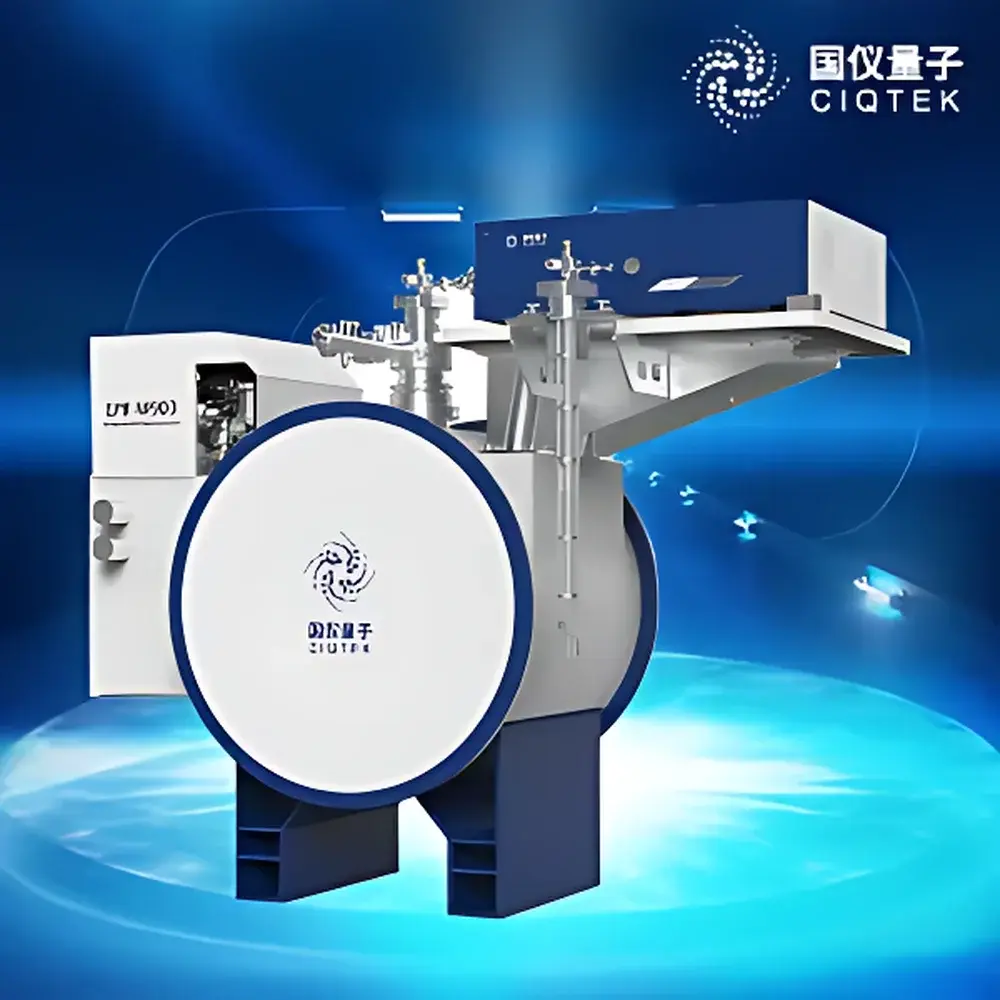
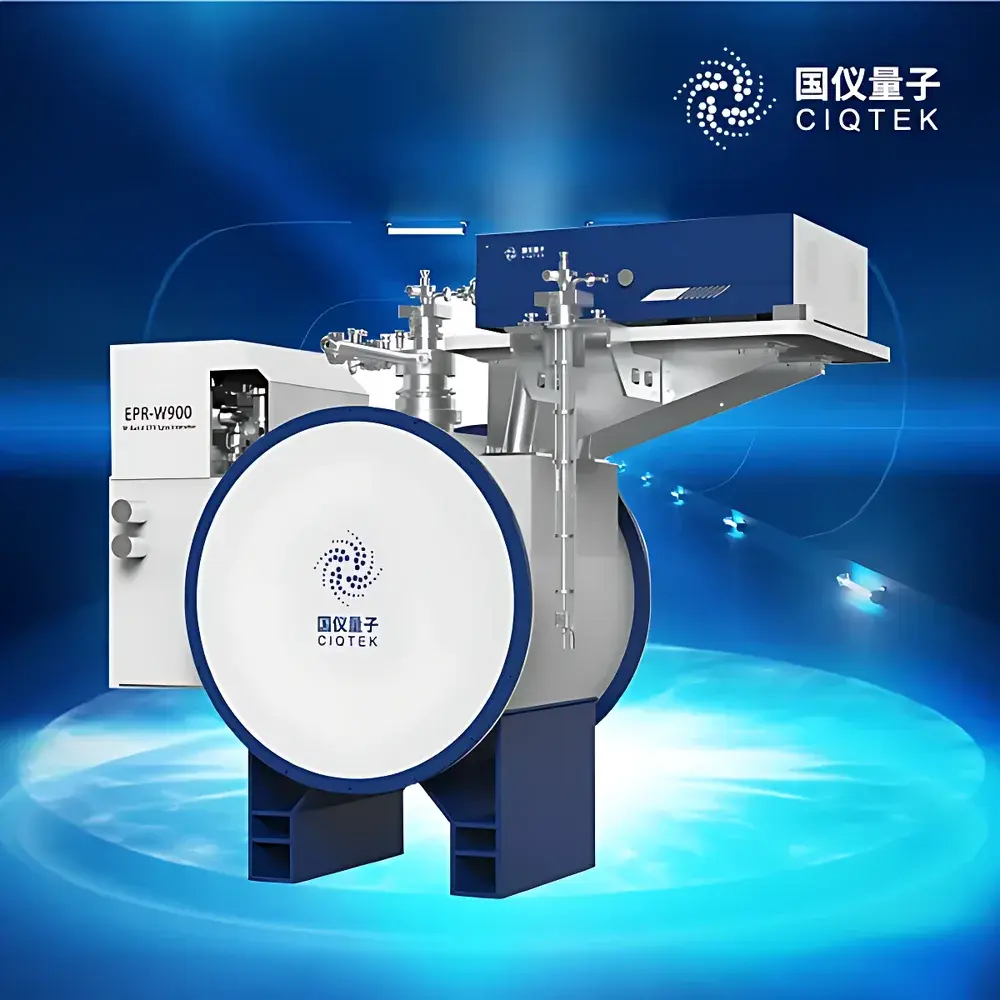
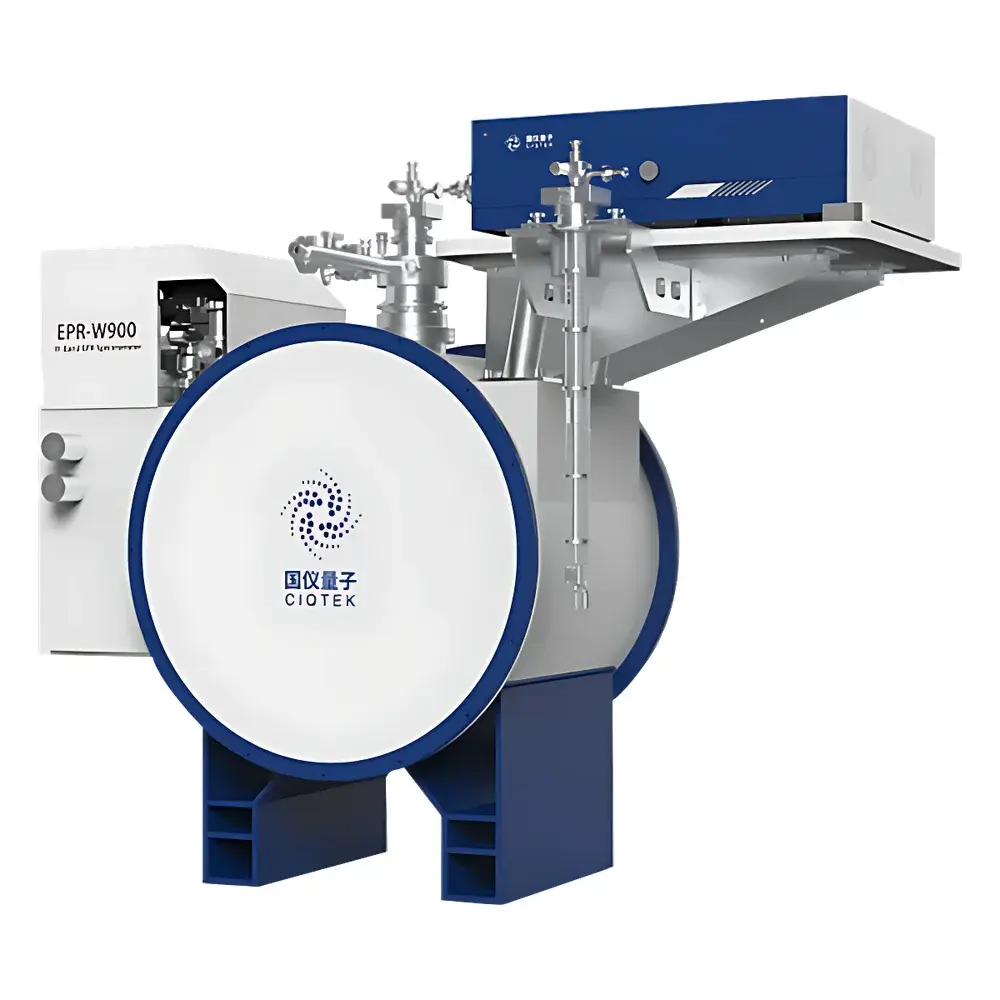
CIQTEK EPR-W900 W-Band Continuous-Wave and Pulsed Electron Paramagnetic Resonance Spectrometer
| Brand | CIQTEK |
|---|---|
| Origin | Anhui, China |
| Manufacturer Type | Original Equipment Manufacturer (OEM) |
| Product Category | Domestic |
| Model | EPR-W900 |
| Instrument Type | Continuous-Wave (CW) and Pulsed EPR |
| Frequency Band | W-Band (94 GHz) |
| Magnetic Field Range | Up to 6 T (with split-pair superconducting magnet) |
| Temperature Control Range | 0.4 K (vacuum cryostat with liquid helium) to 300 K |
| Pulse Channel Count | 12 (including ±X, ±Y, 4 control channels, 4 expandable channels) |
| Pulse Time Resolution | 0.05 ns |
| Maximum Pulses per Channel | 20,000 (with unlimited loop playback) |
| Solid-State RF Power Amplifier Output | 2 W |
| g-Factor Resolution | Enhanced due to high-field operation |
| Sample Volume Compatibility | Optimized for sub-microliter volumes via high filling factor resonator |
Overview
The CIQTEK EPR-W900 is a high-frequency, high-field electron paramagnetic resonance (EPR) spectrometer operating at the W-band (94 GHz), engineered for both continuous-wave (CW) and pulsed EPR experiments. Its core architecture integrates a split-pair superconducting magnet capable of generating magnetic fields up to 6 tesla, enabling superior g-anisotropy resolution and enhanced spectral dispersion—particularly critical for studying transition metal complexes, radical intermediates, and disordered spin systems. The instrument leverages the intrinsic advantages of high-frequency EPR: increased Zeeman splitting, reduced g-strain broadening, and improved orientation selectivity in solid-state samples. Designed for rigorous academic and industrial research environments, the EPR-W900 supports variable-temperature operation from 0.4 K to 300 K using either liquid helium (for sub-Kelvin studies under vacuum) or liquid nitrogen (for routine 80–300 K measurements), ensuring flexibility across quantum materials, catalysis, and biological spin-labeling applications.
Key Features
- W-band (94 GHz) operation with dual CW/pulsed capability—enabling comprehensive spin dynamics characterization including echo-detected EPR, HYSCORE, and DEER.
- Split-pair superconducting magnet system delivering up to 6 T field strength with field homogeneity < 10 ppm over 10 mm DSV, optimized for high-resolution anisotropic spectra.
- Dry-compatible cryogenic platform: integrated vacuum cryostat maintains stable sub-Kelvin temperatures without continuous liquid helium consumption during superconducting magnet operation.
- 12-channel arbitrary waveform generator (AWG) with 0.05 ns time resolution, supporting phase cycling, complex pulse trains, and real-time pulse shaping.
- 2 W solid-state microwave amplifier ensures robust excitation power for challenging low-γ nuclei or dilute spin systems.
- High-filling-factor resonator design maximizes sensitivity for microvolume samples (≤ 1 µL), critical for precious biological or synthetic specimens.
- Unified software interface shared with CIQTEK’s X-band pulsed platforms—ensuring consistent workflow, script-based automation, and seamless method transfer across frequency bands.
Sample Compatibility & Compliance
The EPR-W900 accommodates standard quartz EPR tubes (3 mm and 4 mm OD), custom capillaries, and flat cells for thin-film or surface-bound species. Its resonator geometry supports both frozen solution and single-crystal measurements, with g-tensor determination accuracy validated against NIST-traceable standards. The system complies with IEC 61000-6-3 (EMC emission limits) and meets mechanical safety requirements per ISO 13857. Data acquisition and processing workflows support audit-ready documentation aligned with GLP and GMP principles, including full metadata logging (field sweep parameters, temperature setpoints, pulse sequences, amplifier gain settings) and optional 21 CFR Part 11-compliant electronic signatures when integrated with enterprise LIMS.
Software & Data Management
The native control suite provides real-time spectrum visualization, automated field/frequency calibration, and batch processing for multi-scan averaging and baseline correction. Pulse sequence programming uses a Python-based scripting layer compatible with NumPy and SciPy, facilitating integration with open-source spin simulation tools (e.g., EasySpin, Spinach). Raw time-domain data (FIDs, echoes) and processed frequency-domain spectra are stored in HDF5 format with embedded provenance metadata—including instrument configuration, environmental logs, and user annotations. Export options include ASCII, MATLAB .mat, and JCAMP-DX v6.00 for cross-platform interoperability with third-party analysis packages.
Applications
- Quantum Materials: Characterization of spin coherence times (T₂), zero-field splitting parameters (D, E), and spin–phonon coupling in molecular qubits and defect centers (e.g., Cr²⁺ in oxides).
- Heterogeneous Catalysis: In situ/operando detection of paramagnetic active sites on supported metal oxides and single-atom catalysts under controlled gas atmospheres.
- Structural Biology: Distance measurements (< 2–8 nm) via PELDOR/DEER on spin-labeled membrane proteins and nucleic acid complexes, leveraging W-band’s improved orientation selection.
- Radiation Chemistry: Identification and kinetic tracking of short-lived radical intermediates in irradiated polymers and pharmaceutical formulations.
- Geochemistry & Environmental Science: Speciation of Mn²⁺, Fe³⁺, and organic radicals in soils, sediments, and atmospheric particulates with minimal sample preparation.
FAQ
Does the EPR-W900 support true simultaneous CW and pulsed operation?
No—CW and pulsed modes are hardware-configured and mutually exclusive within a single experiment; however, rapid reconfiguration (< 5 minutes) is enabled by modular RF routing and automatic calibration routines.
What cryogen consumption is required for 0.4 K operation?
Liquid helium is required for base temperature attainment; the dry cryocooler maintains magnet stability but does not replace helium for sub-Kelvin stage cooling.
Is the resonator tunable across the full W-band?
Yes—the TE₀₁₁ cylindrical cavity is manually tunable from 90–96 GHz with < ±10 MHz repeatability after thermal equilibration.
Can the system be upgraded to support ENDOR or ELDOR?
Yes—via optional RF/IF bridge modules and additional synthesizers; all expansion interfaces adhere to IEEE 1149.1 JTAG and PXIe timing standards.
How is magnetic field homogeneity verified and maintained?
Field maps are acquired using a Hall probe array during commissioning; shimming is performed via passive steel pieces and active compensation coils, with routine verification traceable to NMR-based field standards.






