
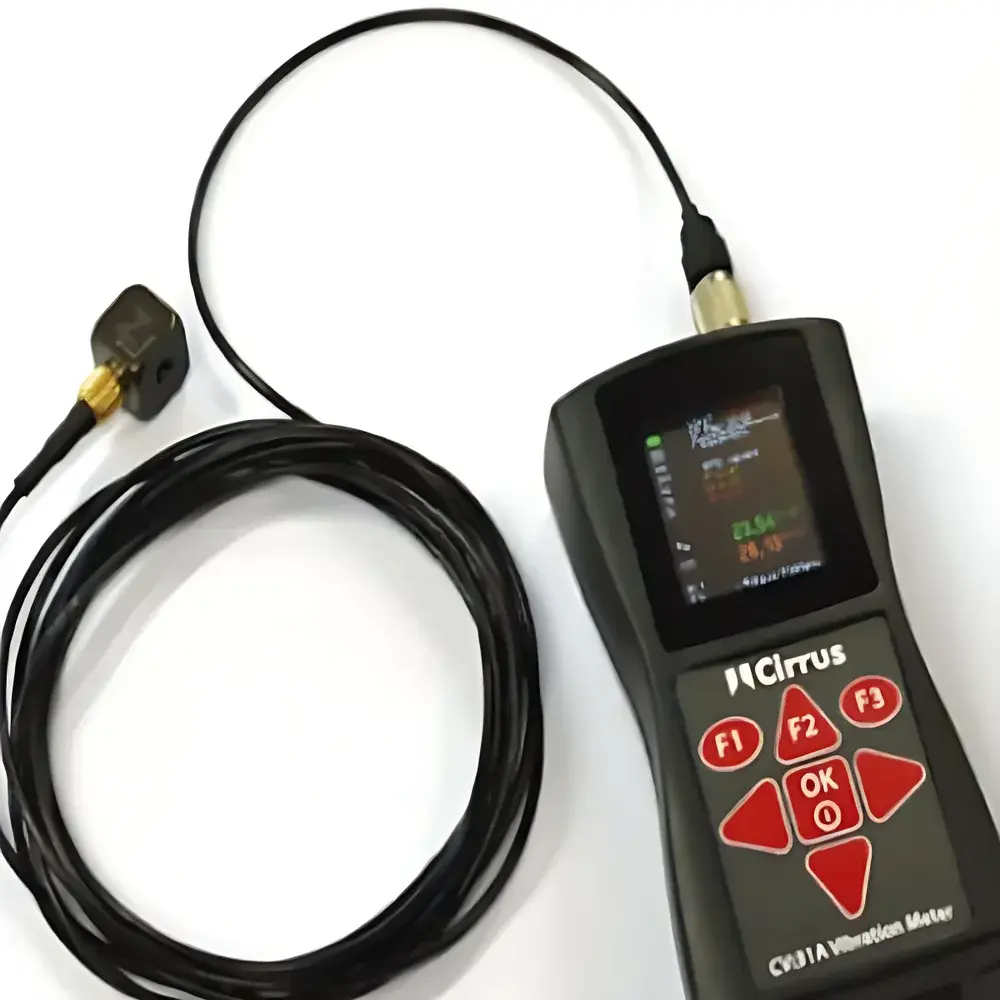
Cirrus Research CV:31A Human & Mechanical Vibration Analyzer
| Brand | Cirrus Research |
|---|---|
| Origin | United Kingdom |
| Model | CV:31A |
| Compliance | ISO 8041:2005, ISO 5349-1:2001, ISO 5349-2:2001, ISO 2631-1/2/4, ISO 6954:2000 |
| Channels | 4-channel IEPE input with TEDS (IEEE 1451.4 Template 25) |
| Acceleration Range | 0.1–2000 Hz (800 m/s² max), Velocity: 1–10000 mm/s, Displacement: 250–15000 µm |
| Weighting Filters | Wb, Wc, Wd, Wh, Wj, Wk, Wm + unweighted (H/A, G/K) |
| FFT Resolution | 125-line per axis (X/Y/Z) |
| selectable bandwidths | 3–240 Hz, 6–480 Hz, 12–960 Hz, 24–1920 Hz |
| Data Storage | 10,000 measurement records + 1,000 FFT spectra |
| Display | High-resolution color OLED |
| Power | 3 × AAA alkaline (LR03), 10–14 h runtime |
| Operating Temp | −20 °C to +60 °C |
| Dimensions | 125 × 65 × 27 mm |
| Mass | 140 g |
Overview
The Cirrus Research CV:31A is a portable, four-channel human and mechanical vibration analyzer engineered for precision assessment of occupational and environmental vibration exposure in compliance with international standards. It operates on the principle of piezoelectric IEPE (Integrated Electronics Piezo-Electric) acceleration sensing, with built-in analog anti-aliasing filtering and digital signal processing optimized for frequency-weighted evaluation per ISO 8041:2005. The instrument supports simultaneous acquisition across four independent channels—three dedicated to triaxial motion (X/Y/Z) and a fourth configurable for seat-pad or hand-arm interface transducers—enabling concurrent measurement of hand-transmitted vibration (HTV), whole-body vibration (WBV), and structural vibration in machinery, vehicles, and marine platforms. Its architecture integrates real-time RMS, peak, MTVV (Maximum Transient Vibration Value), eVDV (estimated Vibration Dose Value), and A(8) daily exposure calculation, making it suitable for workplace health and safety audits, regulatory reporting, and predictive maintenance applications.
Key Features
- Four-channel IEPE input with TEDS (IEEE 1451.4 Template 25) support for automatic sensor identification and calibration data import
- Comprehensive frequency weighting per ISO 5349 (Wh), ISO 2631 (Wb, Wc, Wd, Wj, Wk, Wm), and ISO 6954 (G/K)
- Real-time calculation of A(8), eVDV, RMS, RMSmax, vector sum, peak, and peakmax values
- Three-axis FFT analysis with selectable resolution bands (125-line per axis) and configurable frequency ranges (3–240 Hz up to 24–1920 Hz)
- High-contrast color OLED display with intuitive icon-driven navigation and real-time waveform preview
- Onboard storage for 10,000 time-history records and 1,000 FFT spectra, each timestamped and user-annotatable
- USB 2.0 interface (via ZL:311 cable) for secure data export and firmware updates
- Low-power design powered by three AAA alkaline cells, delivering 10–14 hours of continuous operation
- Rugged, handheld enclosure (125 × 65 × 27 mm, 140 g) rated for ambient operation from −20 °C to +60 °C at ≤95% RH non-condensing
Sample Compatibility & Compliance
The CV:31A is validated for use with a range of triaxial accelerometers certified to ISO 8041:2005, including the CK:31A hand-arm kit (with wrist-mount or tool-coupled transducers) and KD:103 seat-pad accelerometer for WBV assessment. It meets the metrological requirements of ISO 5349-1 and -2 for hand-transmitted vibration, ISO 2631-1/-2/-4 for whole-body vibration in seated, standing, and supine postures, and ISO 6954:2000 for shipboard and offshore structure monitoring. Its filter implementation and dynamic range (>75 dB linearity, ±6% amplitude tolerance) satisfy the traceability and repeatability criteria required under EU Directive 2002/44/EC and the UK Control of Vibration at Work Regulations 2005. All measurement modes adhere to GLP-aligned data integrity practices, supporting audit-ready documentation for occupational hygiene programs.
Software & Data Management
Data transfer is performed via USB 2.0 using Cirrus’ proprietary software suite (compatible with Windows 10/11), which provides full traceability, metadata tagging (operator ID, location, equipment ID), and batch reporting compliant with ISO/IEC 17025 documentation workflows. The software enables post-processing of stored FFT spectra, spectral overlay comparison, and automated generation of A(8) exposure summaries across multiple operators and tools. Audit trails include timestamped configuration changes, calibration history, and user login logs—facilitating alignment with FDA 21 CFR Part 11 electronic record requirements when deployed in regulated manufacturing or pharmaceutical facility environments. Export formats include CSV, PDF, and XML for integration into enterprise EHS (Environment, Health & Safety) platforms.
Applications
- Occupational health assessments of hand-arm vibration syndrome (HAVS) risk in construction, metalworking, and forestry sectors
- Whole-body vibration exposure evaluation in agricultural, mining, and heavy transport vehicle cabins
- Vibration qualification testing of shipboard accommodations, engine rooms, and bridge consoles per ISO 6954
- Mechanical condition monitoring of rotating equipment (pumps, compressors, gearboxes) using FFT-based spectral diagnostics
- Structural vibration analysis of building façades, bridges, and industrial floors subjected to dynamic loading
- Research-grade validation of anti-vibration mounts, suspension systems, and ergonomic seating solutions
- Regulatory compliance verification for CE marking, UKCA, and ISO 45001-certified safety management systems
FAQ
Does the CV:31A support automatic sensor calibration via TEDS?
Yes—it reads IEEE 1451.4 Template 25 TEDS data directly from compatible IEPE accelerometers, importing sensitivity, serial number, and calibration date.
Can the instrument calculate A(8) for multiple workers using different tools within one session?
Yes—the software allows grouping of measurements by operator, tool type, and duration to compute individualized A(8) exposure values per ISO 5349-2 Annex B.
Is the CV:31A suitable for outdoor marine vibration surveys?
Yes—its IP-rated enclosure, wide temperature range, and immunity to electromagnetic interference make it appropriate for deck-mounted or cabin-based shipboard measurements per ISO 6954.
What is the maximum sampling rate supported for FFT analysis?
The CV:31A uses oversampling and decimation to maintain Nyquist compliance; effective real-time sampling rates are determined by selected FFT bandwidth (e.g., 1920 Hz upper limit requires ≥3.84 kHz internal sampling).
Does the device meet requirements for UK HSE vibration reporting?
Yes—it implements all required metrics (Wh, Wk, eVDV, A(8)) and adheres to the methodology outlined in HSE’s INDG271 and L140 guidance documents.







