
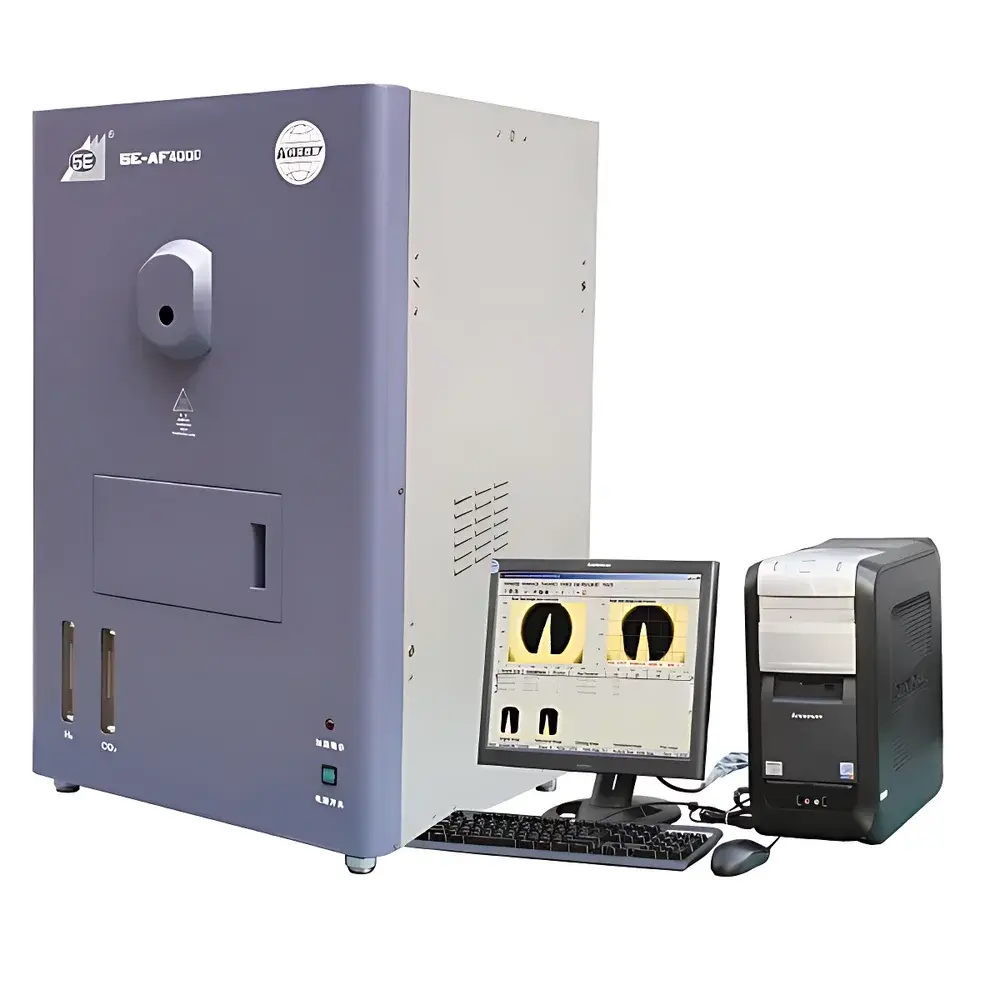
CKIC 5E-AF3000 Intelligent Ash Fusion Temperature Tester
| Brand | CKIC |
|---|---|
| Origin | Hunan, China |
| Model | 5E-AF3000 |
| Maximum Temperature | 1600 °C |
| Sample Capacity | 5 ash cones per run |
| Temperature Control Accuracy | ±1 °C/min (under stable voltage) |
| Imaging System | Integrated CCD camera with real-time high-temperature imaging |
| Image Resolution | ~0.12 mm/pixel (typical spatial resolution) |
| Atmosphere Options | Oxidizing, Weakly Reducing (carbon-sealing method), Weakly Reducing (gas-flow method with H₂/CO₂ or CO/CO₂ mixtures) |
| Compliance | Designed to meet GB/T 219 requirements |
Overview
The CKIC 5E-AF3000 Intelligent Ash Fusion Temperature Tester is a precision laboratory instrument engineered for the standardized determination of ash fusion temperatures (AFT) in coal, coke, and related solid fuels. It operates on the principle of high-temperature optical observation and digital image-based morphological analysis of ash cones, in strict accordance with the Chinese national standard GB/T 219—2008, which specifies methods for determining the characteristic temperatures of ash deformation (DT), softening (ST), hemispherical (HT), and flow (FT). Unlike legacy systems relying solely on manual visual assessment or rudimentary height-change detection (e.g., infrared scanning), the 5E-AF3000 employs real-time CCD imaging coupled with adaptive fuzzy contour recognition algorithms to objectively quantify geometric changes in ash cone morphology under controlled thermal and atmospheric conditions. This approach significantly reduces inter-operator variability and eliminates subjective interpretation bias inherent in traditional visual classification.
Key Features
- Integrated high-temperature furnace with internal transformer and mass flow controller—enabling full system compactness and eliminating external auxiliary units.
- Real-time CCD imaging system optimized for continuous monitoring at temperatures up to 1600 °C, with synchronized timestamped frame capture.
- Intelligent contour recognition engine that detects and tracks ash cone silhouette evolution pixel-by-pixel, supporting robust DT/ST/HT/FT classification based on ISO-compliant shape criteria.
- Multi-atmosphere capability: programmable gas delivery for oxidizing, carbon-sealed weakly reducing, and dynamically regulated weakly reducing atmospheres—including customizable H₂/CO₂ and CO/CO₂ binary mixtures.
- Precise programmable heating control with closed-loop power modulation; achieves ramp rate accuracy of ±1 °C/min across the full temperature range (20–1600 °C).
- Embedded multimedia compression architecture: each 5-sample test generates five individual AVI video files (one per cone), preserving raw thermal progression data for audit-ready playback and retrospective validation.
Sample Compatibility & Compliance
The 5E-AF3000 accommodates standard ash cones prepared from pulverized coal or coke ash according to GB/T 219 procedures. Each cone measures 7.5 mm × 7.5 mm × 20 mm and is mounted on a ceramic support plate. The instrument supports both fixed-point and dynamic ramp protocols, and its gas-handling subsystem meets safety and purity requirements for reducing atmosphere generation (e.g., <50 ppm O₂ residual in H₂/CO₂ mode). While GB/T 219 is the primary compliance reference, the system’s measurement traceability, data integrity, and configurable logging align with broader quality assurance frameworks—including GLP documentation practices and internal QA/QC workflows common in coal-fired power plant laboratories and ISO/IEC 17025-accredited testing facilities.
Software & Data Management
The proprietary Windows-based application provides intuitive test setup, real-time thermal-video overlay, automated AFT event flagging, and exportable reports in CSV and PDF formats. All image sequences are stored with embedded metadata—including furnace temperature, gas composition, time stamp, and operator ID—supporting full experimental traceability. Video files are indexed by sample ID and cone number, enabling rapid retrieval during regulatory review or technical dispute resolution. Audit trails record all parameter modifications, calibration events, and user logins—consistent with data integrity expectations under ICH-GCP and internal SOPs governing coal quality certification.
Applications
This instrument serves critical roles in coal procurement evaluation, boiler design optimization, slagging/fouling risk prediction, and combustion process modeling. Utilities use AFT data to select coals compatible with specific furnace geometries and operating temperatures; research institutions apply it to study mineral phase transformations (e.g., formation of anorthite, mullite, or iron silicates) during ash melting; and equipment manufacturers rely on reproducible AFT measurements to validate refractory material performance under simulated slag conditions. Its multi-atmosphere flexibility also supports academic investigations into redox-dependent ash behavior—particularly relevant for oxy-fuel and circulating fluidized bed (CFB) combustion technologies.
FAQ
Does the 5E-AF3000 comply with international standards such as ASTM D1857 or ISO 540?
While designed primarily to meet GB/T 219, its operational methodology—including cone geometry, heating rate control, and atmosphere specification—is technically aligned with ASTM D1857 and ISO 540:2020. Users may adapt test protocols to satisfy those standards via software-configurable ramp profiles and gas mixture definitions.
Can the system be integrated into a LIMS environment?
Yes—the software supports ODBC-compliant database export and includes a RESTful API interface for scheduled data push to enterprise LIMS platforms, including custom field mapping for sample ID, AFT values, and environmental metadata.
What maintenance is required for long-term stability of the CCD imaging system?
The furnace viewport uses fused quartz with anti-reflective coating; routine cleaning with spectroscopic-grade methanol every 50 tests is recommended. No recalibration of pixel-to-mm scaling is needed unless the lens assembly is physically disturbed.
Is remote monitoring supported during extended overnight tests?
Yes—via encrypted HTTPS web interface, operators can view live thermal video feeds, monitor temperature curves, and receive SMS/email alerts upon completion or fault conditions.




