
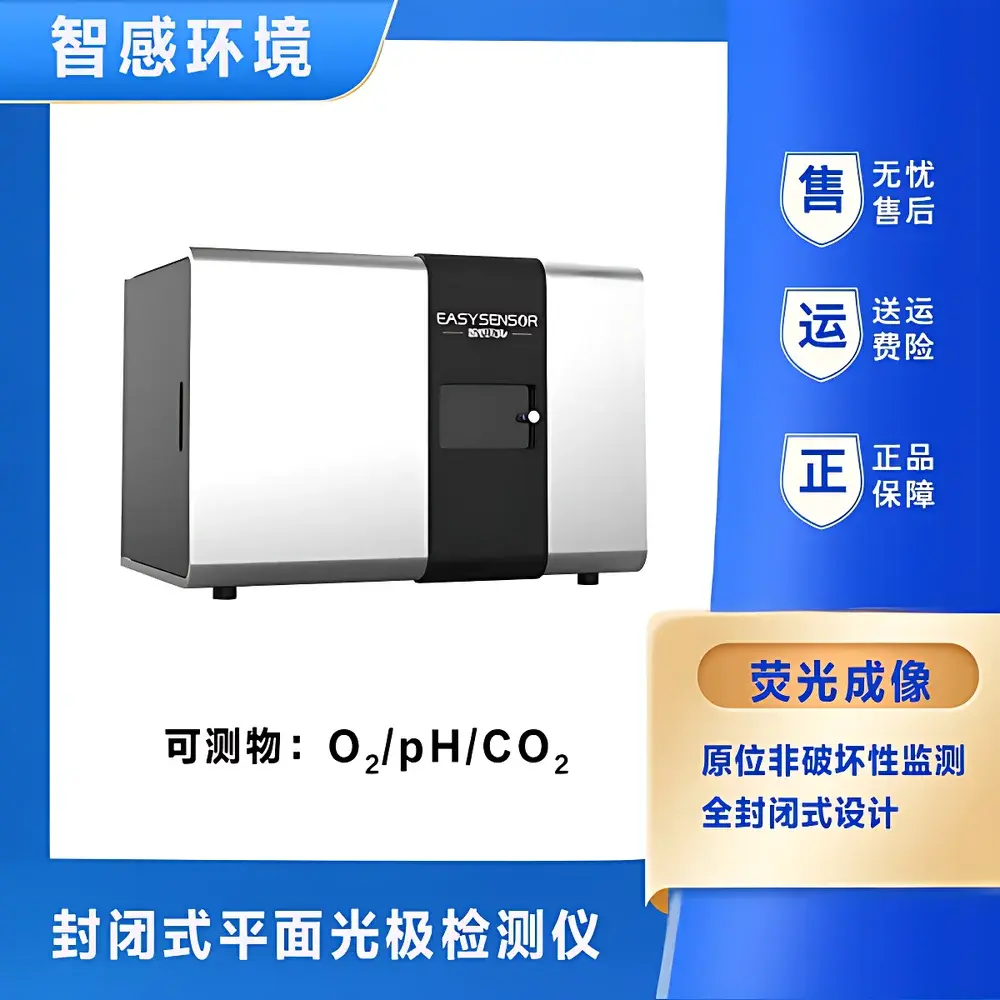
Closed-Loop Planar Optode Imaging System Easysensor PO2100 (01) for Simultaneous 2D O₂/pH/CO₂ Mapping in Aquatic, Sediment, and Soil Systems
| Brand | Easysensor |
|---|---|
| Origin | Jiangsu, China |
| Manufacturer Type | Authorized Distributor |
| Regional Classification | Domestic (China) |
| Model | PO2100 (01) |
| Imaging Resolution | 5472 × 3678 pixels |
| Camera Sensor | 20 MP Color CCD |
| Excitation/Emission Band | 400–500 nm |
| Application Domain | Geoscience, Environmental Biogeochemistry, Rhizosphere Research |
Overview
The Easysensor PO2100 (01) is a closed-loop planar optode imaging system engineered for quantitative, non-invasive, two-dimensional (2D) mapping of dissolved oxygen (O₂), pH, and carbon dioxide (CO₂) distributions across heterogeneous environmental interfaces. It operates on the principle of luminescence-based optical sensing: analyte-specific fluorescent dyes are immobilized within gas-permeable polymer matrices (optode films), where their photophysical properties—primarily luminescence intensity, lifetime, or spectral shift—respond reversibly to local analyte concentrations. Under controlled excitation in the 400–500 nm band, these dyes emit wavelength-resolved fluorescence signals captured by a high-fidelity 20-megapixel color CCD camera. The system reconstructs spatially resolved concentration fields via ratiometric or lifetime-based calibration, enabling time-series visualization of biogeochemical gradients at micron-to-centimeter scales in intact samples.
Key Features
- Hermetically sealed dark chamber design eliminates ambient light interference and ensures stable thermal and optical conditions during acquisition.
- Non-destructive, contactless planar optode imaging preserves sample integrity—ideal for long-term incubation experiments and fragile rhizosphere or sediment–water interface studies.
- Simultaneous multi-analyte capability: interchangeable optode films support independent or co-localized O₂, pH, and CO₂ mapping using spectrally distinct dye chemistries (e.g., Ru(II)-based for O₂, SNARF derivatives for pH, pH-sensitive CO₂ indicators).
- High spatial fidelity: 5472 × 3678 pixel resolution enables sub-millimeter gradient resolution over typical sample areas (up to 10 × 10 cm), with pixel-level quantification traceable to NIST-traceable calibration standards.
- Integrated optical path: precision-mounted lens assembly with user-selectable bandpass filters (optimized for 400–500 nm excitation and corresponding emission windows) ensures maximal signal-to-noise ratio and minimal crosstalk between channels.
- Modular hardware architecture supports field-deployable sample trays and standardized optode film mounting fixtures compatible with common Petri dishes, sediment cores, and rhizoboxes.
Sample Compatibility & Compliance
The PO2100 (01) is validated for use with aqueous phases, unconsolidated sediments, structured soils (including clay-rich and organic horizons), and plant root systems under controlled laboratory conditions. Its optode films conform to ISO 15085 (water quality — determination of dissolved oxygen — optical sensor method) and ASTM D8083 (standard guide for optical oxygen sensors in environmental monitoring). All calibration protocols adhere to GLP-compliant documentation practices, including full audit trails for reference standard preparation, film batch certification, and temperature-compensated calibration curves. While not FDA 21 CFR Part 11 certified out-of-the-box, the software architecture supports integration with validated LIMS environments through exportable CSV/GeoTIFF data formats and timestamped metadata embedding.
Software & Data Management
The proprietary Easysensor OptoView Suite provides a unified workflow—from real-time preview and focus optimization to multi-frame ratiometric analysis and 2D/3D concentration reconstruction. Core modules include: (1) Auto-calibration wizard with polynomial or Stern–Volmer fitting; (2) Spatial registration engine for aligning optode film geometry with sample coordinates; (3) Batch processing pipeline supporting time-lapse sequence analysis and drift correction; (4) Export functions compliant with FAIR data principles (Findable, Accessible, Interoperable, Reusable), generating georeferenced TIFF stacks, MATLAB .mat files, and ISO-standardized NetCDF outputs. All raw image data, calibration parameters, and processing logs are stored in immutable project archives with SHA-256 hash verification.
Applications
This system serves advanced research in biogeochemical cycling, including but not limited to: microscale O₂ dynamics in sulfate-reducing zones of marine sediments; pH buffering capacity mapping in calcareous soils; CO₂ flux heterogeneity at root–soil interfaces under drought stress; coupled nitrification–denitrification hotspots in constructed wetland mesocosms; and redox stratification profiling in stratified lake sediments. It is routinely deployed in university environmental science labs, national geological survey institutes, and EU Horizon-funded projects requiring spatially explicit validation of reactive transport models (e.g., CrunchFlow, PHREEQC-2D coupling).
FAQ
What types of optode films are supported?
The PO2100 (01) accommodates commercially available and custom-synthesized planar optodes—including Clark-type O₂ films, hydrogel-encapsulated pH sensors, and CO₂-permeable silicone membranes doped with pH indicators. Film compatibility is verified per batch via spectral response characterization reports.
Is temperature compensation integrated into the software?
Yes—real-time temperature input (via external Pt100 probe or internal thermistor) automatically adjusts Stern–Volmer constants and diffusion coefficients during image quantification, ensuring accuracy across 5–40 °C operational range.
Can the system be used for field-deployed measurements?
The PO2100 (01) is designed exclusively for controlled laboratory environments. For in situ deployment, Easysensor offers complementary portable optode readers (e.g., PO2-Field Pro) with ruggedized housings and battery operation.
How is calibration traceability maintained?
Each film batch includes a certificate of conformance referencing NIST SRM 2800 (for O₂) or DIN 19268 (for pH), with calibration curves generated against gravimetrically prepared standards and documented in accordance with ISO/IEC 17025 requirements.
What file formats are generated for downstream analysis?
Raw images (.tiff), calibrated concentration maps (.tiff, .nc), and metadata-rich project archives (.eopx) are exported. APIs enable direct import into Python (via xarray), R (raster), and MATLAB environments for custom modeling workflows.




