
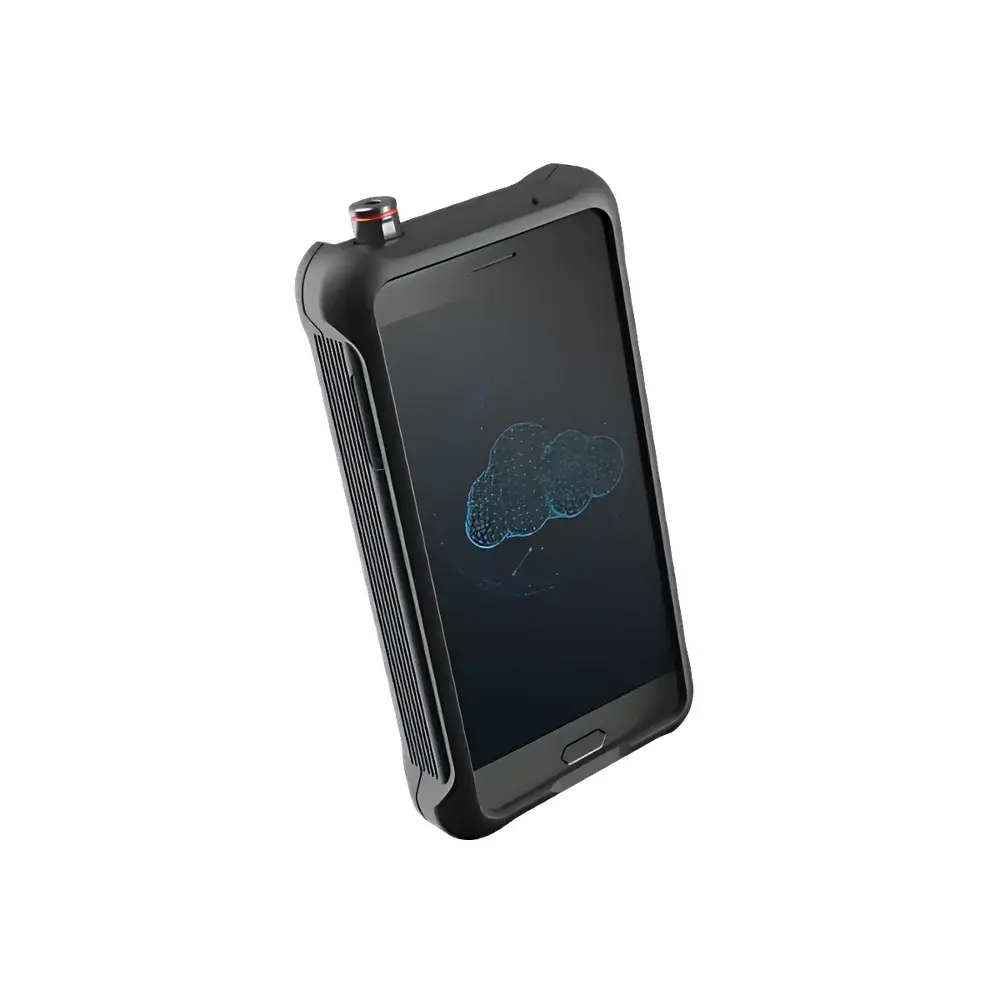
Cloudoptek M1 Portable Raman Spectrometer
| Brand | Cloudoptek |
|---|---|
| Origin | Beijing, China |
| Manufacturer Type | Original Equipment Manufacturer (OEM) |
| Product Category | Domestic |
| Instrument Type | Portable/Handheld Raman Spectrometer |
| Spectral Range | 150–3000 cm⁻¹ |
Overview
The Cloudoptek M1 Portable Raman Spectrometer is an AI-integrated, field-deployable analytical instrument engineered for rapid, non-destructive molecular identification and quantitative mixture analysis. Operating on the principle of inelastic light scattering—where monochromatic laser excitation induces vibrational mode shifts in chemical bonds—the M1 captures high-fidelity Raman spectra across a broad spectral window (150–3000 cm⁻¹), enabling unambiguous fingerprinting of organic and inorganic compounds. Unlike conventional handheld Raman systems relying solely on reference library matching, the M1 embeds deep learning models directly into its edge processing architecture, allowing real-time deconvolution of overlapping spectral features from complex mixtures. This hybrid approach—combining first-principles spectroscopic physics with data-driven pattern recognition—delivers sub-3-second acquisition-to-identification latency and >99% classification accuracy under variable ambient lighting, temperature, and surface conditions. Its compact form factor (≤280 g, 6 hours, making it suitable for forensic screening, customs inspection, pharmaceutical raw material verification, and hazardous substance monitoring in uncontrolled environments.
Key Features
- Edge-AI inference engine co-located with spectrometer sensor—no cloud dependency required for core identification tasks
- Real-time spectral deconvolution for multi-component mixtures; quantifies relative concentrations down to 3% v/v ethanol in aqueous matrices
- Modular optical design ensures batch-to-batch spectral reproducibility (±0.5 cm⁻¹ wavenumber stability over 8-hour thermal drift test)
- Cloud-synchronized knowledge base: dynamically updated compound library (>10,000 entries) with domain-specific expansion packs (e.g., fentanyl analogues, NPS, precursor chemicals, toxic industrial compounds)
- FDA 21 CFR Part 11–compliant audit trail generation for all spectral acquisitions, algorithmic decisions, and database versioning events
- IP54-rated enclosure with anti-reflective, scratch-resistant sapphire window; certified for operation at 0–45 °C and 10–90% RH non-condensing
Sample Compatibility & Compliance
The M1 accommodates solid powders, tablets, liquids, gels, and coated surfaces without sample preparation. It complies with IEC 61326-1 (EMC for laboratory equipment) and IEC 61010-1 (safety requirements for electrical equipment). Its laser source (785 nm, Class 3R, <500 mW output) meets EN 60825-1:2014 standards. For regulated workflows, the system supports GLP/GMP-aligned documentation protocols—including electronic signatures, user role-based access control, and immutable metadata logging per ASTM E2500-22. Library updates undergo ISO/IEC 17025–traceable validation prior to deployment.
Software & Data Management
Cloudoptek’s SpectraLink™ software suite provides local spectral acquisition, visualization, and reporting via Windows/Linux clients or web browser interface. All devices operate within a unified cloud fabric: spectral libraries, AI model weights, and calibration profiles are centrally managed and version-controlled. Each instrument maintains local cache synchronization with configurable update policies (manual, scheduled, or event-triggered). Raw spectra (.spc, .csv) and processed results (.json, .pdf) are exportable with embedded hash signatures for data integrity verification. Audit logs record operator ID, timestamp, instrument serial number, spectral acquisition parameters, and decision confidence scores—fully compatible with enterprise LIMS integration via RESTful API.
Applications
- Law enforcement: On-site detection of illicit drugs, cutting agents, and novel psychoactive substances (NPS) at border checkpoints or field operations
- Pharmaceutical QA/QC: Rapid verification of active pharmaceutical ingredients (APIs), excipients, and counterfeit tablets per USP and Ph. Eur. 2.2.48
- Hazardous material response: Identification of unknown solids/liquids in chemical spill scenarios without direct contact
- Academic research: Teaching tool for vibrational spectroscopy principles with live spectral simulation and annotation capabilities
- Industrial hygiene: Screening of workplace contaminants including polycyclic aromatic hydrocarbons (PAHs), heavy metal complexes, and pesticide residues
FAQ
Does the M1 require internet connectivity to perform identification?
No—core AI inference and spectral matching occur locally on-device. Internet access is only required for optional library updates, remote diagnostics, or LIMS synchronization.
How is spectral calibration maintained across units and over time?
Each unit performs automated daily wavelength calibration using an internal silicon reference peak (520.7 cm⁻¹); factory calibration certificates include NIST-traceable uncertainty values.
Can users import custom reference spectra or build private libraries?
Yes—SpectraLink™ supports user-defined spectral libraries with configurable matching thresholds, confidence scoring, and hierarchical classification rules.
Is the system validated for use in regulated pharmaceutical environments?
Yes—validation packages (IQ/OQ/PQ documentation, risk assessments, and 21 CFR Part 11 configuration reports) are available upon request and align with Annex 11 and EU GMP guidelines.
What safety certifications does the M1 hold for international deployment?
CE marking (EMC + LVD), RoHS compliance, and FCC Part 15 Subpart B certification are standard; additional country-specific approvals (e.g., KC, PSE, RCM) can be arranged through regional distributors.







