
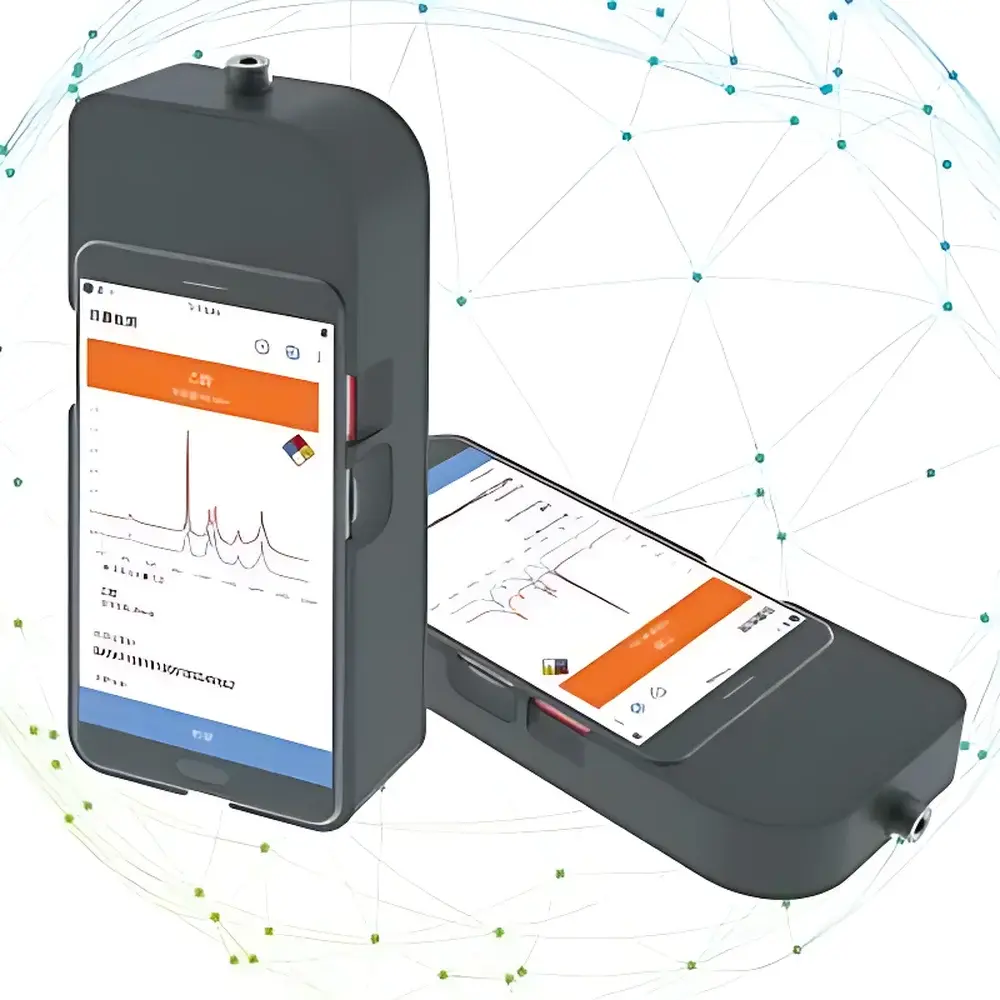
CloudOptek M1S Cloud-Intelligent Handheld Area-Scan Raman Spectrometer
| Brand | CloudOptek |
|---|---|
| Origin | Beijing, China |
| Model | M1S |
| Laser Wavelength | 785 nm |
| Scan Modes | Lissajous scanning, single-point scanning, customizable area-matrix scanning |
| Laser Power | 1–500 mW (adjustable) |
| Spectral Range | 200–1800 cm⁻¹ |
| Spectral Resolution | 8–11 cm⁻¹ |
| Detection Time | <3 s (e.g., ethanol) |
| Connectivity | 4G, Wi-Fi, Bluetooth, NFC |
| GNSS Support | A-GPS, GLONASS, BeiDou |
| Biometric Authentication | Fingerprint + Iris recognition |
| Security Architecture | MCS cloud-network-terminal isolation framework |
| Dimensions | ~205 × 85 × 27.5 mm |
| Weight | ~500 g |
| Database | Cloud-synchronized base library (auto-updated), expandable library (instant sync), user-defined library |
| Sample Types | Solids, liquids, powders, gels, opaque or dark-colored materials |
Overview
The CloudOptek M1S is a handheld, area-scan Raman spectrometer engineered for field-deployable, real-time identification and quantitative analysis of hazardous substances—including explosives, illicit drugs, precursor chemicals, pharmaceutical actives, and adulterants in food matrices. Unlike conventional point-probe Raman systems, the M1S employs a custom-designed wide-field optical architecture combined with high-efficiency Lissajous trajectory scanning, enabling spatially resolved spectral acquisition across user-defined regions of interest. This approach significantly improves signal-to-noise ratio (SNR) for low-reflectivity or highly absorbing samples—such as black powder, nitrocellulose-based explosives, or carbon-rich contaminants—without requiring sample preparation or surface enhancement. The instrument operates on a 785 nm excitation laser (Class 3B), optimized to minimize fluorescence interference while maintaining sufficient photon flux for rapid spectral acquisition. Its core measurement principle follows Stokes-shifted inelastic scattering, with spectral calibration traceable to NIST-traceable standards and validated against ASTM E2529-21 (Standard Guide for Raman Spectroscopy in Forensic Analysis).
Key Features
- Area-scan Raman acquisition via programmable Lissajous scanning—enabling robust spectral collection from heterogeneous, textured, or optically challenging surfaces.
- Adaptive laser power control (1–500 mW) with real-time SNR feedback loop; automatic dwell time adjustment ensures optimal signal fidelity without sample degradation.
- Dual-domain operational architecture: “Detection Domain” enforces instrument-level compliance with IEC 61010-1 (safety) and IEC 62471 (photobiological safety); “Personal Domain” supports secure biometric access (fingerprint + iris) and encrypted local data caching.
- MCS (Multi-layer Cloud–Network–Terminal Security) framework compliant with ISO/IEC 27001-aligned data governance protocols; all spectral metadata, GPS coordinates, operator IDs, and timestamps are cryptographically signed and audit-trail enabled.
- On-device AI inference engine trained on >12,000 reference spectra across 480+ hazardous compounds—including IED precursors (e.g., ammonium nitrate, PETN, RDX), controlled pharmaceuticals (e.g., fentanyl analogues), and food adulterants (e.g., melamine, Sudan dyes).
- Sub-3-second detection latency for common targets (e.g., ethanol, acetone, TNT), with mixture deconvolution accuracy ≤5% relative error in component mass fraction estimation under controlled ambient lighting.
Sample Compatibility & Compliance
The M1S accommodates unprepared solid, liquid, gel, and suspension samples—including dark-pigmented, granular, or irregularly shaped materials commonly encountered at checkpoints or crime scenes. It meets EN 13892-2 for portable spectroscopic analyzers used in security screening and complies with EU Directive 2014/30/EU (EMC) and 2014/53/EU (RED). All firmware and cloud platform operations adhere to FDA 21 CFR Part 11 requirements for electronic records and signatures where deployed in regulated environments (e.g., pharmaceutical supply chain verification). Instrument validation documentation supports GLP/GMP-aligned deployment per ISO/IEC 17025:2017 Annex A.2.
Software & Data Management
The M1S integrates with CloudOptek’s secure, multi-tenant AI management platform—deployable on private clouds or air-gapped government infrastructure. The platform provides version-controlled spectral libraries (base, extended, and user-curated), automated library synchronization, and federated learning capabilities that allow regional labs to collaboratively refine detection models without sharing raw spectral data. Audit logs record every spectrum acquisition, algorithmic inference, database update, and user authentication event—fully exportable in CSV/JSON formats for forensic reporting. API endpoints support integration with existing CBRNE command-and-control systems (e.g., JADOCS, ICAM) and customs risk engines.
Applications
- Explosives detection at border crossings, airports, and critical infrastructure checkpoints—capable of identifying concealed bulk explosives, binary mixtures, and homemade device components.
- Forensic drug analysis by law enforcement—rapid differentiation between structurally similar opioids, synthetic cannabinoids, and novel psychoactive substances (NPS).
- Pharmaceutical quality assurance—non-destructive verification of API identity and excipient composition in finished dosage forms or raw material shipments.
- Food safety surveillance—detection of undeclared additives, pesticide residues, or economically motivated adulteration (EMA) in dairy, spices, and dietary supplements.
- Chemical threat response—on-scene identification of unknown white powders, volatile organic compounds (VOCs) in sealed containers, and industrial chemical spills.
FAQ
Does the M1S require external calibration standards for routine operation?
No. The system performs self-calibration before each acquisition using an integrated silicon reference peak (520.7 cm⁻¹), traceable to NIST SRM 2241. Field recalibration is optional and supported via certified polymer standards.
Can the device operate offline in remote or low-connectivity environments?
Yes. Core spectral acquisition, preprocessing, and AI inference run entirely on-device. Cloud synchronization occurs only upon reconnection, preserving full functionality during network outages.
How is spectral data privacy enforced across multi-agency deployments?
Each tenant organization receives logically isolated storage, role-based access controls (RBAC), and configurable data residency policies—ensuring compliance with jurisdiction-specific data sovereignty laws (e.g., GDPR, CCPA, China PIPL).
What regulatory frameworks does the M1S support for audit readiness?
The platform maintains full ALCOA+ (Attributable, Legible, Contemporaneous, Original, Accurate, Complete, Consistent, Enduring, Available) compliance for spectral records, including immutable timestamping, electronic signatures, and 21 CFR Part 11–compliant audit trails.
Is the M1S suitable for detecting peroxide-based explosives (e.g., TATP, HMTD)?
Yes. The instrument’s high-sensitivity mode and optimized 785 nm excitation enable reliable detection of thermally labile peroxides down to sub-10 mg quantities on common substrates (e.g., paper, plastic, fabric), validated per NIJ Standard 0604.01.
Related Products





