
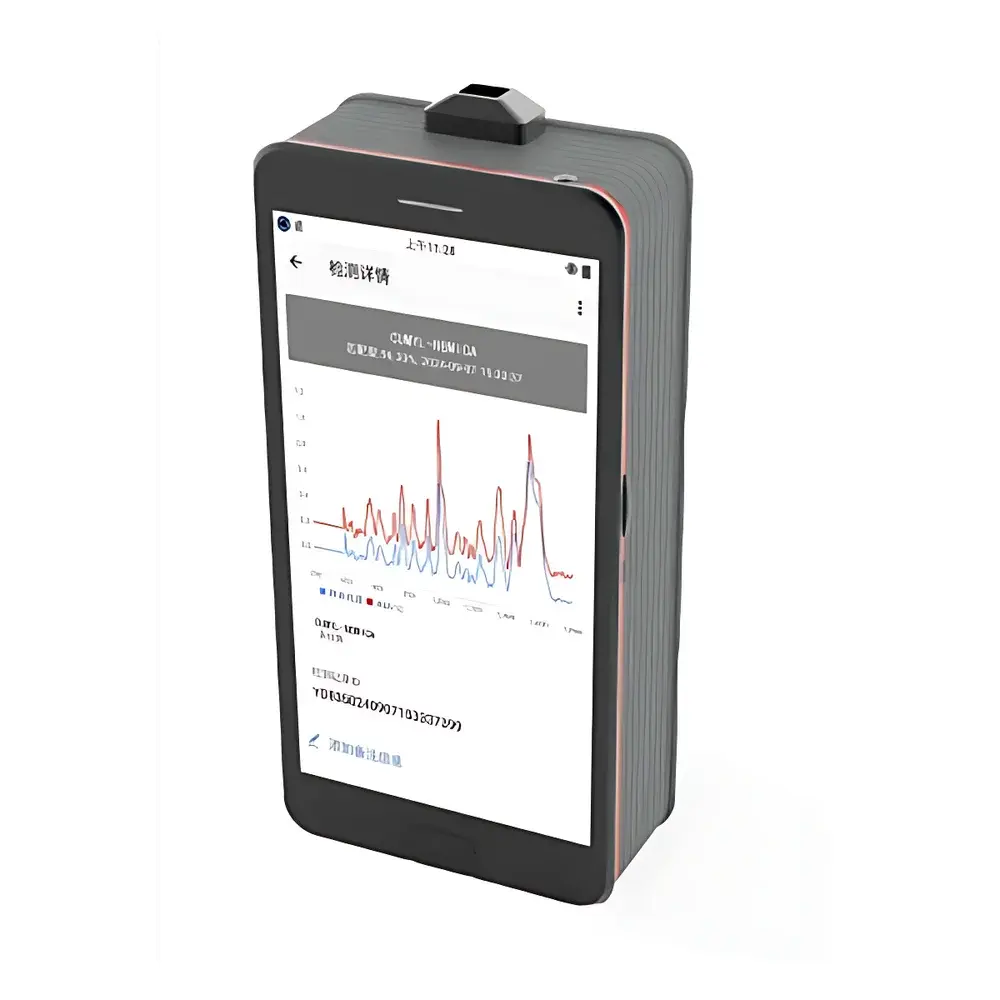
Cloudoptek M1S Handheld High-Frequency Area-Scanning Raman Spectrometer
| Brand | Cloudoptek |
|---|---|
| Origin | Beijing, China |
| Manufacturer Type | Original Equipment Manufacturer (OEM) |
| Instrument Type | Portable/Handheld Raman Spectrometer |
| Model | M1S |
| Configuration | Area-scanning Raman system with digital micromirror device (DMD)-based beam steering |
| Laser Operation Mode | Defocused raster scanning (non-focalized, programmable rectangular scan field) |
| Scan Field | Configurable up to 3 × 3 mm² |
| Detection Method | Point-by-point spectral acquisition with spatial registration for Raman imaging |
Overview
The Cloudoptek M1S Handheld High-Frequency Area-Scanning Raman Spectrometer is an engineered solution for field-deployable, safety-critical molecular identification. Unlike conventional handheld Raman instruments that rely on static, tightly focused 50-µm laser spots—posing thermal ignition risks for energetic materials and photodegradation for light-sensitive or dark-colored compounds—the M1S implements a DMD-based area-scanning architecture. This approach replaces point illumination with dynamically steered, defocused laser rastering across a user-defined rectangular region (up to 3 × 3 mm²). By distributing optical energy over a controllable surface area and eliminating localized power density spikes, the M1S inherently complies with IEC 60825-1 laser safety Class 3R operational constraints while preserving spectral fidelity. The system operates at standard excitation wavelengths (e.g., 785 nm), with thermoelectrically cooled CCD/CMOS detection enabling high signal-to-noise ratio (SNR) acquisition under ambient lighting conditions. Its core function is not only rapid qualitative identification but also spatially resolved chemical mapping—enabling Raman imaging without mechanical stage movement.
Key Features
- DMD-driven non-focalized raster scanning: Eliminates hot-spot formation, reducing risk of thermal decomposition, ignition, or charring in explosives, peroxides, dyes, and carbonaceous samples.
- Programmable scan field geometry: Adjustable rectangular scan area (e.g., 1 × 1 mm², 2 × 1.5 mm², up to 3 × 3 mm²) enables adaptive matching to sample dimensions and heterogeneity scale.
- Point-resolved spectral acquisition: Each pixel within the scan matrix acquires a full Raman spectrum, supporting post-hoc chemometric analysis including PCA, cluster analysis, and spectral unmixing.
- Battery-powered, IP54-rated enclosure: Designed for extended operation (>4 hrs) in industrial, customs, hazmat, and forensic field environments.
- Integrated GPS, IMU, and timestamping: Enables georeferenced spectral logging compliant with ASTM E2926-22 (Standard Guide for Raman Microspectroscopy) and ISO/IEC 17025 traceability requirements.
Sample Compatibility & Compliance
The M1S is validated for direct analysis of solids, powders, tablets, gels, and coated surfaces—including hazardous classes defined in UN TDG and GHS. Its defocused scanning mode meets the inherent safety prerequisites for screening Class 1 explosives (e.g., TNT, PETN), organic peroxides (e.g., MEKP), and highly absorptive substances (e.g., melanin-rich biological tissues, carbon black composites). The instrument conforms to electromagnetic compatibility standards EN 61326-1 and laser product safety IEC 60825-1 (3R). Data integrity protocols align with FDA 21 CFR Part 11 requirements via audit-trail-enabled software, supporting GLP/GMP-regulated workflows in pharmaceutical counterfeiting detection and raw material verification.
Software & Data Management
The proprietary Cloudoptek Raman Suite v3.2 provides real-time spectral preview, automated library matching (with NIST, SDBS, and custom reference libraries), and on-device generation of 2D Raman intensity maps. All spectra are stored with embedded metadata (GPS coordinates, operator ID, environmental temperature/humidity, laser power calibration log). Export formats include .SPA, .CSV, and HDF5—ensuring interoperability with MATLAB, Python (scikit-learn, HyperSpy), and commercial chemometrics platforms. Secure cloud synchronization (AES-256 encrypted) enables centralized spectral database management and federated model training across multi-site deployments.
Applications
- Hazardous material identification in first responder and military CBRN scenarios
- Pharmaceutical raw material verification and counterfeit drug detection at ports of entry
- Forensic trace evidence analysis (e.g., explosive residue distribution on clothing or surfaces)
- Quality control of battery cathode materials and pigment blends in manufacturing
- Environmental monitoring of surface-adsorbed pollutants (e.g., PAHs on soil particles)
FAQ
Does the M1S require sample preparation or contact with the target?
No. It performs non-contact, non-destructive analysis at standoff distances of 5–15 mm. No pressing, scraping, or solvent extraction is needed.
How does area scanning improve detection sensitivity for mixtures?
By acquiring spectra from multiple spatial locations within a heterogeneous sample, the M1S increases statistical confidence in component identification and reduces false negatives caused by sampling bias—a known limitation of single-spot instruments.
Is spectral resolution affected by the scanning mode?
No. Optical resolution remains fixed by the spectrometer’s grating and detector pixel binning; spatial resolution is decoupled from spectral resolution via DMD pixel-level control.
Can the M1S be calibrated for quantitative analysis?
Yes. Integrated NIST-traceable polystyrene and silicon reference standards support wavelength and intensity calibration. Quantitative models require user-developed PLS or ML regression against laboratory-validated reference sets.
What regulatory documentation is provided for audit readiness?
Each unit ships with a Factory Calibration Certificate, IQ/OQ documentation templates, and a 21 CFR Part 11 compliance statement covering electronic signatures, audit trails, and data immutability controls.






