
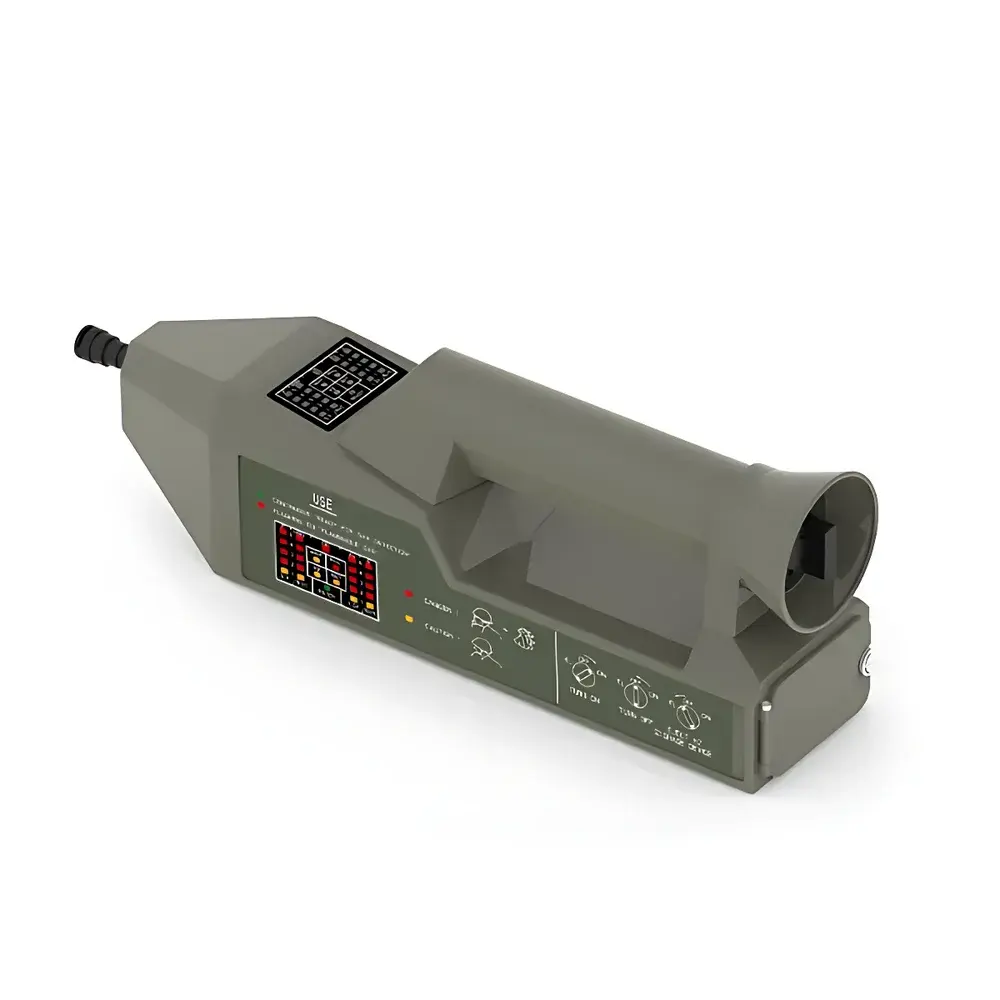
CloudOptek MFP-600 Hydrogen Flame Photometer
| Brand | CloudOptek |
|---|---|
| Origin | Beijing, China |
| Manufacturer Type | Original Equipment Manufacturer (OEM) |
| Product Origin | Domestic (PRC) |
| Model | MFP-600 |
| Detection Range | Organophosphorus agents (G- and V-series nerve agents), sulfur-containing agents (HD, HL vesicants), nitrogen/hydrogen/oxygen-containing agents (HN, AC), arsenical agents (L, SA), and combustible gases (CH) |
| Detection Limits | ≤0.05 µg/L for Sarin (GB), ≤10.00 µg/L for Hydrocyanic Acid (AC), ≤5 µg/L for Lewisite (L), ≤1 µg/L for Sulfur Mustard (HD) |
| Response Time | 2–60 seconds (agent-dependent) |
Overview
The CloudOptek MFP-600 Hydrogen Flame Photometer is a field-deployable, elemental-selective chemical threat detection system engineered for rapid identification and semi-quantitative analysis of chemical warfare agents (CWAs) and toxic industrial chemicals (TICs). It operates on the principle of hydrogen-fueled flame emission spectroscopy: analytes introduced into a stabilized, high-temperature H2/air flame undergo thermal atomization and excitation, inducing element-specific line emissions in the ultraviolet–visible (UV–Vis) spectral region. Phosphorus (P), sulfur (S), arsenic (As), and nitrogen (N) emit characteristic atomic spectra at discrete wavelengths—e.g., P at 526 nm, S at 364 nm, As at 234 nm—enabling unambiguous elemental fingerprinting. Unlike absorption-based or immunoassay methods, flame photometry provides direct elemental evidence independent of molecular structure, granting intrinsic capability to detect novel, structurally undefined, or impure threat compounds—including Novichok analogues and precursor chemicals—without reliance on preloaded spectral libraries.
Key Features
- Single-button operational architecture: Fully automated ignition, flame stabilization, sample introduction, spectral acquisition, and result reporting—no manual calibration, filter selection, or real-time parameter adjustment required.
- Multi-phase sampling compatibility: Integrated aspiration and nebulization modules support gaseous, liquid, aerosol, mist, and particulate (dust) matrices without hardware modification.
- Elemental selectivity with broad threat coverage: Simultaneous monitoring of P, S, As, N, and C signatures enables classification across four major CWA classes (nerve, vesicant, blood, choking) and combustible gases (CH).
- Ruggedized field design: IP65-rated enclosure, shock-absorbing chassis, and wide ambient operating range (−10 °C to +50 °C) ensure reliability in tactical and emergency response environments.
- Real-time response kinetics: Agent-specific detection latency between 2 s (for volatile phosphonates) and 60 s (for low-volatility arsenicals), optimized via dynamic flame temperature control and pulse-modulated photodetection.
Sample Compatibility & Compliance
The MFP-600 accepts direct vapor draw, liquid micro-sampling (1–100 µL), and aerosolized collection media (e.g., glass fiber filters, electrostatic precipitators). It complies with NATO AEP-88 Annex B requirements for CWA detector performance validation and meets ISO/IEC 17025:2017 criteria for method validation in accredited laboratories. While not certified to MIL-STD-810H or STANAG 4383 per se, its detection limits align with OPCW Verification Annex thresholds for Schedule 1 agents. All firmware and data handling protocols adhere to GLP-compliant audit trail requirements, including time-stamped event logging and immutable result archiving.
Software & Data Management
Instrument control and spectral interpretation are managed via embedded Linux-based firmware with a touchscreen GUI. Raw emission spectra (300–800 nm, 0.5 nm resolution) and integrated peak intensities are stored in vendor-neutral CSV and XML formats. The software supports optional integration with centralized CBRN command systems via TCP/IP or RS-232; all communications are encrypted using TLS 1.2. Data export includes full metadata (ambient temperature, humidity, flame stability index, integration time), satisfying traceability needs under ISO/IEC 17025 and FDA 21 CFR Part 11 (when deployed in regulated QC/QA environments).
Applications
- Tactical CBRN reconnaissance: Forward-deployed detection at checkpoints, border crossings, and incident perimeters.
- Forensic field screening: On-site verification of suspected contamination in soil, water, or surface swabs prior to lab submission.
- Industrial hygiene monitoring: Continuous surveillance of phosphine, arsine, or hydrogen sulfide in semiconductor fabrication or chemical manufacturing facilities.
- Emergency response triage: Rapid differentiation between nerve agent exposure (P signature dominant) and cyanide poisoning (N/C signature) during mass casualty events.
- Training and simulation: Reusable, non-hazardous calibration standards enable safe operator proficiency drills without live agent use.
FAQ
Does the MFP-600 require periodic recalibration with certified reference standards?
No—its optical path and flame dynamics are factory-characterized and thermally stabilized; only annual verification against NIST-traceable elemental solutions is recommended per ISO/IEC 17025.
Can it distinguish between sarin (GB) and cyclosarin (GF)?
It identifies both as organophosphorus agents via the 526 nm P emission; structural differentiation requires complementary GC-MS or IMS analysis.
Is the instrument suitable for continuous unattended operation?
Yes—it supports 24/7 duty cycling with auto-shutdown after 30 min of inactivity and remote status polling via Modbus RTU.
What safety certifications does it hold for hydrogen fuel handling?
It incorporates dual-stage H2 pressure regulation, catalytic flame arrestors, and automatic shut-off upon flame-out detection, meeting EN 13821:2002 for portable flammable gas detection equipment.
How is spectral interference from common atmospheric constituents mitigated?
Background subtraction uses real-time reference channel monitoring at adjacent non-emissive wavelengths, combined with adaptive baseline correction algorithms trained on >10,000 ambient air spectra.
Related Products




