
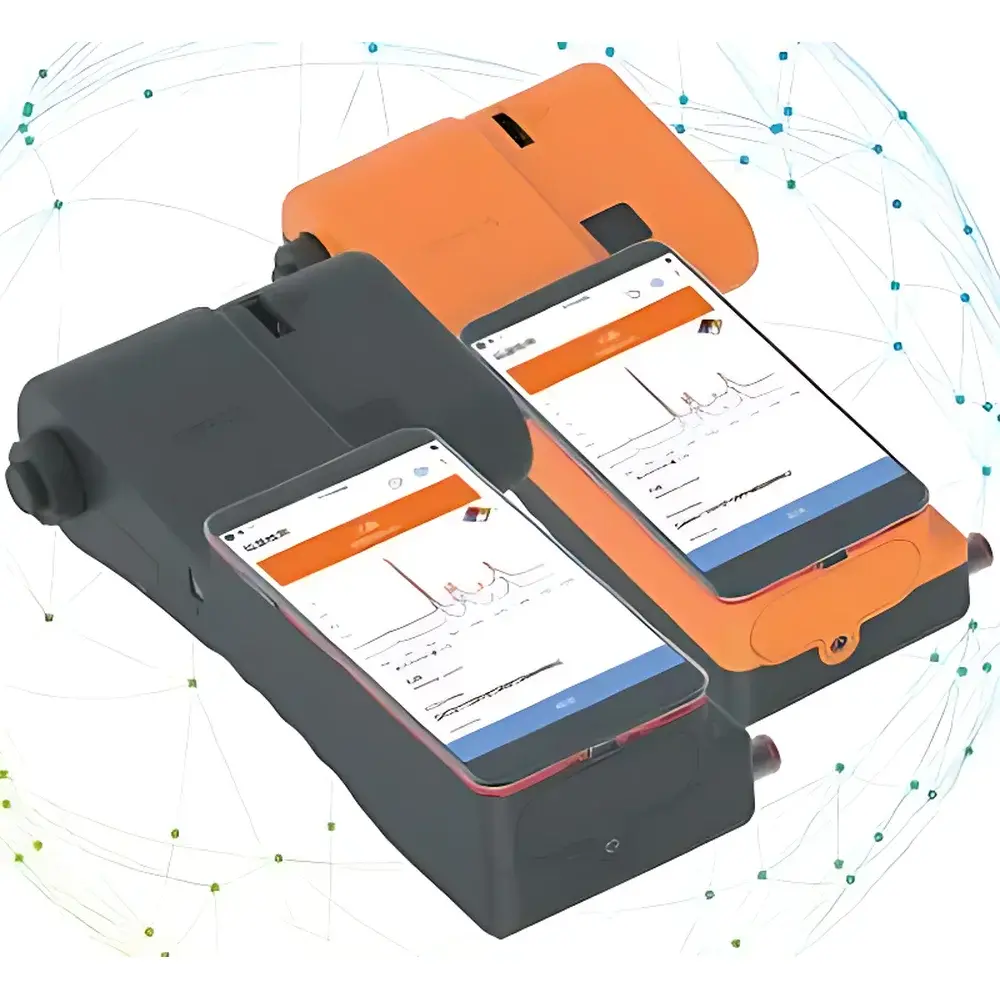
CloudOptek T1 Cloud-Intelligent Handheld Nuclear, Explosives & Hazardous Chemical Detection System
| Brand | CloudOptek |
|---|---|
| Origin | Beijing, China |
| Manufacturer Type | Authorized Distributor |
| Country of Origin | China |
| Model | T1 |
| Pricing | Available Upon Request |
| Explosives Sensitivity | 1 ng |
| Fluorescence Quenching Detection | Yes |
| Raman Excitation Wavelength | 785 nm |
| Raman Spectral Range | 200–1800 cm⁻¹ |
| Raman Resolution | 8–11 cm⁻¹ |
| Radiation Detection Types | α, β, γ |
| Radiation Energy Range | 25 keV – 3 MeV |
| Energy Accuracy | ±10% |
| Dose Rate Alarm Threshold | 1 µSv/h – 1000 µSv/h |
| Detector Type | Scintillation Detector |
| Dimensions | ~270 × 118 × 62 mm |
| Weight | ~1.5 kg |
| Display | 5.7″ FHD (2560 × 1440) |
| Connectivity | 4G, Wi-Fi, Bluetooth, NFC, A-GPS, GLONASS, BeiDou |
| ID Card Reading | Supports Chinese Second-Generation Resident Identity Cards |
Overview
The CloudOptek T1 is a tri-modal, handheld field detection system engineered for integrated nuclear radiation monitoring, trace explosives identification, and hazardous chemical screening in real time. It operates on a unified platform combining three complementary analytical techniques: scintillation-based ionizing radiation detection (for α, β, and γ emissions), fluorescence quenching assay (for vapor-phase nitroaromatic and peroxide-based explosives), and confocal 785 nm laser Raman spectroscopy (for molecular fingerprinting and compound identification). Unlike single-technology point detectors, the T1 implements sequential, context-aware interrogation: initial rapid radiological survey triggers automated fluorescence screening; positive signals initiate targeted Raman acquisition with adaptive integration time and signal-to-noise optimization. Its cloud-native architecture enables remote firmware updates, centralized spectral library management, and distributed threat pattern analysis across multi-agency deployments—fully compliant with operational requirements for border security, critical infrastructure protection, and emergency response teams.
Key Features
- Tri-Modal Detection Architecture: Simultaneous yet functionally segregated operation of radiation dosimetry, fluorescence quenching biosensor arrays, and high-resolution Raman spectroscopy ensures orthogonal verification and minimizes false positives.
- Cloud-Enabled AI Analytics Platform: Proprietary deep learning models trained on >12,000 reference spectra (including IED precursors, military explosives, radioactive isotopes, and industrial toxics) support real-time classification, mixture deconvolution, and quantitative proportion estimation with <5% relative error under controlled validation conditions.
- Adaptive Signal Processing: On-device algorithms dynamically adjust laser power, integration time, and spectral binning based on ambient light, sample reflectivity, and measured SNR—enabling reliable detection even on non-ideal surfaces (e.g., fabrics, plastics, porous materials).
- Dual-Domain Security Architecture: Hardware-enforced separation between the user-facing “Personal Domain” (Android-based UI, biometric login, encrypted local storage) and the certified “Detection Domain” (FIPS 140-2 validated cryptographic modules, air-gapped sensor firmware, write-once audit logs).
- Multi-Constellation GNSS Integration: Concurrent A-GPS, GLONASS, and BeiDou positioning provides sub-10 m geotagging accuracy for forensic traceability and incident mapping—critical for chain-of-custody documentation in regulated environments.
Sample Compatibility & Compliance
The T1 detects solid particulates, surface residues, and volatile vapors without direct contact or sample preparation. It accommodates diverse substrates including clothing, luggage linings, vehicle interiors, and cargo packaging. All detection modalities comply with IEC 62495:2010 (handheld radiation monitors), ASTM E2581-21 (Raman identification of explosives), and EN 13893:2021 (fluorescence-based trace detection). Firmware and cloud platform components are designed to support GLP/GMP-aligned workflows, including full electronic audit trails, role-based access control, and 21 CFR Part 11–compatible electronic signatures for regulatory submissions.
Software & Data Management
The T1 runs CloudOptek’s SecureField OS—a hardened Android 12-based operating system with SELinux enforcement and verified boot. Sensor data is encrypted at rest (AES-256) and in transit (TLS 1.3). The companion CloudOptek Sentinel Platform offers multi-tenant SaaS deployment or private-cloud installation, supporting spectral library versioning, cross-device correlation analytics, and automated report generation in PDF/CSV formats. All raw spectra, metadata, and operator logs are retained with immutable timestamps and SHA-256 hash integrity verification.
Applications
- Aviation and maritime port security screening for concealed explosives and illicit radioactive sources
- First responder situational awareness during HAZMAT incidents and post-blast investigations
- Regulatory compliance checks for chemical inventory control in pharmaceutical and semiconductor manufacturing
- Border patrol and customs interdiction targeting improvised explosive device (IED) components and dual-use precursors
- Emergency preparedness drills requiring portable, interoperable CBRN detection capability
FAQ
Does the T1 require external calibration standards for routine operation?
No—factory-calibrated detectors and self-referencing Raman internal standards eliminate daily recalibration. Annual traceable verification against NIST-traceable sources is recommended.
Can the system identify unknown mixtures without prior library entries?
Yes—its unsupervised clustering engine performs spectral decomposition and proposes candidate component combinations, flagged for expert review within the Sentinel Platform.
Is the device certified for use in intrinsically safe (IS) environments?
The T1 meets ATEX Category 3G (Zone 2) and IECEx Zone 2 requirements for non-incendive operation; optional IS-rated enclosures are available for Class I, Division 2 deployments.
How is data sovereignty maintained in multi-agency deployments?
Each tenant operates on logically isolated virtual instances; physical data residency options include EU-based AWS GovCloud, US DoD Impact Level 4-certified infrastructure, or on-premise Kubernetes clusters.
What maintenance intervals are specified for detector longevity?
Scintillation detector lifetime exceeds 5 years at typical field usage (≤4 hrs/day); Raman laser diode MTBF is rated at >10,000 hours; preventive maintenance is scheduled annually or after 500 operational cycles.





