
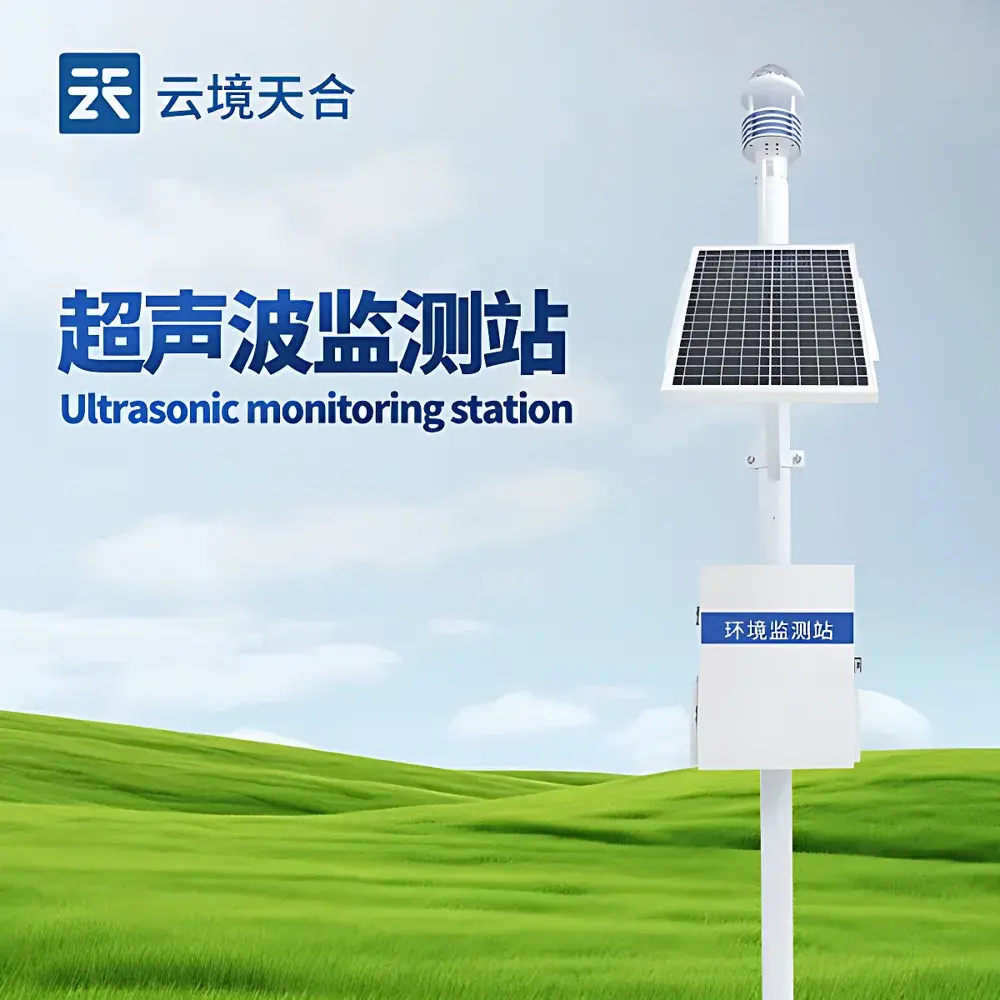
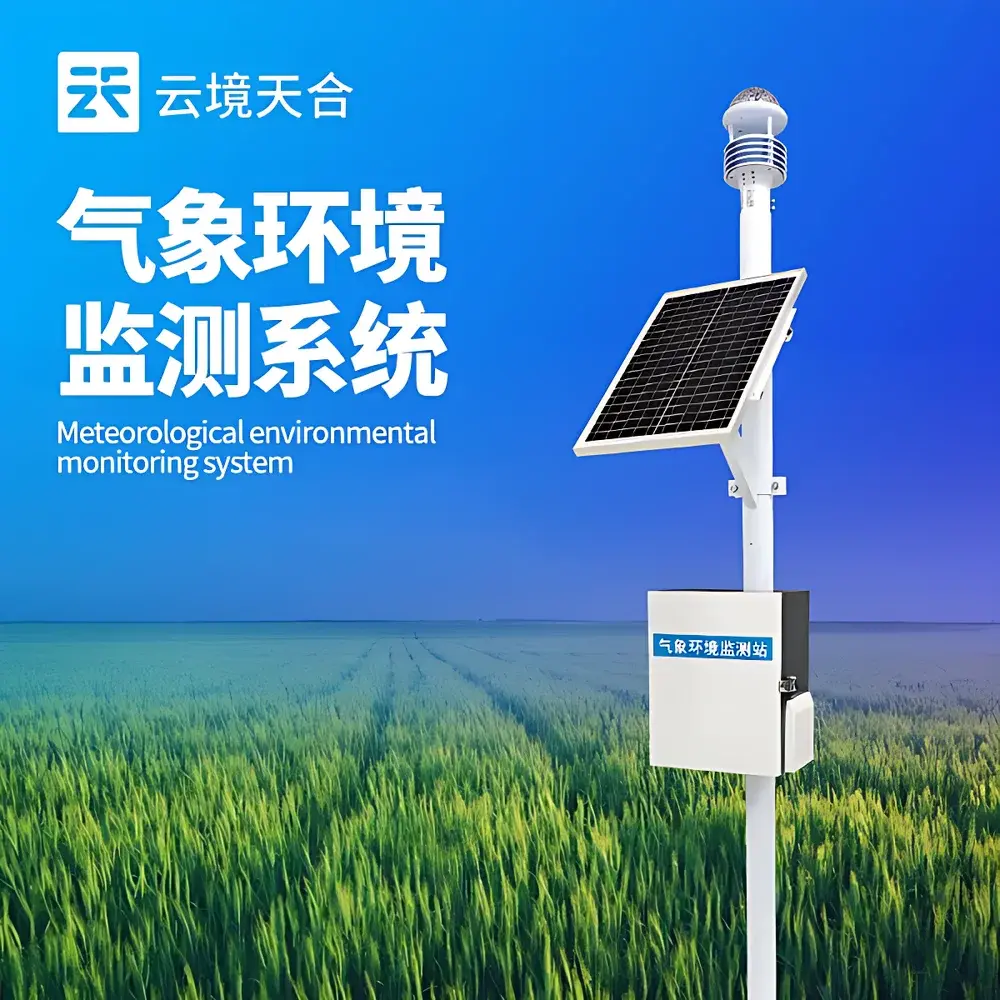
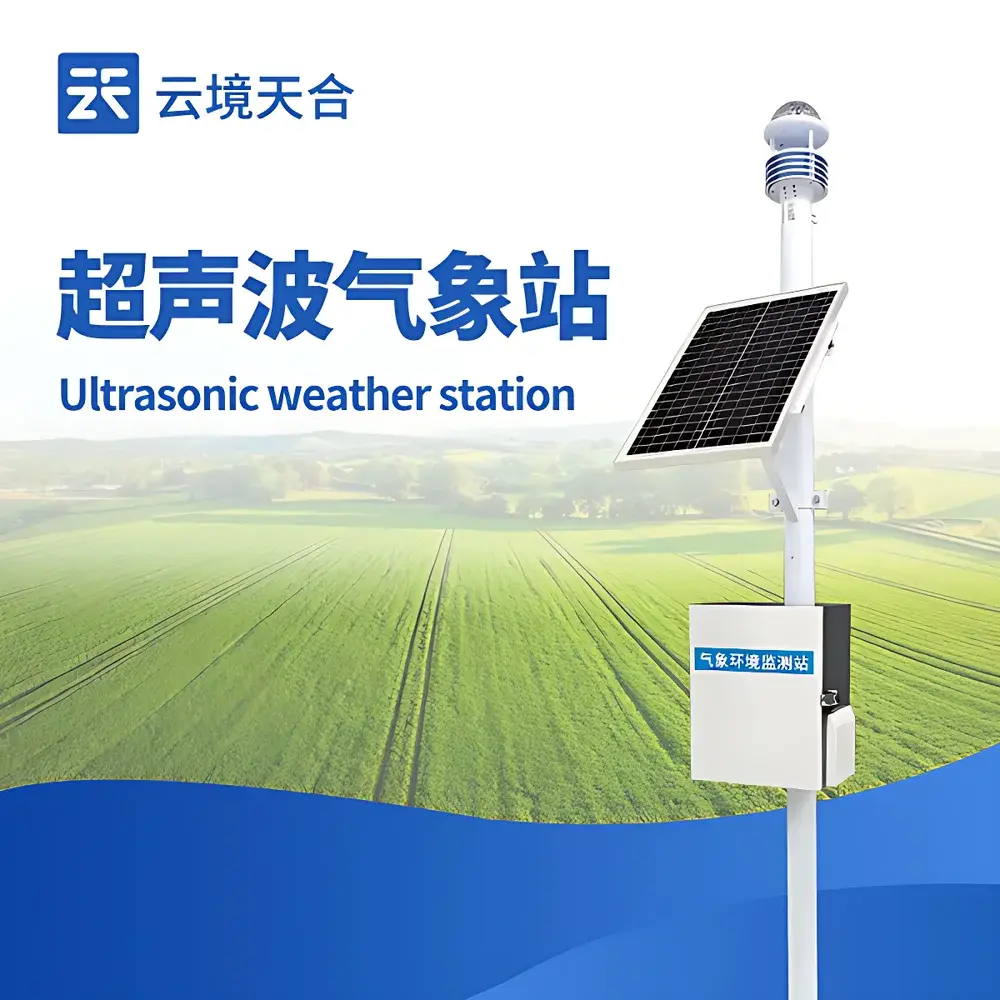
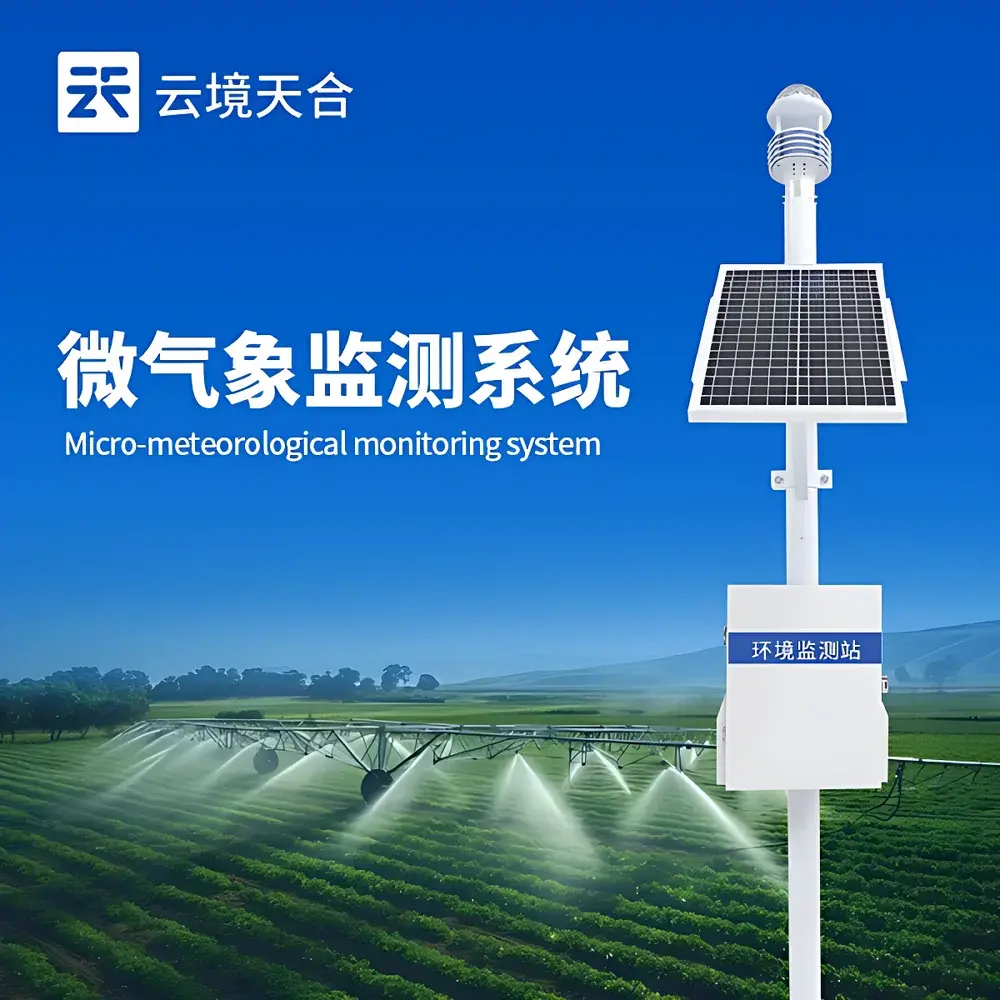
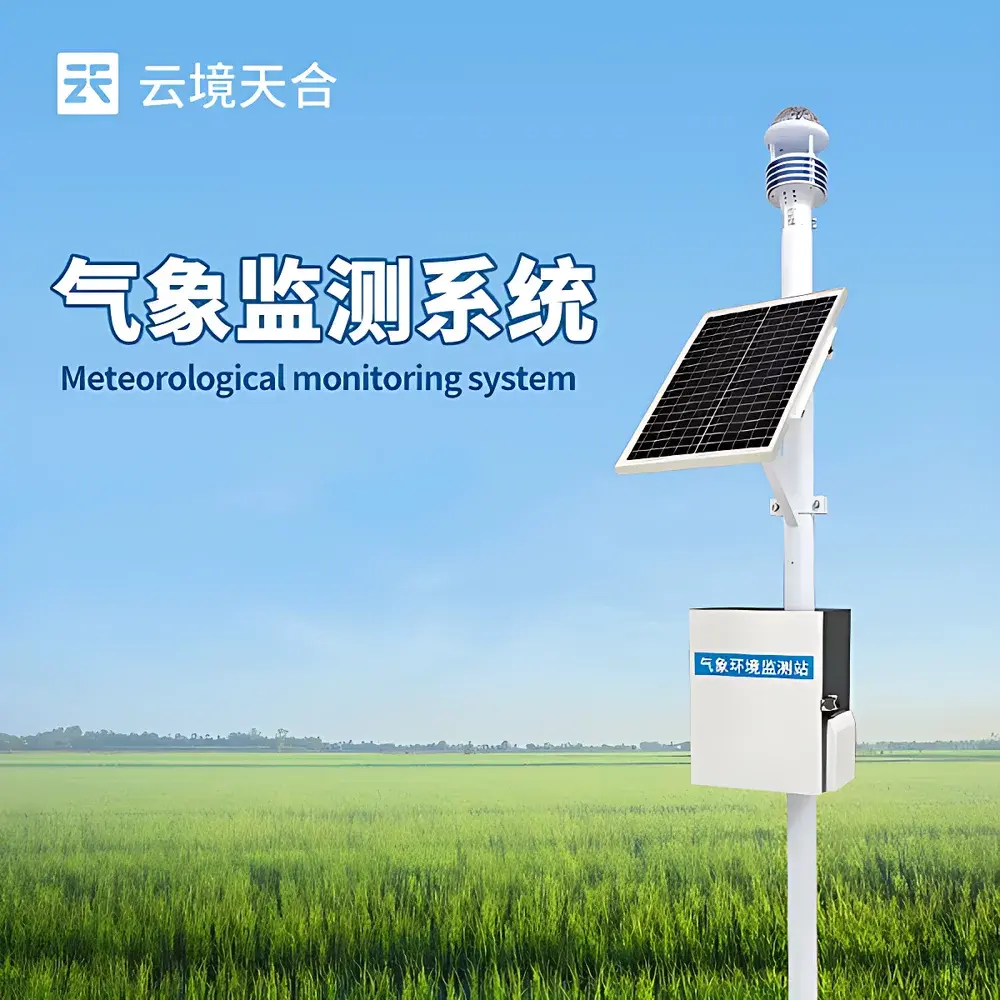
Cloudscape TH-CQX7 Integrated 7-Parameter Ultrasonic Weather Station
| Brand | Cloudscape |
|---|---|
| Model | TH-CQX7 |
| Origin | Shandong, China |
| Manufacturer Type | OEM/ODM Producer |
| Instrument Type | All-in-One Ultrasonic Weather Station |
| Measurement Range | Wind Speed: 0–60 m/s |
| Accuracy | Wind Speed ±0.1 m/s + 0.01V, Wind Direction ±2°, Temp ±0.3°C (at 25°C), RH ±3% RH (20–80% RH), Pressure ±0.25%, Illuminance <±3%, Optical Rain Rate ≤±4% |
| Resolution | Wind Speed 0.01 m/s, Wind Direction 1°, Temp 0.01°C, RH 0.01% RH, Pressure 0.1 hPa, Illuminance 1 lux, Rain Rate 0.01 mm/min |
| Communication | Standard GPRS |
| Power Supply | 8–16 V DC input |
| Enclosure Material | Imported ASA polymer |
| IP Rating | IP65+ |
| Mounting | 2 m carbon steel mast, direct-sleeve sensor integration (no flange required) |
| Data Output | RS485 Modbus RTU & JSON over serial |
| Compliance | ISO 9001, ISO 14001, ISO 45001 certified manufacturer |
| Software | PC desktop client (serial/Modbus/JSON), Android app (Bluetooth/background operation), cloud platform (CS architecture, HJ-212, HTTP/TCP forwarding, map view, alarm thresholds, scriptable data post-processing) |
Overview
The Cloudscape TH-CQX7 Integrated 7-Parameter Ultrasonic Weather Station is an engineered solution for autonomous, long-term environmental observation in unattended field deployments. Unlike conventional anemometers relying on mechanical cups or vanes, the TH-CQX7 employs time-of-flight ultrasonic wind sensing—measuring phase shifts between continuously frequency-modulated acoustic signals transmitted across orthogonal transducer pairs. This eliminates moving parts, startup latency, and thermal drift errors associated with analog timing circuits. Coupled with semiconductor-based temperature (diode junction voltage), capacitive humidity, piezoresistive barometric pressure, photodiode-based illuminance, and optical rain detection (light scattering attenuation), the system delivers synchronized, high-temporal-resolution meteorological data without inter-sensor calibration drift. Designed for continuous 24/7 operation under ambient extremes (−40 to +80 °C), it meets the functional requirements of regulatory-grade environmental monitoring where traceability, reproducibility, and low-maintenance reliability are critical—not merely convenience.
Key Features
- Integrated ultrasonic wind sensor with concealed top-mounted transducers—prevents snow accumulation, rain masking, and aerodynamic shadowing from mounting hardware.
- Single-housing 7-parameter sensor assembly: wind speed (0–60 m/s), wind direction (0–360°), air temperature (−40 to +80 °C), relative humidity (0–100% RH), atmospheric pressure (300–1100 hPa), solar irradiance (0–157,286 lux), and optical rain rate (0–4 mm/min).
- GX-12-4P standardized modular connectors for power, RS485 Modbus RTU, and JSON serial output—enabling plug-and-play interoperability with SCADA, PLCs, and edge gateways.
- MPPT solar charge controller (150 W max) with 20% efficiency gain over PWM systems; supports scalable battery configurations (20–100 Ah) for multi-day autonomy during low-irradiance periods.
- ASA polymer enclosure—resistant to UV degradation, salt fog, and thermal cycling; validated to IP65 minimum ingress protection per IEC 60529.
- Tool-free mounting on 2 m carbon steel mast via direct sleeve interface—no法兰盘 (flange) required, reducing installation time and mechanical failure points.
Sample Compatibility & Compliance
The TH-CQX7 is intended for outdoor deployment in open terrain, agricultural plots, forest edges, coastal zones, transportation corridors, and urban microclimate networks. Its measurement principles comply with foundational standards referenced in WMO Guide to Instruments and Methods of Observation (CIMO Guide, Chapter 12), ASTM D5112 (acoustic anemometry), and ISO 7726 (thermal environment instrumentation). While not certified to IEC 61000-6-2/6-4 for EMC immunity, its industrial-grade PCB layout, shielded cabling support, and galvanic isolation on RS485 lines ensure stable operation in electrically noisy environments (e.g., near variable-frequency drives or RF transmitters). The manufacturer holds ISO 9001 (quality), ISO 14001 (environmental), and ISO 45001 (occupational health & safety) certifications—documenting process control rigor applicable to instrument consistency and documentation traceability.
Software & Data Management
Data acquisition and management span three tiers: local, mobile, and cloud. The Windows desktop application accepts raw serial input (Modbus RTU or JSON), enables user-defined parameter mapping, timestamped CSV export, and JavaScript-based post-processing scripts—supporting custom unit conversions, anomaly flagging, or derived index calculation (e.g., heat index, dew point). The Android application operates in foreground and background modes, auto-discovers devices via Bluetooth or QR-coded Modbus configuration, and renders time-series plots with pinch-zoom and point inspection. The cloud platform follows a browser-native CS architecture—requiring no client-side installation. It implements role-based access control (RBAC), audit-trail logging per GLP/GMP-aligned practices, SMS/email alerting on user-defined thresholds, geospatial device mapping, and protocol-agnostic data forwarding (HJ-212, HTTP POST, TCP socket). All platforms support embedded JavaScript execution—allowing end-users to implement domain-specific logic without firmware updates.
Applications
- Agricultural decision support: real-time evapotranspiration estimation, frost warning, irrigation scheduling, and phenology modeling using integrated temperature/humidity/wind/light/rain metrics.
- Environmental compliance monitoring: baseline meteorological data collection for EPA or EEA reporting frameworks (e.g., ambient air quality modeling inputs, noise propagation correction).
- Disaster early warning: rapid detection of convective initiation indicators (e.g., sharp humidity drop + rising temperature + gust front signature) in flood-prone or wildfire-risk regions.
- Educational instrumentation: robust, self-contained platform for university atmospheric science labs—demonstrating ultrasonic anemometry, optical precipitation physics, and IoT telemetry architecture.
- Renewable energy site assessment: long-term wind resource characterization (IEC 61400-12-1 pre-feasibility tier) and solar irradiance validation at distributed PV installations.
FAQ
Does the TH-CQX7 require periodic recalibration?
No scheduled recalibration is mandated under normal operating conditions. Sensor stability is verified through factory calibration certificates traceable to NIST-equivalent national standards. Field verification may be performed using reference instruments per ISO/IEC 17025 guidelines.
Can the device operate without solar power?
Yes—it accepts 8–16 V DC input via GX-12-4P connector. External AC/DC adapters or battery banks may be used where solar insolation is insufficient or prohibited.
Is Modbus register mapping documentation publicly available?
Yes—complete Modbus RTU register tables, including holding register addresses, data types (UINT16, FLOAT32), scaling factors, and units, are provided in the technical manual shipped with each unit.
What is the maximum recommended distance for RS485 communication?
Up to 1,200 meters at 9,600 bps using twisted-pair shielded cable (AWG24, 120 Ω characteristic impedance) and proper termination.
How is data security handled on the cloud platform?
All data transmissions use TLS 1.2+ encryption. User accounts enforce strong password policies and optional two-factor authentication. Data at rest is encrypted using AES-256; backups follow ISO 27001-aligned retention and deletion protocols.
Related Products







