
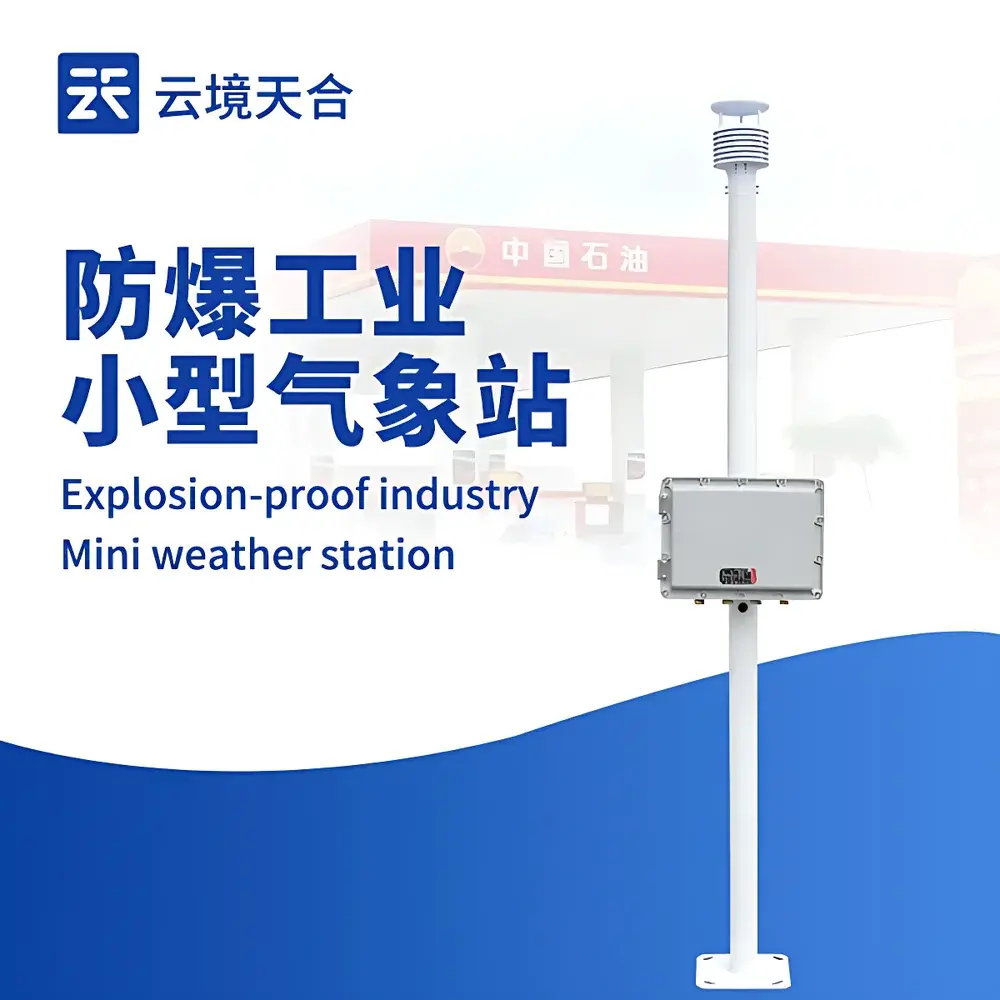
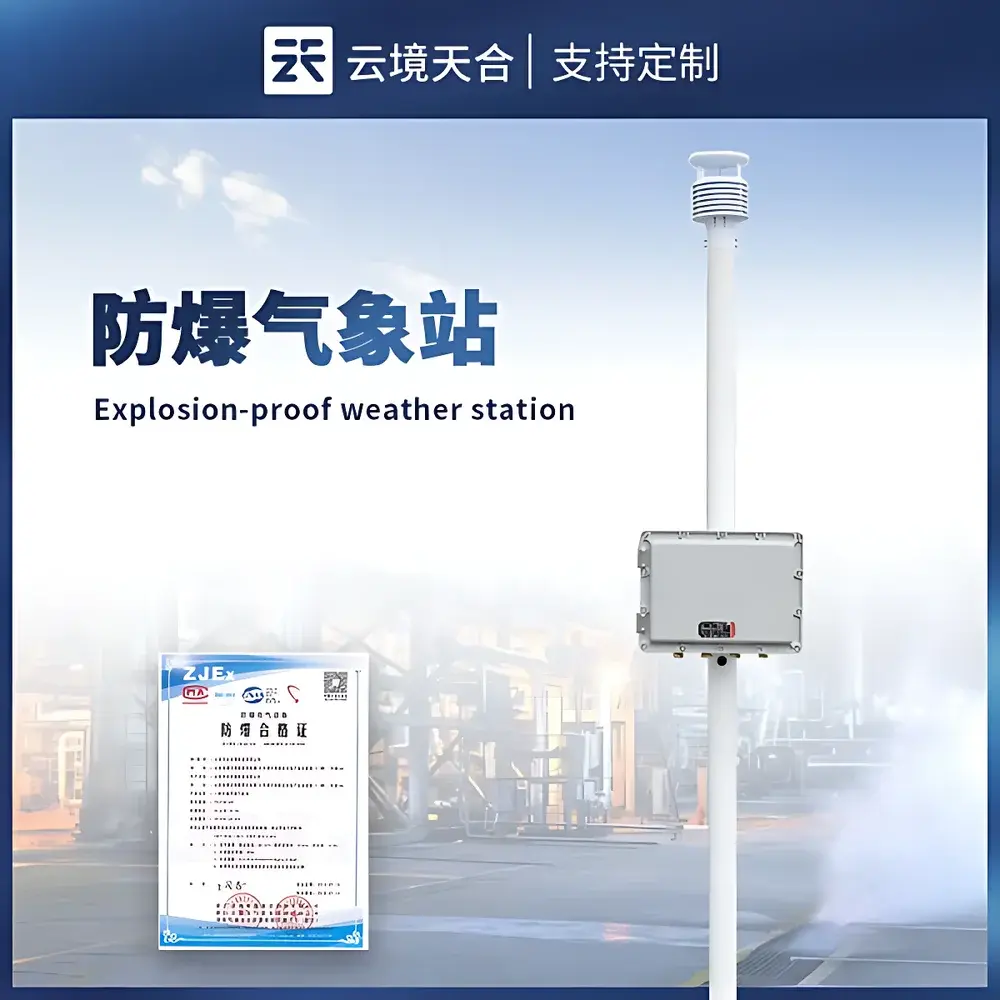
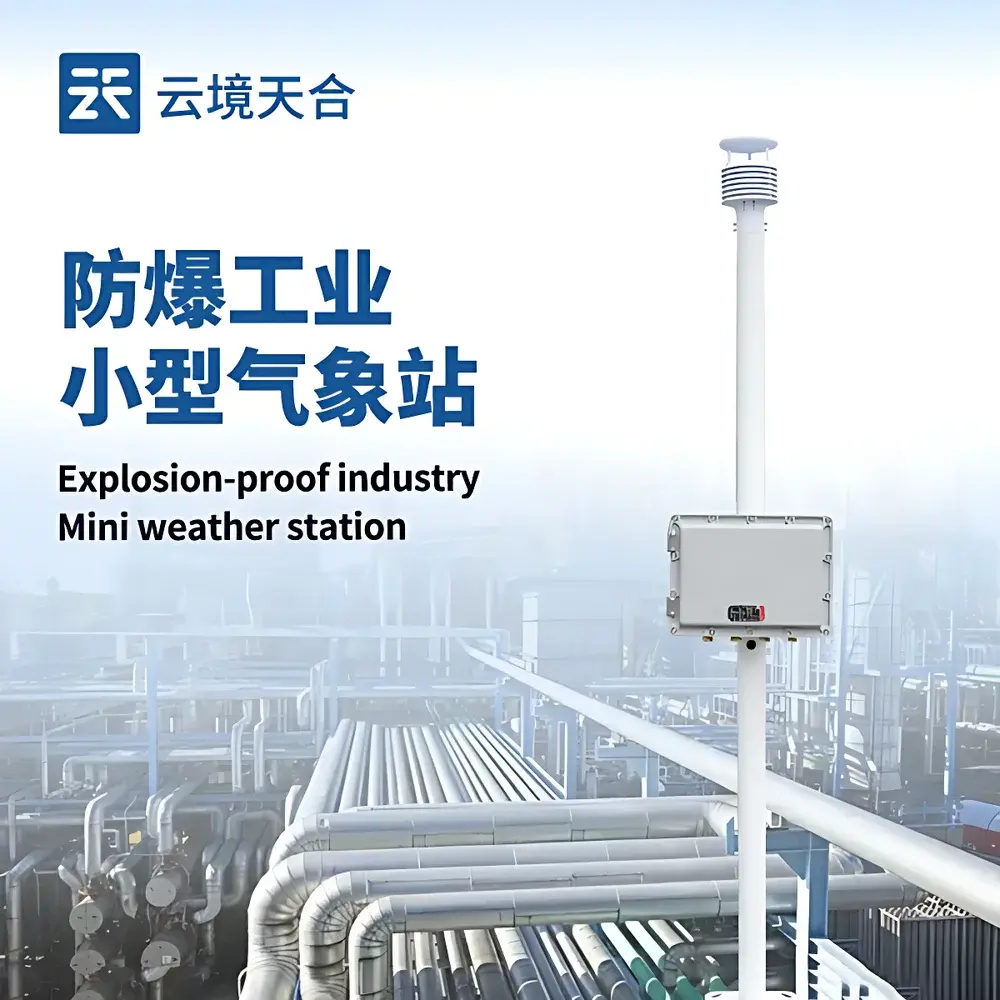
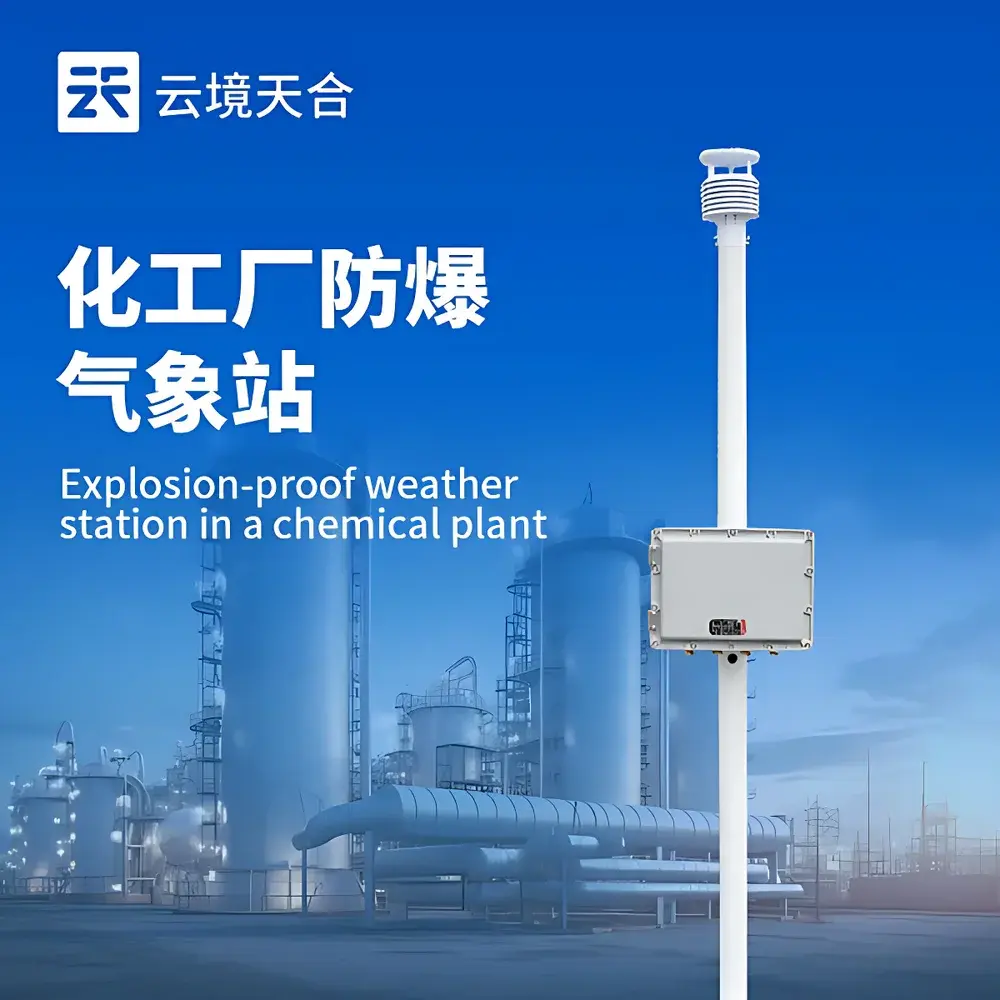
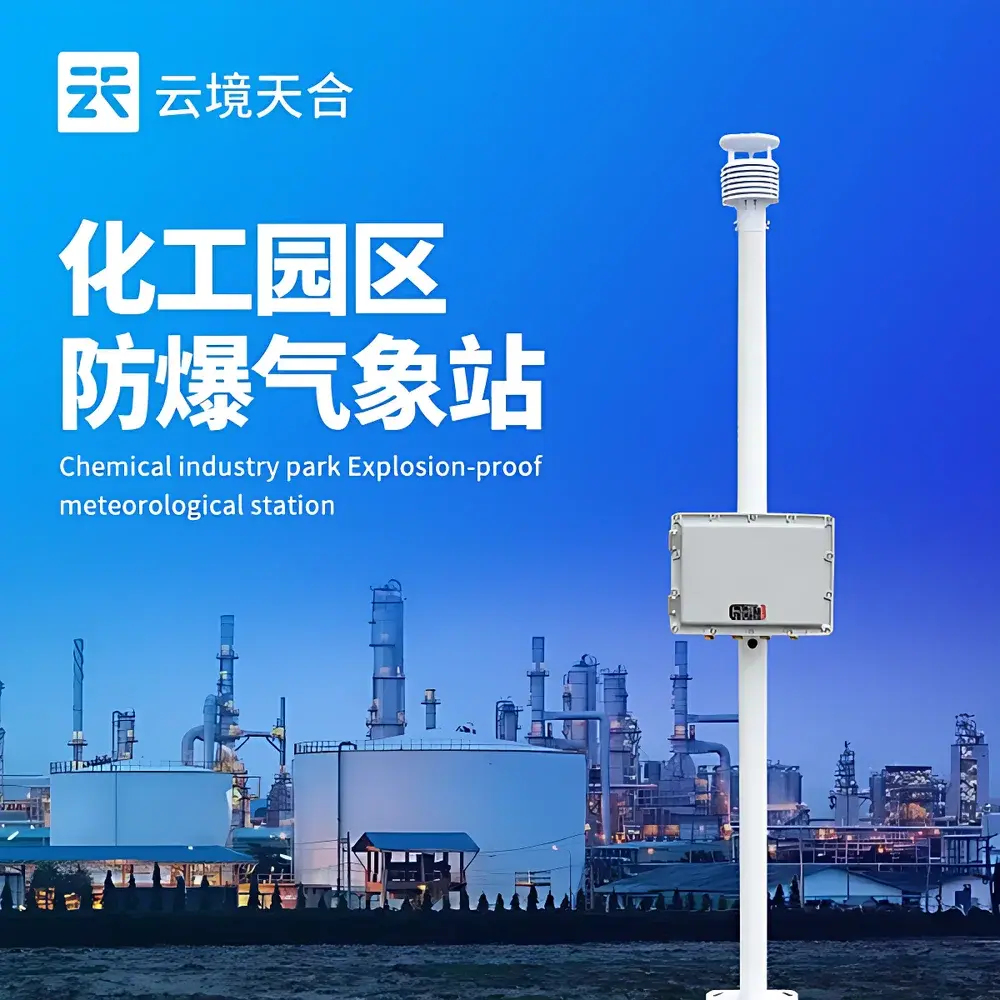
Cloudscape TH-FB01 Intrinsically Safe Industrial Mini Weather Station
| Brand | Cloudscape |
|---|---|
| Origin | Shandong, China |
| Manufacturer Type | Manufacturer |
| Country of Origin | China |
| Model | TH-FB01 |
| Instrument Type | Integrated Intrinsically Safe Weather Station |
| Wind Speed Range | 0–60 m/s |
| Wind Speed Accuracy | ±0.1 m/s + 0.01V |
| Wind Direction Range | 0–360° |
| Wind Direction Accuracy | ±2° |
| Air Temperature Range | −40 to +80 °C |
| Temp Accuracy | ±0.3 °C @ 25 °C |
| Humidity Range | 0–100 %RH |
| RH Accuracy | ±3 %RH (20–80 %RH) |
| Atmospheric Pressure Range | 300–1100 hPa |
| Pressure Accuracy | ±0.25 %FS |
| Data Storage Capacity | ≥500,000 records |
| Power Consumption | 1.75 W |
| Enclosure Rating | IP66/IP67 equivalent (per GB3836 compliance) |
| Certification | Ex ia IIC T6 Ga (GB3836.1-2010 & GB3836.4-2010) |
| Communication | RS-485 Modbus RTU |
| Software Compliance | Supports audit trail, configurable data logging intervals, and user-defined parameter mapping |
Overview
The Cloudscape TH-FB01 is an intrinsically safe, compact, integrated weather station engineered for continuous environmental monitoring in hazardous industrial locations classified under Zone 0/1 (IIC gas group, T6 temperature class). Designed in strict accordance with GB3836.1-2010 (equivalent to IEC 60079-0) and GB3836.4-2010 (IEC 60079-11), the system employs intrinsic safety (‘i’ protection) as its primary explosion prevention method—eliminating ignition energy at the source rather than relying on containment or purging. Its measurement architecture combines ultrasonic time-of-flight and phase-difference techniques for wind speed and direction, semiconductor junction voltage sensing for air temperature, capacitive polymer sensing for relative humidity, and piezoresistive MEMS transduction for atmospheric pressure. All five parameters are co-located within a single, sealed sensor head, minimizing spatial averaging error and ensuring synchronous acquisition under dynamic process conditions.
Key Features
- Ultrasonic anemometer with concealed top-mounted transducers—immune to snow accumulation, ice bridging, or mechanical obstruction from debris or vegetation
- Single-unit 5-parameter sensor assembly (wind speed, wind direction, temperature, humidity, barometric pressure) with factory-matched calibration coefficients
- ASA polymer housing rated for chemical resistance, UV stability, and mechanical impact resilience (IK10 equivalent per IEC 62262)
- RS-485 interface compliant with Modbus RTU protocol (slave ID configurable, baud rate up to 115.2 kbps), enabling direct integration into DCS, PLC, or SCADA systems without gateway hardware
- Onboard non-volatile memory storing ≥500,000 timestamped records with circular overwrite logic; supports power-loss recovery and time-synchronized logging
- Low-power architecture (1.75 W nominal) compatible with standard AC220 V ±10 %, 50 Hz supply; optional DC24 V input variant available upon request
- Comprehensive five-fold protection: explosion-proof (Ex ia IIC T6 Ga), dust-tight (IP6X), water-immersion resistant (IPX7), vibration-damped (IEC 60068-2-6), and corrosion-resistant (ISO 12944 C5-M)
Sample Compatibility & Compliance
The TH-FB01 is validated for deployment in Class I, Division 1 / Zone 1 environments involving flammable gases such as hydrogen, ethylene, acetylene, and propane (IIC group), as well as combustible dusts (Group IIIB/IIIC). It meets the essential health and safety requirements of China’s mandatory explosion-protection standards GB3836.1 and GB3836.4, and is certified by nationally accredited testing institutes (CNAS-accredited). While not CE-marked or ATEX-certified, its design principles align with IEC 60079-11:2011 for intrinsic safety. The device supports GLP-aligned operational practices through deterministic timestamping, write-protected firmware, and traceable calibration metadata embedded in each data packet. All firmware updates require authenticated digital signatures, and configuration changes generate immutable log entries with operator ID and UTC timestamp.
Software & Data Management
The included Windows-based desktop software provides local data acquisition, visualization, and post-processing without cloud dependency. It accepts raw Modbus RTU frames or JSON-formatted payloads over serial COM ports, enabling interoperability with legacy control systems. Users may define custom logging intervals (1 sec to 24 hr), configure virtual channels via JavaScript scripting (ECMAScript 5.1), and apply real-time unit conversions or derived parameter calculations (e.g., wind chill, dew point, sea-level pressure). Audit trails record all configuration modifications, data exports, and script executions—including source IP (for network-enabled variants) and SHA-256 hash of exported files. Export formats include CSV (with ISO 8601 timestamps), PDF reports (with embedded calibration certificates), and SQLite databases compatible with Python/Pandas workflows.
Applications
- Real-time meteorological supervision in petrochemical tank farms, LNG terminals, and offshore platform topsides
- Environmental input for emergency response modeling during VOC release incidents or fire plume dispersion analysis
- Process safety interlock triggering—e.g., automatic shutdown of roof vents or flare stack ignition based on wind vector thresholds
- Long-term climatic trend analysis for corrosion prediction models in refinery piping networks
- Validation of CFD simulations used in facility siting studies (API RP 752 / CCPS guidelines)
- Regulatory reporting for local ecological monitoring authorities requiring traceable, certified environmental data streams
FAQ
Is the TH-FB01 certified for use in Zone 0 areas?
Yes—it holds Ex ia IIC T6 Ga certification per GB3836.4-2010, permitting installation in Zone 0 (continuous hazard presence) for gas groups IIC.
Can the device interface directly with Siemens S7-1500 PLCs?
Yes—via standard Modbus RTU over RS-485; preconfigured function blocks and sample TIA Portal projects are provided.
Does the onboard memory retain data during AC power failure?
Yes—non-volatile FRAM ensures full retention of logged records and system configuration across power cycles.
What is the recalibration interval recommendation?
Annual verification against NIST-traceable references is advised; factory calibration certificates include uncertainty budgets per ISO/IEC 17025.
Is remote firmware update supported?
Firmware updates require physical USB connection and signed binary packages; no OTA capability is implemented to maintain integrity in SIL-2 aligned environments.
Related Products







