
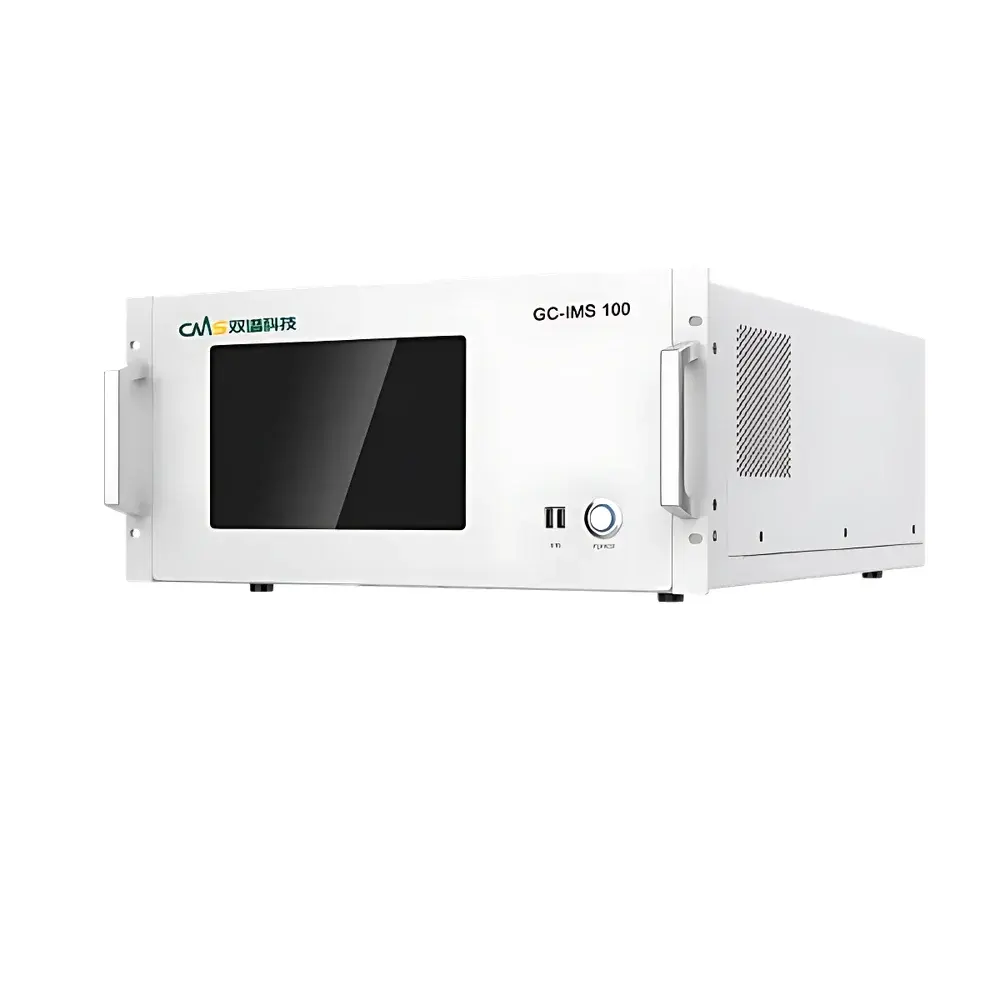
CMS odor 1000 Online GC-IMS System for Odor and VOC Monitoring
| Brand | FPI (Focus Photonics Inc.) |
|---|---|
| Origin | Zhejiang, China |
| Manufacturer Type | Original Equipment Manufacturer (OEM) |
| Product Category | Domestic |
| Model | CMS odor 1000 |
| Detection Principle | Gas Chromatography–Ion Mobility Spectrometry (GC-IMS) |
| Instrument Type | Online Analytical System |
| Typical Configuration | Multi-Compound VOC & Odorant Analyzer |
| Regulatory Compliance | GB 14554–201X, DB31/1025–2016, DB12/059–2018 (22 regulated odorants, qualitative & quantitative) |
| Detection Limit | Sub-ppt (parts-per-quadrillion) for key sulfur/nitrogen compounds |
| Resolution | 100 (IMS drift time resolution, FWHM) |
| Accuracy | ≤10% RSD (relative standard deviation) for calibrated odorants |
| Response Time | ≤10 s (IMS-only mode) |
Overview
The CMS odor 1000 is an online analytical system engineered for continuous, real-time monitoring of odor-causing volatile organic compounds (VOCs) and inorganic odorants in ambient air, stack emissions, and process streams. It integrates gas chromatography (GC) with high-resolution ion mobility spectrometry (IMS) — a hyphenated technique that combines chromatographic separation with orthogonal drift-tube ion mobility discrimination. Unlike conventional GC-MS systems, GC-IMS operates at ambient pressure without requiring high-vacuum infrastructure, enabling robust field deployment with minimal infrastructure dependency. The system targets regulatory-relevant odorants including hydrogen sulfide, methyl mercaptan, dimethyl sulfide, ammonia, trimethylamine, aldehydes (e.g., acetaldehyde, formaldehyde), ketones (e.g., acetone), esters, and short-chain fatty acids — all defined under national and regional odor standards such as GB 14554–201X, DB31/1025–2016, and DB12/059–2018. Its dual-spectrum architecture delivers trace-level detection (sub-ppt LOD for key sulfur- and nitrogen-containing species), making it suitable for early-warning odor event detection, source apportionment, and compliance verification in complex industrial environments.
Key Features
- Dual-polarity Differential IMS (DIMS) drift tube: Simultaneous positive- and negative-ion mode detection within a single acquisition cycle — eliminating manual polarity switching and reducing analysis cycle time by >40% versus sequential-mode IMS.
- Hadamard-transformed photoionization source (10.6 eV VUV lamp): Enables soft, non-fragmenting ionization with high ion transmission efficiency and low background noise; optimized for low-odor-threshold compounds (e.g., skatole, indole, geosmin).
- Retention time (GC) + drift time (IMS) dual-dimensional identification: Provides orthogonal chemical fingerprinting for unambiguous compound assignment, significantly improving specificity over single-dimension techniques.
- Multi-mode flow path architecture: Supports rapid IMS-only screening (≤10 s per spectrum) for event-triggered monitoring, and full GC-IMS profiling (5–15 min) for comprehensive speciation and quantification.
- Fully inertized sample pathway: SilcoNert®-coated stainless-steel tubing, heated transfer lines (up to 120 °C), and passivated injection valves minimize adsorption losses of polar, reactive, or high-boiling odorants (e.g., carboxylic acids, amines).
- Zero-vacuum operation: Eliminates need for turbomolecular pumps, oil diffusion systems, or vacuum interlocks — reducing power consumption, maintenance frequency, and total cost of ownership.
Sample Compatibility & Compliance
The CMS odor 1000 is validated for direct analysis of undiluted ambient air, ducted exhaust streams, and headspace samples from biofilters or composting facilities. It complies with ISO 16000-6 for VOC sampling and analysis protocols, and supports audit-ready reporting aligned with GLP and ISO/IEC 17025 requirements. Quantitative performance meets the precision and accuracy thresholds stipulated in GB/T 38401–2019 (Determination of odorants in ambient air using GC-IMS). All calibration standards are traceable to NIST SRMs or equivalent certified reference materials (CRMs). The system’s measurement uncertainty budget accounts for matrix effects, humidity interference (0–95% RH, compensated via internal humidity sensor), and temperature-induced retention time drift (auto-corrected via internal alkane marker system).
Software & Data Management
FPI’s proprietary OdorVision™ software provides real-time spectral visualization, automated peak detection, library matching against a curated database of >280 odor-relevant compounds (including isomers and stereoisomers), and integrated quantification using internal standard normalization. Data export supports CSV, NetCDF, and mzML formats for third-party chemometric analysis (e.g., PCA, PLS-DA). Audit trails comply with FDA 21 CFR Part 11 requirements, including electronic signatures, user role-based access control, and immutable raw data archiving. Remote diagnostics, firmware updates, and method scheduling are managed via TLS-encrypted web interface compatible with enterprise IT security policies.
Applications
- Continuous odor monitoring at municipal wastewater treatment plants, landfill leachate collection points, and anaerobic digestion facilities.
- Mobile odor mapping (‘odor walk’ or ‘sniff vehicle’) using integrated GPS-synchronized data logging and georeferenced plume modeling.
- Source identification and temporal profiling in petrochemical, pharmaceutical, and food processing industrial parks.
- Method development and validation support for environmental laboratories accredited under CNAS (China National Accreditation Service) or equivalent international schemes.
- Academic research on atmospheric chemistry of odorant transformation products, microbial VOC emissions, and human olfactory response correlation studies.
FAQ
Does the CMS odor 1000 require carrier gas or compressed air?
Yes — it uses ultra-high-purity nitrogen (99.999%) as both GC carrier gas and IMS drift gas. Optional onboard nitrogen generator integration is available for fully autonomous operation.
Can the system quantify odor intensity (OUE) directly?
No — it reports compound-specific concentrations (µg/m³ or ppbv). Odor unit estimation requires post-processing using established odor threshold values (e.g., from EVOA or ASTM D6988) and mixture interaction models (e.g., additive or synergistic summation).
Is GC column conditioning required between analyses?
Not routinely — the system employs thermal desorption and bake-out protocols during idle cycles. Column lifetime exceeds 12 months under typical ambient monitoring conditions (≤50 µg/m³ total VOC load).
How is humidity handled during long-term unattended operation?
An integrated Nafion™ dryer module and real-time RH compensation algorithm correct for water cluster formation in IMS spectra, maintaining consistent drift time alignment across 10–95% RH ranges.
What cybersecurity measures are implemented for remote data access?
All remote connections enforce TLS 1.2+ encryption, certificate-based authentication, and session timeout after 15 minutes of inactivity. No default credentials are shipped; initial setup mandates password complexity enforcement and two-factor authentication enablement.







