
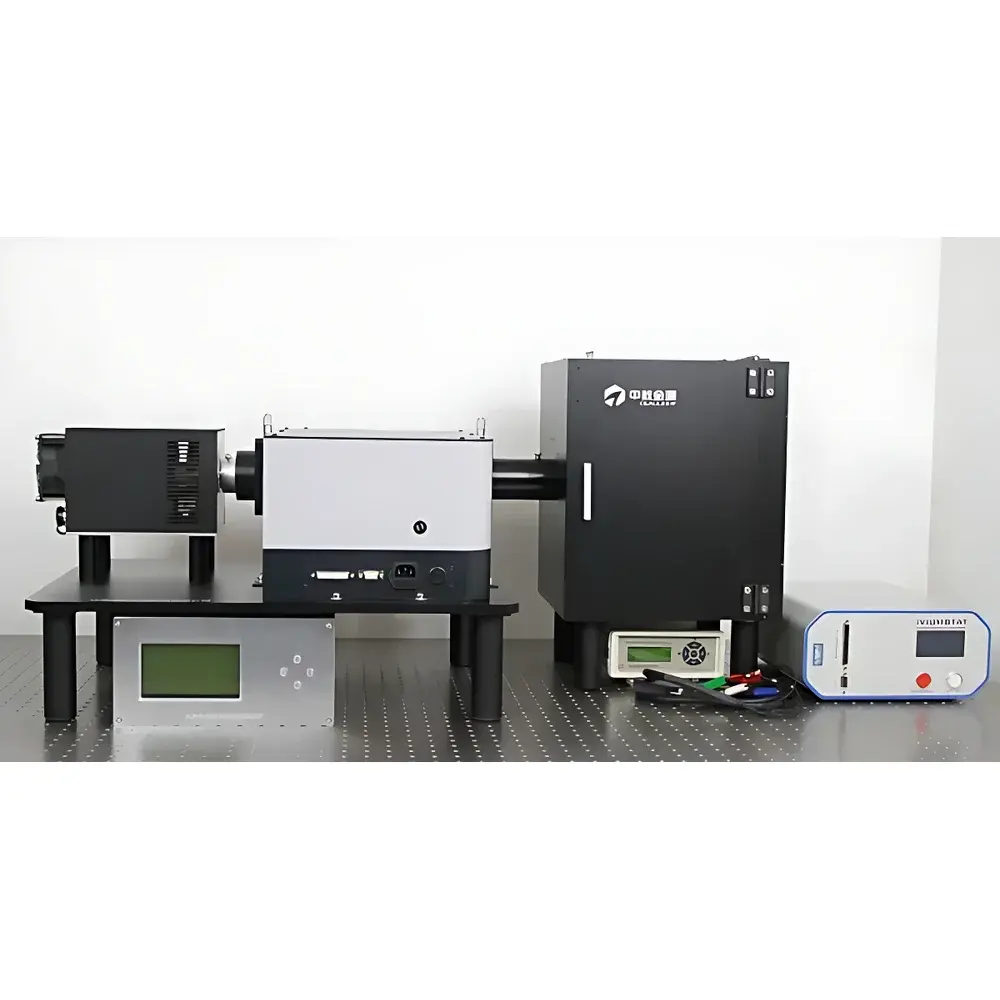
CNIEL Photoelectrochemical Testing System
| Brand | CNIEL |
|---|---|
| Origin | Beijing, China |
| Manufacturer Type | OEM Manufacturer |
| Product Origin | Domestic (China) |
| Model | CNIEL PEC-System |
| Price | USD 57,800 (FOB Beijing) |
| Measurement Mode | DC |
Overview
The CNIEL Photoelectrochemical Testing System is a modular, research-grade instrumentation platform engineered for quantitative photoelectrochemical (PEC) characterization of semiconductor photoelectrodes, dye-sensitized solar cells (DSSCs), perovskite photovoltaic materials, and photocatalytic thin films. It operates on the principle of controlled illumination coupled with potentiostatic/galvanostatic electrochemical interrogation under standardized irradiance conditions. The system integrates calibrated broadband and monochromatic light sources with precision current–voltage (I–V), chronoamperometric (CA), and incident photon-to-current efficiency (IPCE) measurement capabilities. Designed for laboratory-based fundamental studies and materials screening, it supports ASTM E2533–21 (Standard Test Method for Measuring IPCE of Photocatalytic Materials) and aligns with ISO 15444–2 guidelines for spectral responsivity calibration in optoelectronic devices.
Key Features
- Modular architecture supporting interchangeable light sources (Xe, D2, W-halogen, Hg) and optical accessories (monochromators, bandpass filters, integrating spheres)
- High-stability continuous-wave xenon lamp options: CEL-S500 (2.00 mW/cm² output intensity) and CEL-HXF300 (10.00 mW/cm²), both covering 200–1600 nm spectral range
- Tunable monochromatic illumination via motorized monochromator (CEL-SLA/SLF configurations); spectral bandwidth adjustable from 1 to 20 nm (FWHM)
- DC-biased electrochemical interface compatible with standard three-electrode PEC cells (working, counter, reference electrodes)
- Integrated optical power calibration traceable to NIM (National Institute of Metrology, China) standards; real-time irradiance monitoring via calibrated Si and InGaAs photodiodes
- Rugged mechanical design with thermal management for long-term stability during extended IPCE scans or time-resolved photocurrent measurements
Sample Compatibility & Compliance
The system accommodates standard quartz or fused-silica electrochemical cells (e.g., 3-electrode PEC cells with Pt mesh counter electrode and Ag/AgCl reference electrode). Compatible sample formats include planar photoanodes (TiO2, BiVO4, Fe2O3), powder-coated FTO substrates, and suspended nanoparticle slurries in aqueous or non-aqueous electrolytes. All optical and electrical components meet IEC 61000-4 electromagnetic compatibility requirements. The system’s software supports audit trails and user-access controls compliant with GLP and GMP documentation frameworks. While not FDA-certified as a medical device, its data acquisition protocols conform to 21 CFR Part 11 principles for electronic records integrity when configured with timestamped, password-protected user accounts and exportable raw-data logs.
Software & Data Management
The proprietary CNIEL PEC Control Suite (v4.2) provides synchronized control of light source wavelength/intensity, potentiostat biasing, and data acquisition at up to 10 kHz sampling rate. Key functions include automated IPCE mapping across 200–1600 nm (step resolution: 1 nm), dark-current subtraction, spectral responsivity normalization, and Tafel analysis. Export formats include CSV, ASCII, and HDF5 for third-party analysis (e.g., Python SciPy, MATLAB, OriginPro). All measurement sessions generate metadata-rich files containing lamp operating hours, monochromator calibration coefficients, ambient temperature/humidity logs, and user-defined experimental notes—enabling full traceability and reproducibility per ISO/IEC 17025 requirements.
Applications
- Quantitative IPCE and external quantum efficiency (EQE) mapping of photoelectrodes under AM1.5G-equivalent illumination
- Wavelength-resolved photocurrent onset potential determination for bandgap estimation
- Stability assessment via chronoamperometry under constant monochromatic irradiation
- Electrochemical impedance spectroscopy (EIS) integration for charge-transfer resistance analysis at specific photon energies
- Photoelectrocatalytic CO2 reduction or water-splitting kinetics under controlled spectral excitation
- Validation of theoretical optical absorption models using experimentally derived action spectra
FAQ
What light sources are included by default?
The base configuration includes either the CEL-S500 or CEL-HXF300 xenon lamp module with integrated monochromator. Optional add-ons include deuterium (190–400 nm), tungsten-halogen (350–2500 nm), and mercury (discrete lines at 254, 365, 405, 436 nm) lamps.
Is spectral calibration performed before shipment?
Yes—each system ships with factory-applied spectral irradiance calibration certificates for all standard lamp–monochromator combinations, referenced to NIM-traceable standards. Users may perform field recalibration using optional NIST-traceable photodiode sensors.
Can the system be integrated with third-party potentiostats?
Yes—the optical subsystem features TTL-triggered synchronization and analog voltage outputs (0–10 V) compatible with Gamry, BioLogic, and PalmSens potentiostats. Full API documentation is provided for custom LabVIEW or Python integration.
What is the minimum measurable photocurrent resolution?
With the standard low-noise current amplifier, the system achieves ≤50 pA RMS noise floor over 1 s integration time, enabling reliable detection of sub-nA photocurrents from low-activity catalysts.





