
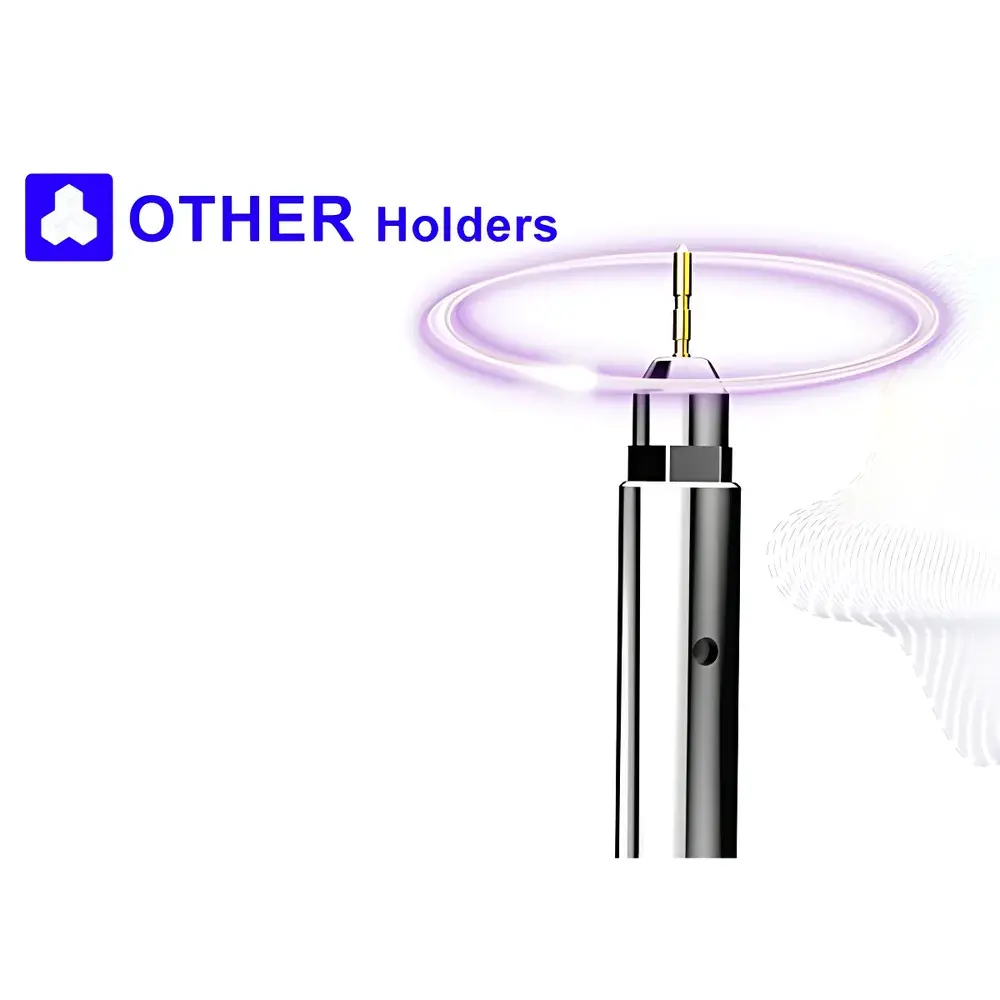
CNT-OTAR-S Full-Angle Tomographic Sample Holder for Transmission Electron Microscopy
| Brand | CHIPNOVA |
|---|---|
| Model | CNT-OTAR-S |
| Holder Type | In Situ Tomographic Sample Holder |
| Compatible TEM Platforms | Thermo Fisher/FEI, JEOL, Hitachi (HR)TEM/STEM |
| Sample Mounting Options | Single-Axis Tip & C-Type Tip |
| Tip Exchangeable | Yes |
| Tip Configurations | 3 mm Half-Grid (C-Type), Rod/Conical (Single-Axis) |
| Maximum Tilt Range | ±54° (Tomographic Series) |
| Tilt Increment | 6° |
| Drift Rate | <0.5 nm/min (Stabilized State) |
| Holder Body Material | High-Strength Titanium Alloy |
| EDS/EELS/SAED Compatibility | Fully Supported |
| Application Domain | Materials Science, Nanogeology, In Situ Structural Analysis |
| Compliance | Designed for GLP-aligned electron tomography workflows |
Overview
The CNT-OTAR-S Full-Angle Tomographic Sample Holder is an engineered solution for high-fidelity electron tomography in transmission electron microscopy (TEM). Unlike conventional single-axis tilt holders, this holder enables acquisition of complete angular coverage through two interchangeable tip architectures—single-axis and C-type—each optimized for distinct specimen geometries and data fidelity requirements. It operates on the principle of tilt-series acquisition, where sequential images are collected at discrete angular increments (e.g., ±54° in 6° steps) around a common axis, followed by weighted back-projection or iterative reconstruction algorithms to generate isotropic 3D volume data at near-atomic resolution. Designed specifically for high-resolution (HR)TEM, STEM, and analytical modes including EDS, EELS, and SAED, the holder maintains mechanical stability and thermal consistency during prolonged acquisition—critical for minimizing drift-induced misalignment and preserving quantitative structural integrity across tilt series.
Key Features
- Modular tip architecture: Interchangeable single-axis and C-type tips enable platform-agnostic sample transfer between TEM, FIB-SEM, and atom probe (AP) systems—facilitating correlative multimodal characterization.
- C-type tip with 3 mm half-grid configuration: Engineered to maximize unobstructed beam path at extreme tilt angles (±90° α-rotation), eliminating shadowing artifacts and enabling uniform contrast distribution in tomographic reconstructions.
- Single-axis tip with full 360° rotation capability: Supports continuous or stepped azimuthal rotation, mitigating wedge-shaped missing information zones typical of limited-tilt geometries and improving completeness of Fourier-space sampling.
- Monolithic titanium alloy body: Precision-machined from aerospace-grade Ti-6Al-4V, delivering exceptional stiffness-to-weight ratio, low thermal expansion coefficient, and long-term dimensional stability under vacuum and high-voltage conditions.
- Sub-nanometer drift performance: Achieves <0.5 nm/min positional stability after thermal equilibration—validated under standard high-resolution imaging conditions—ensuring alignment accuracy across multi-hour tilt-series acquisitions.
Sample Compatibility & Compliance
The CNT-OTAR-S accommodates diverse specimen morphologies—including rod-shaped nanoparticles, conical nanowires, and standard 3 mm half-grid copper or gold support films—without requiring custom mounting fixtures. Its mechanical design conforms to standard Gatan, Oxford, and FEI-compatible stage interfaces, ensuring seamless integration into existing TEM workflows. All materials and surface treatments comply with ultra-high vacuum (UHV) compatibility standards (≤1×10⁻¹⁰ mbar base pressure), minimizing outgassing during extended operation. The C-type tip’s non-magnetic, low-Z construction eliminates parasitic X-ray fluorescence interference during energy-dispersive spectroscopy (EDS), supporting quantitative elemental mapping in tomographic volumes. The holder supports full compliance with ASTM E2782 (Standard Guide for Electron Tomography) and ISO/IEC 17025 traceability frameworks when used within validated laboratory quality management systems.
Software & Data Management
While hardware-agnostic, the CNT-OTAR-S is fully compatible with industry-standard tomography software suites—including IMOD, UCSF Tomo, SerialEM, and Thermo Fisher’s Velox—enabling automated tilt-series acquisition, real-time fiducial tracking, dose-symmetric tilt schemes, and GPU-accelerated reconstruction. Integrated stage position logging ensures full metadata capture (tilt angle, focus offset, stigmation, beam shift) per image frame, satisfying audit requirements under FDA 21 CFR Part 11 and GLP/GMP documentation protocols. Raw data export follows HDF5 and MRC2014 formats, ensuring interoperability with machine-learning-based denoising (e.g., Cryo-CARE) and segmentation pipelines (e.g., ilastik, Amira).
Applications
This holder is routinely deployed in advanced materials characterization workflows requiring volumetric insight at sub-5 nm resolution. Primary use cases include: 3D reconstruction of nanoporous catalyst frameworks for pore-network topology analysis; tomographic quantification of dislocation networks and stacking faults in irradiated nuclear alloys; correlative structural–chemical mapping of mineral–fluid interfaces in nanogeological samples; and in situ heating-enabled dynamic studies of grain boundary evolution in battery electrode materials. Published validation includes nanoscale 3D analysis of geological specimens, as reported in *Atomic Spectroscopy* (2022), where ±54° tilt-series reconstructions revealed previously unresolved crystallographic heterogeneities in clay–quartz composite matrices.
FAQ
What TEM platforms is the CNT-OTAR-S holder compatible with?
It is mechanically and electronically compatible with all major high-resolution TEM/STEM systems from Thermo Fisher Scientific (including Talos, Glacios, and Titan platforms), JEOL (JEM-ARM series), and Hitachi (HF series), provided standard double-tilt or tomography-stage interfaces are available.
Can the holder be used for in situ heating experiments?
Yes—the titanium alloy body and modular tip interface support integration with commercially available heating modules (e.g., Protochips Fusion, DENSsolutions Wildfire), maintaining tilt functionality up to 800°C under controlled gas or vacuum environments.
Is EDS quantification reliable when using the C-type tip?
Absolutely—the C-type tip uses high-purity oxygen-free copper and titanium components with no ferromagnetic or high-Z contaminants, eliminating background X-ray peaks and ensuring accurate k-factor-based quantification across tilt series.
How is calibration performed for tilt-series alignment?
Calibration leverages standard gold or polystyrene nanosphere fiducials deposited directly onto the specimen grid; the holder’s repeatable mechanical repeatability (<0.1° angular hysteresis) ensures consistent alignment reference frames across multiple sessions.
Does CHIPNOVA provide application support or reconstruction workflow guidance?
Yes—technical documentation includes detailed SOPs for tilt-series acquisition, drift compensation protocols, and recommended reconstruction parameters aligned with ASTM E2782 best practices; remote expert consultation is available upon request.





