
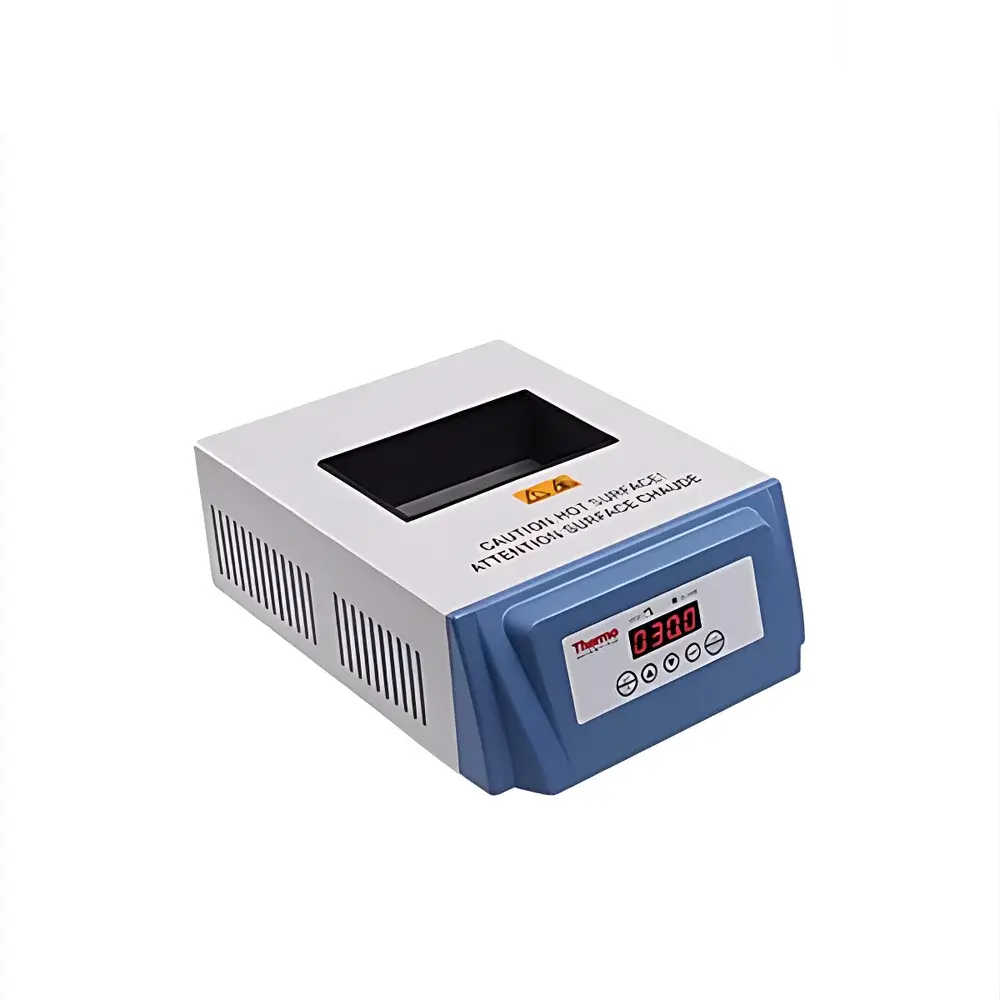
Cole-Parmer Dry Bath Heater Model 36402-09
| Brand | Cole-Parmer |
|---|---|
| Origin | USA |
| Model | 36402-09 |
| Temperature Range | Ambient to 130 °C |
| Temperature Uniformity | ±0.3 °C |
| Input Voltage | 230 V AC |
| Power Rating | 150–400 W (model-dependent) |
| Module Capacity | Single-module configuration |
| Heating Module Depth | 2.8 cm (03137-00 only) |
Overview
The Cole-Parmer Dry Bath Heater Model 36402-09 is a precision-engineered, single-module dry block heater designed for consistent, contamination-free thermal processing of samples in analytical, clinical, and research laboratories. Unlike water baths, this device employs solid aluminum heating blocks to deliver rapid thermal response and eliminate risks associated with liquid evaporation, condensation, or microbial growth. Its operation is based on resistive heating elements embedded within thermally conductive aluminum blocks, enabling precise conductive heat transfer to sample vessels placed directly into machined wells. The unit operates across a calibrated temperature range from ambient to 130 °C, making it suitable for enzyme incubations, DNA denaturation, reagent warming, sample thawing, and controlled evaporation protocols—particularly where sterility, reproducibility, and vessel compatibility are critical.
Key Features
- Single-module configuration with interchangeable, application-specific aluminum heating blocks—enabling rapid adaptation to diverse tube formats and plate types;
- Digital temperature control with high-resolution setpoint adjustment and real-time display, ensuring traceable and repeatable thermal profiles;
- Temperature uniformity of ±0.3 °C across the block surface—validated per ASTM E220 and ISO/IEC 17025 calibration practices for laboratory equipment;
- Modular power architecture supporting 150 W to 400 W output depending on block size and thermal load, optimized for energy efficiency and thermal stability;
- Robust aluminum housing with integrated thermal insulation and overtemperature protection circuitry compliant with IEC 61010-1 safety standards;
- Compatibility with a comprehensive portfolio of 14 standardized heating modules—including 6–96-well microplate heaters (03137-08 / 03137-10), deep-well configurations (03137-00), and multi-diameter tube arrays (e.g., 03130–03136 series).
Sample Compatibility & Compliance
The Model 36402-09 accommodates a wide spectrum of laboratory consumables without modification. Standard modules support common tube diameters from 7.9 mm to 25.4 mm (e.g., 0.5 mL, 1.5 mL, 15 mL, and 50 mL conical tubes), as well as ANSI/SLAS-compliant 6-, 12-, 24-, 48-, and 96-well microplates. The 03137-00 flat-plate module provides uniform surface heating ideal for Petri dishes or custom containers. All aluminum blocks are anodized for chemical resistance and ease of decontamination. The system meets CE marking requirements and conforms to UL 61010-1 and EN 61326-1 for electromagnetic compatibility. While not intrinsically certified for hazardous locations, its sealed construction minimizes vapor ingress during routine organic solvent handling when used in ventilated enclosures.
Software & Data Management
This analog/digital hybrid heater does not include onboard data logging or network connectivity. However, its digital controller supports stable setpoint retention and displays current block temperature with 0.1 °C resolution—sufficient for GLP-aligned manual recording workflows. For regulated environments requiring audit trails, integration with external temperature validation systems (e.g., Fluke 1523/1524 with calibrated probes) is recommended. Users may document operational parameters—including setpoint, duration, module type, and operator ID—in paper-based or LIMS-integrated electronic batch records. The heater’s design supports FDA 21 CFR Part 11 compliance when deployed within validated SOPs that define calibration frequency (minimum annually), probe placement (center + corner wells), and deviation thresholds (±0.5 °C from setpoint).
Applications
- Pre-analytical sample preparation: thawing frozen serum, plasma, or tissue homogenates at controlled rates to preserve biomolecular integrity;
- Molecular biology workflows: pre-heating restriction enzyme buffers, PCR master mixes, or lysis reagents prior to reaction setup;
- Quality control testing: conditioning reference standards and calibrants to specified temperatures before instrumental analysis (e.g., HPLC, ICP-MS);
- Environmental and food safety labs: accelerating digestion steps in EPA Method 3050B or AOAC 985.27 protocols when paired with acid-resistant modules;
- Pharmaceutical development: maintaining excipient solutions at constant temperature during viscosity or solubility screening studies.
FAQ
Is the Model 36402-09 compatible with microcentrifuge tubes?
Yes—modules such as 03130-00 (30× 7.9 mm) and 03131-00 (24× 10.3 mm) accommodate standard 0.5 mL and 1.5 mL microcentrifuge tubes with secure fit and minimal thermal lag.
Can this heater be used for overnight incubations?
It is engineered for unattended operation up to 24 hours when installed in a clean, dry, well-ventilated lab environment and monitored per institutional safety policies. Overtemperature cutoff ensures fail-safe shutdown.
Does Cole-Parmer provide NIST-traceable calibration certificates?
Calibration certificates are available upon request at time of purchase (additional fee applies). Certificates include as-found/as-left data, uncertainty budgets, and compliance statements aligned with ISO/IEC 17025.
What is the expected service life under continuous use?
With proper maintenance—including periodic cleaning of block wells and verification of thermal performance—the unit demonstrates >50,000 hours of operational reliability, consistent with industrial-grade heating element lifespans defined in IEC 60519-12.
Are replacement heating modules backward-compatible with legacy units?
Yes—all current modules (03130–03137 series) maintain mechanical and electrical compatibility with prior-generation Cole-Parmer dry bath heaters (e.g., 36403-xx series), preserving investment in existing accessories.



