
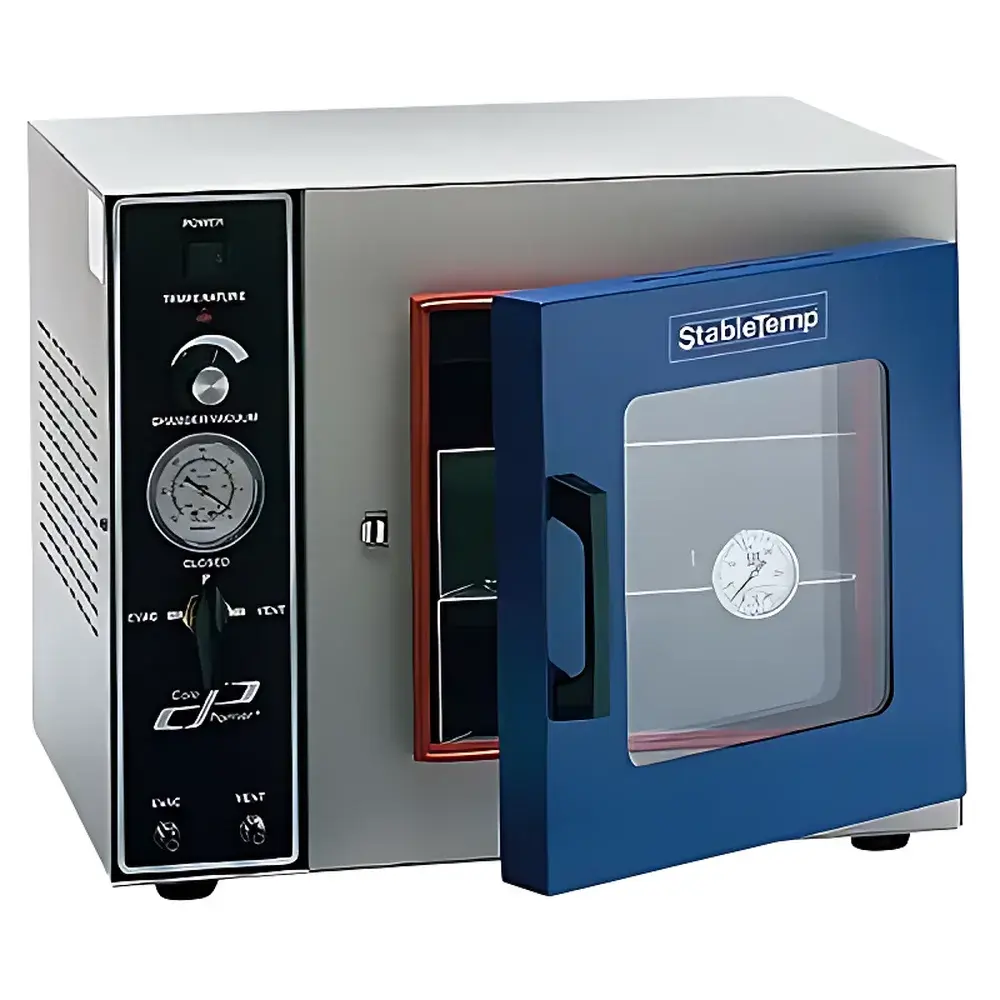
Cole-Parmer StableTemp Vacuum Oven Model 05053-22
| Brand | StableTemp |
|---|---|
| Origin | USA |
| Manufacturer Type | Authorized Distributor |
| Product Category | Imported |
| Model | 05053-22 |
| Instrument Type | Vacuum Oven |
| Temperature Range | +5°C above ambient to 200°C |
| Temperature Uniformity | ±5°C at 100°C |
| External Dimensions | 63 × 56 × 63 cm |
| Internal Chamber Dimensions | 36 × 36 × 51 cm |
| Vacuum Range | 0–30 inHg |
| Power Supply | 120 VAC |
| Net Weight | 310 lb (140 kg) |
Overview
The Cole-Parmer StableTemp Vacuum Oven Model 05053-22 is an engineered solution for controlled thermal processing under reduced pressure, designed specifically for laboratories requiring precise moisture removal, solvent evaporation, heat-sensitive sample drying, and degassing applications. Operating on the fundamental principle of lowering the boiling point of volatile substances via vacuum application—thereby enabling effective drying at significantly reduced temperatures—the oven integrates robust thermal management with reliable vacuum integrity. Its chamber operates within a calibrated temperature range from +5°C above ambient up to 200°C, with uniformity maintained at ±5°C at 100°C per ASTM E2203 (Standard Practice for Calibration of Ovens and Furnaces). The unit complies with general electrical safety standards for laboratory equipment (UL 61010-1 / CSA C22.2 No. 61010-1), and its construction supports GLP-compliant workflows when paired with NIST-traceable calibration documentation (optional P/N 17002-30).
Key Features
- Polycarbonate-insulated tempered glass door with shatter-resistant construction, minimizing risk of injury during routine observation and enhancing operator safety.
- High-integrity sealing system featuring dual silicone gaskets and a positive-pressure door latch, ensuring consistent vacuum retention across the full 0–30 inHg operating range.
- Integrated three-way valve assembly for sequential evacuation, purge, and vent operations—enabling rapid cycle transitions and contamination control between batches.
- Front-mounted 1/4″ stainless steel vacuum port with standard hose barb fitting, compatible with common vacuum tubing (ID: 1/4″) and compatible with mechanical or oil-free vacuum pumps.
- Dual rear 1/4″ NPT(F) threaded ports for real-time monitoring: accommodates optional thermocouple, relative humidity, or pressure transducer probes without compromising chamber integrity.
- Independent overtemperature protection via a redundant bimetallic safety thermostat, set to activate at 220°C to prevent thermal runaway and safeguard samples and chamber components.
- Aluminum wire shelving with high thermal conductivity—minimizes localized hot spots and promotes even heat distribution across the 36 × 36 × 51 cm working volume.
Sample Compatibility & Compliance
The StableTemp Vacuum Oven is suitable for drying, curing, and stabilizing a broad spectrum of materials—including polymers, pharmaceutical intermediates, ceramic precursors, electronic components, and biological matrices—without oxidative degradation. Its vacuum capability eliminates oxygen exposure, making it ideal for oxidation-prone compounds and low-volatility solvents. The unit meets baseline requirements for ISO/IEC 17025-accredited laboratories when operated with documented calibration procedures and traceable reference standards. Optional NIST-traceable calibration reports (P/N 17002-30) support audit readiness for FDA-regulated environments where instrument qualification (IQ/OQ/PQ) and data integrity (21 CFR Part 11 alignment via external logging systems) are required.
Software & Data Management
This analog-controlled vacuum oven does not incorporate digital controllers or embedded software. Temperature regulation is achieved via a precision hydraulic thermostat with direct-read dial thermometer; vacuum level is monitored using a calibrated analog Bourdon-tube gauge. For laboratories requiring electronic data capture, the dual rear NPT(F) ports allow integration with third-party data loggers (e.g., Omega OM-DAQPRO-5300 or Testo 176-T4) to record time-stamped temperature, pressure, and optional humidity profiles. All calibration records—including initial factory verification and subsequent periodic checks—must be retained per internal quality SOPs to satisfy GLP/GMP documentation expectations.
Applications
- Residual solvent removal from APIs and excipients prior to lyophilization or tablet compression.
- Moisture content determination in hygroscopic powders per ASTM D1719 and USP <643>.
- Pre-bake conditioning of PCB substrates and sensor housings to eliminate outgassing during vacuum deposition.
- Thermal stabilization of catalysts and metal-organic frameworks (MOFs) under inert or low-oxygen conditions.
- Accelerated aging studies of polymer films and encapsulation resins under controlled thermal-vacuum stress.
- Drying of delicate botanical extracts and enzyme preparations where conventional convection ovens induce denaturation.
FAQ
Does this oven support programmable ramp-hold cycles?
No—Model 05053-22 uses a manual hydraulic thermostat and lacks digital programming capability. For automated thermal profiling, consider the Cole-Parmer Programmable Vacuum Oven Series (e.g., P/N 05053-50).
Can I install a digital temperature controller retroactively?
Not recommended. The oven’s structural and regulatory design assumes analog control architecture; field modifications void UL listing and compromise safety certification.
What vacuum pump is recommended for optimal performance?
A two-stage rotary vane pump rated for ≤0.05 mbar ultimate vacuum (e.g., Welch 1402 or KNF NP 201) ensures stable operation within the specified 0–30 inHg range and minimizes oil backstreaming risk.
Is the interior chamber stainless steel?
Yes—the inner chamber is constructed from electropolished 304 stainless steel, providing corrosion resistance against acidic vapors and facilitating cleanroom-compatible decontamination.
How often should calibration be performed?
Per ISO/IEC 17025 and internal quality policy, temperature and vacuum sensors should be verified annually—or before critical validation runs—using traceable references and documented procedures.



