
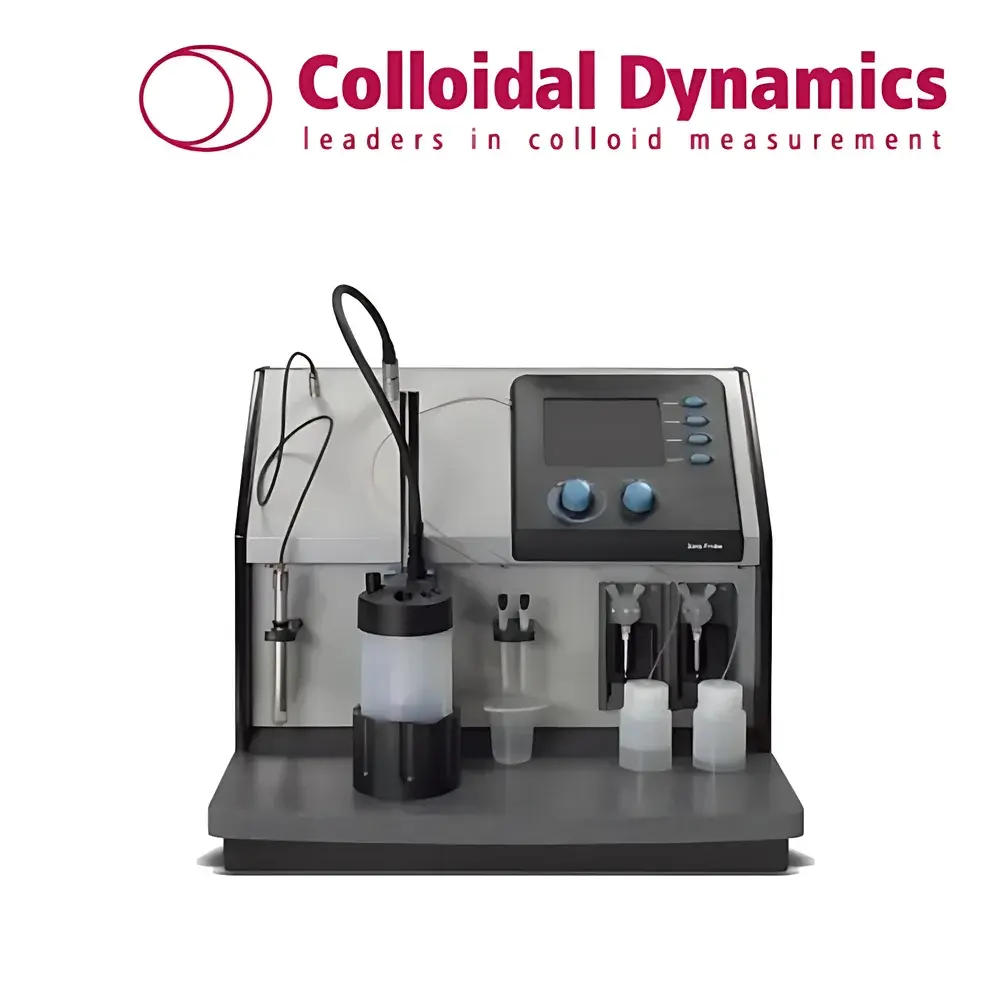
Colloidal Dynamics ZetaProbe Electroacoustic Zeta Potential Analyzer
| Brand | Colloidal Dynamics |
|---|---|
| Origin | USA |
| Manufacturer Type | Authorized Distributor |
| Origin Category | Imported |
| Model | ZetaProbe |
| Price Range | USD 68,000–136,000 |
| Zeta Potential Range | ±300 mV |
| pH Range | 1–13 |
| Operating Temperature Range | 5–50 °C |
| pH Resolution | 0.1 |
| Temperature Resolution | 0.1 °C |
| Accuracy | ±1% of reading (typical) |
| Repeatability | ±0.01 mV (standard deviation over 10 measurements) |
Overview
The Colloidal Dynamics ZetaProbe is a benchtop electroacoustic zeta potential analyzer engineered for direct, in-situ measurement of electrophoretic mobility and zeta potential in concentrated, undiluted colloidal dispersions — including pastes, gels, slurries, cements, and highly viscous or heterogeneous systems where conventional laser Doppler electrophoresis fails. Unlike optical methods requiring dilution and optical clarity, the ZetaProbe employs patented Multiple Frequency Electro-Acoustic Spectroscopy (MFEAS), which measures the acoustic response of charged particles under an oscillating electric field. This principle enables quantitative determination of dynamic electrophoretic mobility across broad frequency spectra (typically 1–10 MHz), followed by rigorous conversion to zeta potential using the O’Brien–Hunter theory adapted for concentrated systems. The instrument operates without optical path constraints, eliminating sample preparation artifacts and preserving native dispersion structure — critical for process-relevant characterization in industrial R&D and manufacturing environments.
Key Features
- Patented Multiple Frequency Electro-Acoustic Spectroscopy (MFEAS) for robust zeta potential quantification in opaque, turbid, or high-concentration samples (up to 60% v/v solids)
- Integrated automatic titration module with dual-channel precision dosing for real-time pH and additive titrations — enabling rapid isoelectric point (IEP) determination and dispersant/flocculant optimization
- Simultaneous acquisition of zeta potential, dynamic electrophoretic mobility, conductivity, temperature, and pH — all referenced to NIST-traceable calibration standards
- Real-time correction for double-layer distortion and particle-particle interactions using proprietary concentration-dependent dielectric and conductivity models
- Compact, modular architecture with built-in temperature-controlled cell holder (5–50 °C) and auto-compensated pH/temperature sensor suite (0.1 °C / 0.1 pH resolution)
- FDA 21 CFR Part 11-compliant software with full audit trail, electronic signatures, and secure user-role management for GLP/GMP-regulated labs
Sample Compatibility & Compliance
The ZetaProbe accommodates a wide spectrum of challenging materials without dilution or filtration: ceramic slips, coal-water slurries, pharmaceutical suspensions, cement pastes, latex emulsions, clay gels, pigment dispersions, and biological colloids. Its non-optical detection method ensures compatibility with opaque, absorbing, or highly scattering media — eliminating the need for centrifugation, ultrasonication, or solvent exchange. The system meets ASTM D7824–22 (Standard Test Method for Zeta Potential of Colloidal Dispersions by Electroacoustic Measurement) and supports ISO 13099-3:2021 compliance for zeta potential reporting. All calibration protocols follow NIST-traceable reference materials (e.g., polystyrene sulfate latex standards), and hardware design conforms to IEC 61010-1 safety requirements for laboratory electrical equipment.
Software & Data Management
ZetaProbe Control Suite is a Windows-based application offering intuitive workflow navigation, automated method templates, and customizable report generation (PDF, CSV, XML). It features embedded statistical analysis tools for batch comparison, trend monitoring, and DOE-based formulation screening. Raw electroacoustic spectra are stored with full metadata (time stamp, operator ID, environmental conditions, cell ID), and all processing steps — including background subtraction, double-layer correction, and mobility-to-zeta conversion — are fully traceable and reversible. Audit logs record every parameter change, data export, and user login event. Data integrity is reinforced via encrypted database storage and optional integration with LIMS platforms via ASTM E1467-compliant APIs.
Applications
The ZetaProbe delivers actionable insights across materials science, process engineering, and quality assurance domains. In ceramics and minerals processing, it optimizes slurry rheology and green-body strength by mapping zeta potential vs. pH and dispersant dose. In pharmaceutical development, it characterizes nanoparticle surface charge stability under physiological pH gradients. For coatings and ink formulations, it validates surfactant efficacy and shelf-life prediction models. In wastewater treatment and mineral flotation, it quantifies collector adsorption kinetics on ore surfaces. Additional validated use cases include catalyst support charge tuning, polishing slurry zeta control in semiconductor CMP, and IEP-driven purification of biopolymers such as casein or pectin.
FAQ
Can the ZetaProbe measure zeta potential in samples with >40% solids content?
Yes — the electroacoustic method is uniquely suited for concentrated systems up to 60% v/v, with no requirement for dilution or optical transparency.
Does the instrument require calibration with standard particles?
Yes — routine calibration uses NIST-traceable polystyrene sulfate latex standards; pH and conductivity sensors are calibrated per ISO 787-18 and ASTM D1125 protocols.
How does the ZetaProbe correct for double-layer overlap in high-ionic-strength systems?
It applies a modified O’Brien–Hunter model incorporating measured conductivity, dielectric constant, and volume fraction to iteratively solve for effective particle surface potential.
Is the automatic titration module compatible with non-aqueous solvents?
No — the integrated titration system is designed exclusively for aqueous electrolyte solutions (e.g., KCl, NaNO₃) within pH 1–13 and conductivity ≤2 S/m.
What regulatory documentation is provided for GMP validation?
IQ/OQ/PQ protocols, 21 CFR Part 11 validation package, and risk-based URS documentation are available upon request for qualified laboratories.



