
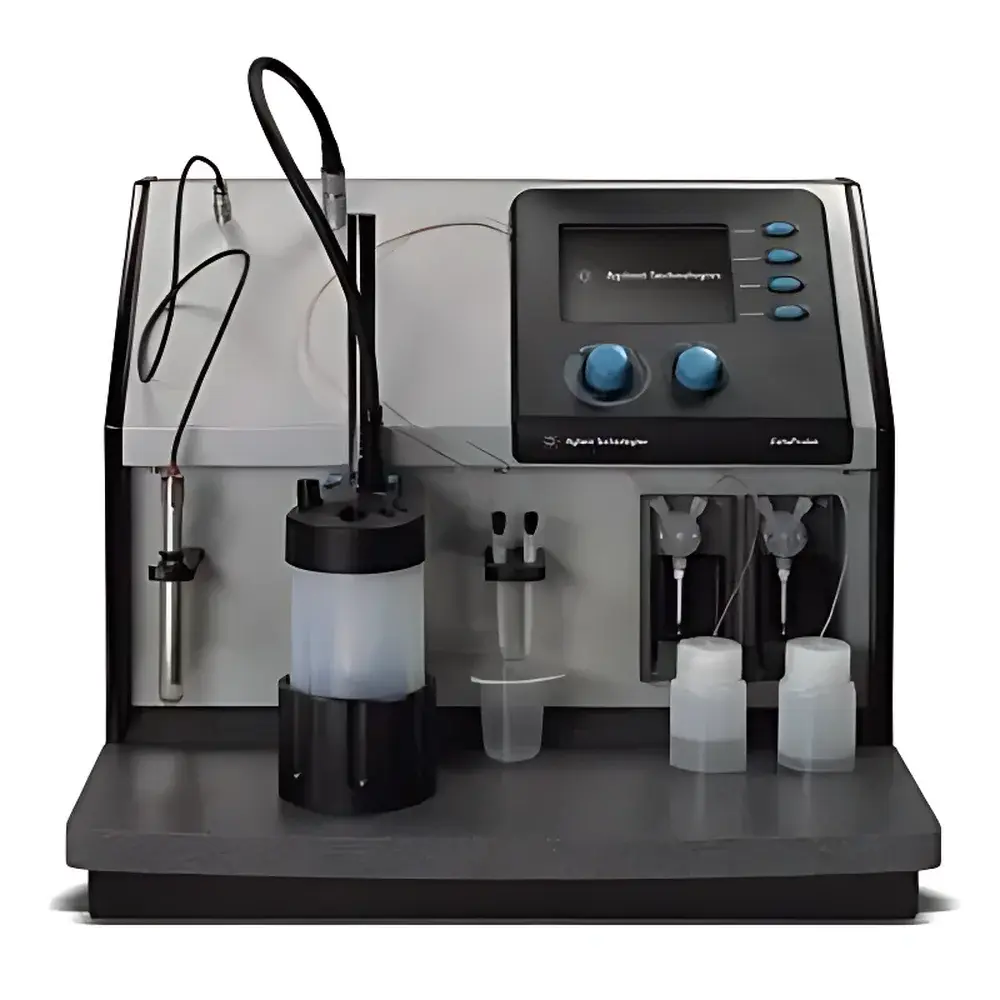
Colloidal Dynamics ZetaProbe High-Concentration Zeta Potential Analyzer
| Brand | Colloidal Dynamics |
|---|---|
| Origin | USA |
| Model | ZetaProbe |
| Sample Concentration Range | 0.5–60 vol% |
| Zeta Potential Measurement Range | ±500 mV (typical) |
| Particle Size Range for Zeta Measurement | 1 nm – 50 µm |
| pH Range | 0.5–13.5 |
| Conductivity Range | 0–5 S/m |
| Sample Volume | 20–250 mL |
| Measurement Time | <30 s per reading |
| Titration Resolution | 1 µL |
| IEP Detection | Automated via Multi-Point Titration |
| Data Export Format | Native CSV and Excel-Compatible .xls |
Overview
The Colloidal Dynamics ZetaProbe High-Concentration Zeta Potential Analyzer is an engineered solution for direct, non-dilutive electrophoretic characterization of colloidal dispersions across industrially relevant concentration ranges. Unlike conventional laser Doppler microelectrophoresis systems—which require sample dilution to avoid multiple scattering and conductivity artifacts—the ZetaProbe employs patented multi-frequency electroacoustic spectroscopy (ESA), a technique grounded in the physical coupling between acoustic waves and charged particle motion under an oscillating electric field. This principle enables robust measurement of dynamic electrophoretic mobility—and thus zeta potential—without optical path constraints or assumptions about particle size distribution. As a result, the instrument delivers quantitative surface charge data for opaque, highly concentrated, or optically heterogeneous systems such as titanium dioxide slurries, CMP polishing formulations, pigment pastes, ceramic slips, and cementitious suspensions, where traditional optical methods fail.
Key Features
- Patented multi-frequency electroacoustic spectroscopy (ESA) for label-free, dilution-free zeta potential determination
- Direct analysis of samples from 0.5 to 60 vol% solids—no centrifugation, filtration, or dilution required
- Integrated dual-channel syringe pump with 1 µL volumetric resolution for automated acid/base or additive titrations
- Real-time, simultaneous acquisition of zeta potential, pH, conductivity, temperature, and dynamic mobility
- Immersion-type probe design with axial bottom agitation—no moving parts in contact with sample; minimal maintenance
- IEP (Isoelectric Point) identification via programmable titration sequences with automatic endpoint detection
- No particle size input required—measurements are inherently independent of optical scattering models
- Robust mechanical architecture optimized for laboratory and pilot-plant environments, including vibration-damped housing and IP54-rated electronics
- Measurement cycle completes in under 30 seconds per data point, with configurable time-delay options for kinetic studies
Sample Compatibility & Compliance
The ZetaProbe accommodates viscous, gel-like, and heterogeneous suspensions—including cement pastes, latex concentrates, phosphor slurries, clay dispersions, and abrasive polishing compounds—that cannot be reliably analyzed by optical zeta potential analyzers. Its electroacoustic transduction mechanism remains insensitive to optical opacity, particle aggregation state, or high ionic strength (up to 5 S/m). The system supports GLP-compliant operation through audit-trail-enabled software logging, user-access controls, and timestamped raw-data archiving. While not certified to a specific regulatory standard, its measurement methodology aligns with ASTM D7825–19 (Standard Test Method for Zeta Potential of Nanoparticles in Aqueous Media by Electroacoustic Techniques) and supports documentation requirements for FDA 21 CFR Part 11–governed quality control workflows when deployed with appropriate procedural controls.
Software & Data Management
The ZetaProbe Control Suite provides a Windows-native interface with intuitive workflow navigation, real-time graphing, and automated report generation. All measurements—including titration curves, mobility vs. pH plots, and conductivity-corrected zeta values—are stored in a relational database with full metadata tagging (operator ID, timestamp, method name, calibration status). Raw data exports natively to CSV and Excel-compatible .xls formats, enabling seamless integration with LIMS platforms and statistical process control (SPC) tools. Software versioning, electronic signature support, and configurable user roles ensure traceability and compliance readiness. Calibration logs, sensor diagnostics, and system self-tests are accessible within the application, supporting routine instrument qualification per ISO/IEC 17025 guidelines.
Applications
The ZetaProbe serves as a critical tool in formulation science and process optimization across sectors where colloidal stability dictates product performance. In pigment and ink manufacturing, it quantifies dispersant efficacy and identifies optimal surfactant dosage without altering slurry rheology. For semiconductor CMP slurry development, it correlates zeta potential trends with removal rate and surface defectivity. In ceramics and advanced materials processing, it guides wet-milling parameters and binder selection by monitoring surface charge evolution during aging. Additional validated use cases include: stabilization assessment of natural latex emulsions; flocculation control in mineral dewatering; surface functionalization verification of catalyst supports and zeolites; and pH-dependent charge profiling of pharmaceutical nanosuspensions during early-stage development.
FAQ
Does the ZetaProbe require optical transparency for measurement?
No—electroacoustic spectroscopy does not rely on light transmission or scattering; it functions equally well with opaque, colored, or turbid suspensions.
Can the instrument measure zeta potential of gels or highly viscous pastes?
Yes—its immersion probe and axial agitation design enable reproducible measurements of semi-solid systems such as cement paste, battery electrode slurries, and polymer-modified dispersions.
Is particle size input necessary for zeta potential calculation?
No—the electroacoustic method derives electrophoretic mobility directly from pressure wave amplitude and phase shift; no Smoluchowski or Henry function assumptions are applied.
How is the isoelectric point (IEP) determined?
Through automated titration: the software increments titrant volume, records zeta potential at each step, and fits the resulting curve to identify the pH at which zeta = 0 mV.
What calibration procedures are recommended for routine operation?
Daily verification using standardized reference suspensions (e.g., polystyrene latex in low-conductivity buffer) and periodic sensor validation against NIST-traceable pH and conductivity standards.



