
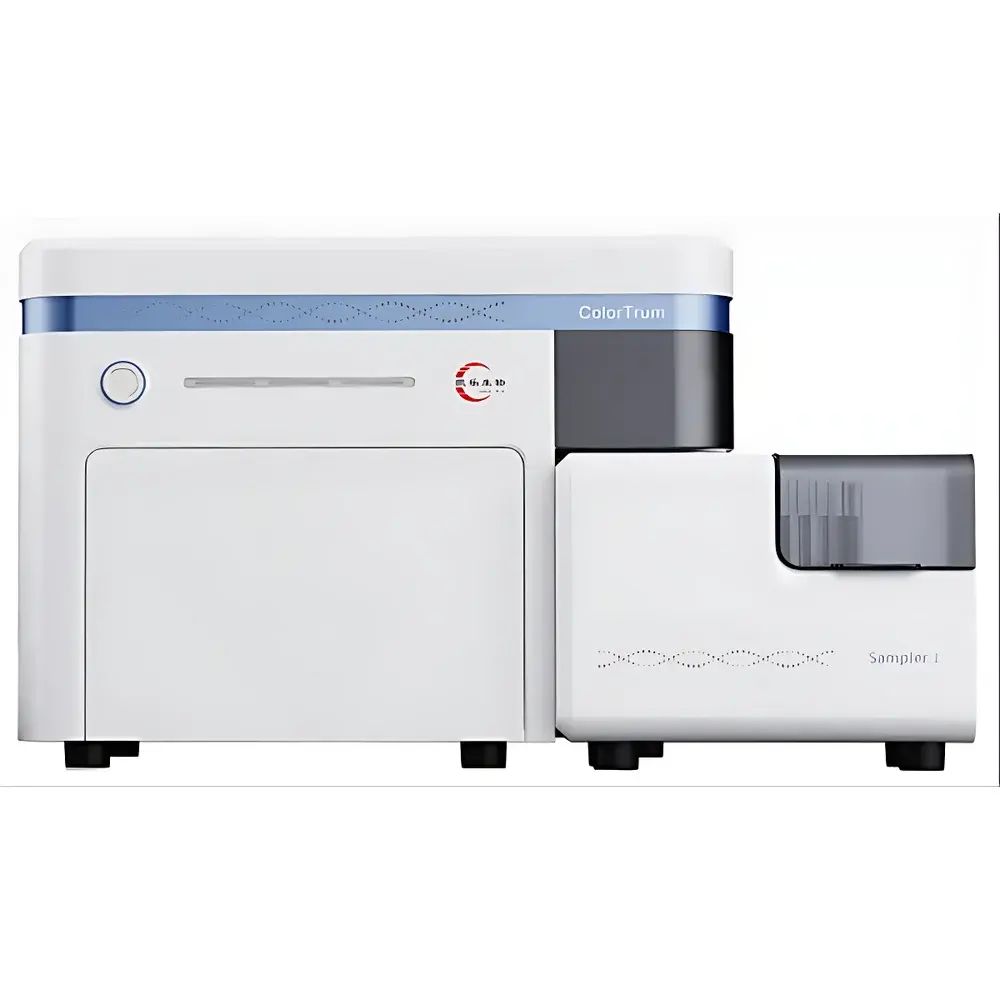
ColorTrum SAMPLER1 Full-Spectrum Flow Cytometer
| Brand | KELLER HCW |
|---|---|
| Origin | Jiangsu, China |
| Manufacturer Type | Authorized Distributor |
| Product Category | Domestic |
| Model | SAMPLER1 |
| Pricing | Available Upon Request |
| Product Type | Flow Cytometer |
| Spectral Detection Range | 420–832 nm |
| Dynamic Range | 10⁷·² (log scale) |
| Fluorescence Sensitivity | High |
| Resolution | High |
| Linearity | ≥0.99 |
| Continuous Sample Loading Duration | Up to 30 min |
| Temperature Control | Precise |
| Vibration Damping | Integrated |
| Optical-Electronic Module | Modular Design |
Overview
The ColorTrum SAMPLER1 Full-Spectrum Flow Cytometer is an advanced benchtop flow cytometry platform engineered for high-parameter, high-fidelity spectral profiling of single cells and submicron particles. Unlike conventional filter-based cytometers, the SAMPLER1 employs full-spectrum detection—capturing the complete fluorescence emission profile across 420–832 nm using a high-throughput transmission grating and back-illuminated scientific CMOS detector array. This architecture enables unmixing of highly overlapping fluorophore signatures without hardware reconfiguration, supporting up to 30+ simultaneous parameters from a single acquisition. The system operates on hydrodynamic focusing principles with laminar sheath flow, ensuring consistent core stream stability and minimal coefficient of variation (<2% CV for PE-Cy7 in standard calibration beads). Designed for reproducible quantitative immunophenotyping, cell cycle analysis, apoptosis assessment, and rare-event detection, the SAMPLER1 meets the analytical rigor required in academic core facilities, biopharma QC labs, and translational research environments.
Key Features
- Full-spectrum acquisition across 420–832 nm with 2-nm optical resolution and <0.5% wavelength drift over 8-hour operation
- Dynamic range of 10⁷·² on linear and logarithmic scales—validated per ISO 21501-4 for particle sizing and fluorescence intensity quantification
- Integrated thermal management system maintaining sample chamber at 4–37 °C ±0.3 °C, compliant with CLSI H56-A guidelines for temperature-sensitive assays
- Vibration-isolated optical baseplate with passive damping mounts, reducing mechanical noise to <5 nm RMS displacement under ambient lab conditions
- Modular photodetector architecture featuring low-noise transimpedance amplifiers and 16-bit digitization per channel, enabling high-fidelity signal capture without gain switching artifacts
- Continuous sample introduction capability for ≥30 minutes without clogging or pressure fluctuation—verified using 10 µm polystyrene bead suspensions at 60 µL/min flow rate
Sample Compatibility & Compliance
The SAMPLER1 accommodates suspension-based biological samples including peripheral blood mononuclear cells (PBMCs), dissociated tumor tissue, cultured adherent cells (after enzymatic detachment), and microbial populations. Compatible with standard 12×75 mm FACS tubes, 96-well plates (via optional autosampler), and microcentrifuge tubes (with adapter). All fluidic pathways are constructed from medical-grade PEEK and fused silica capillaries, certified per USP Class VI and ISO 10993-5 for cytotoxicity. The instrument complies with IEC 61010-1:2010 for laboratory equipment safety and supports audit-ready operation under GLP and GMP frameworks—including electronic signature support, user role-based access control, and 21 CFR Part 11–compliant data integrity features when paired with validated software modules.
Software & Data Management
Acquisition and analysis are managed through SpectraFlow Suite v3.2—a CE-IVD marked application built on a .NET 6 framework with native HDF5 file storage. The software provides real-time spectral unmixing using constrained non-negative matrix factorization (cNMF), batch compensation with reference controls, and automated population identification via density-based spatial clustering (DBSCAN) and t-SNE dimensionality reduction. Raw data files include embedded metadata per MIAME and MIFlowCyt standards. Export options include FCS 3.1, CSV, PNG, and interactive HTML reports with embedded gating history. Data backups adhere to ISO/IEC 27001-aligned encryption protocols; local archive retention policies are configurable to meet institutional IRB or regulatory retention mandates (e.g., FDA 21 CFR Part 11, EMA Annex 11).
Applications
- High-dimensional immunophenotyping of human immune subsets (e.g., T-cell exhaustion markers PD-1, TIM-3, LAG-3 alongside activation states)
- Comprehensive phospho-flow analysis for intracellular signaling pathway interrogation (e.g., p-STAT5, p-ERK, p-S6)
- Cell cycle and DNA content profiling using DAPI/Hoechst with multi-cycle deconvolution algorithms
- Rare event detection in hematopoietic stem cell monitoring (frequency detection limit: 0.001% at 95% confidence, n=10⁶ events)
- Microvesicle and exosome characterization via side-scatter calibration against NIST-traceable silica nanoparticles (100–1000 nm)
- Multi-species compatibility validated for mouse, non-human primate, bovine, and zebrafish samples
FAQ
What spectral unmixing algorithm does the SAMPLER1 use?
It implements constrained Non-negative Matrix Factorization (cNMF) with user-defined reference spectra or auto-generated basis sets from control samples.
Is the system compatible with third-party reagents and antibodies?
Yes—no proprietary labeling requirements; fully interoperable with BD Horizon, BioLegend TotalSeq, and Sony iQue-compatible conjugates.
Can the SAMPLER1 be integrated into a LIMS environment?
Yes—supports ASTM E1482-compliant HL7 v2.5.1 and RESTful API endpoints for bidirectional sample tracking and result ingestion.
Does the instrument support automated cleaning protocols?
Yes—integrated syringe-driven decontamination cycles with configurable bleach, ethanol, and water flush sequences, logged with timestamps and operator IDs.
What maintenance intervals are recommended for optimal performance?
Optical alignment verification every 6 months; fluidic tubing replacement every 12 months; annual calibration using NIST-traceable Rainbow beads (Cat. No. RCP-30-5A).



