
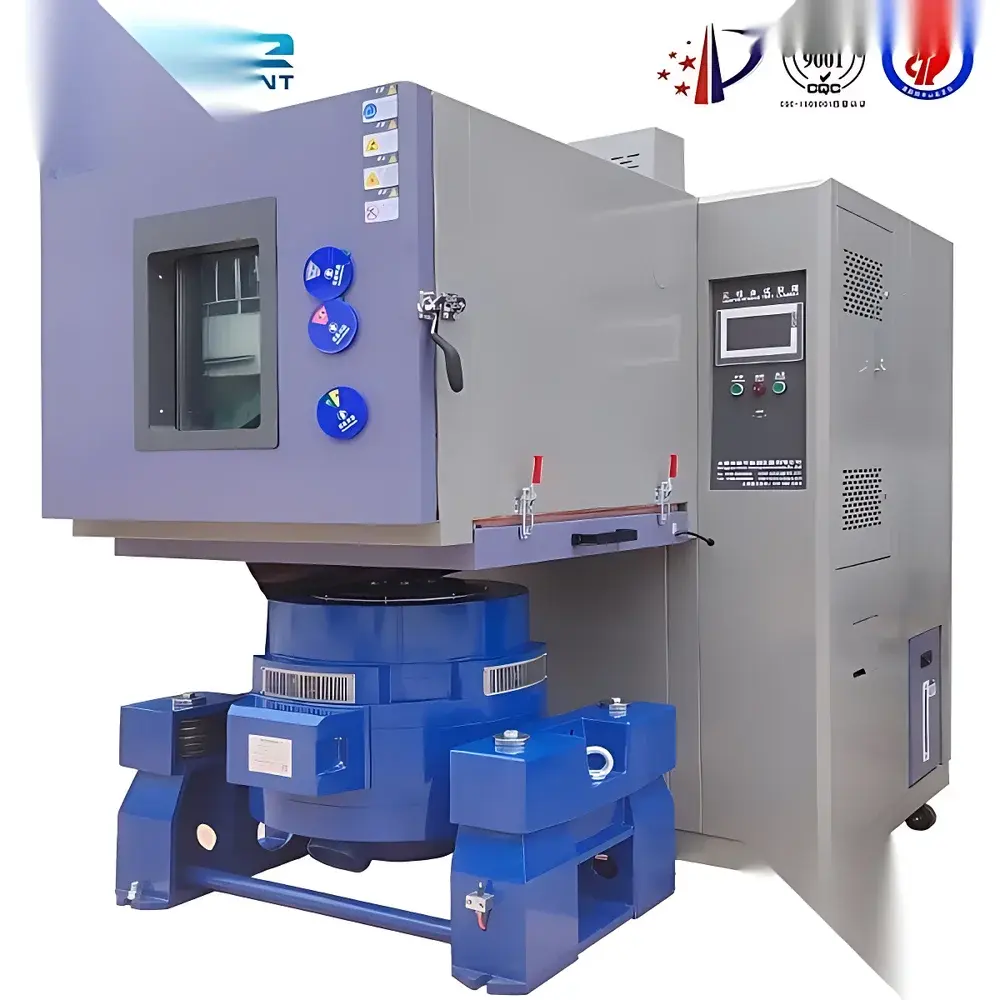
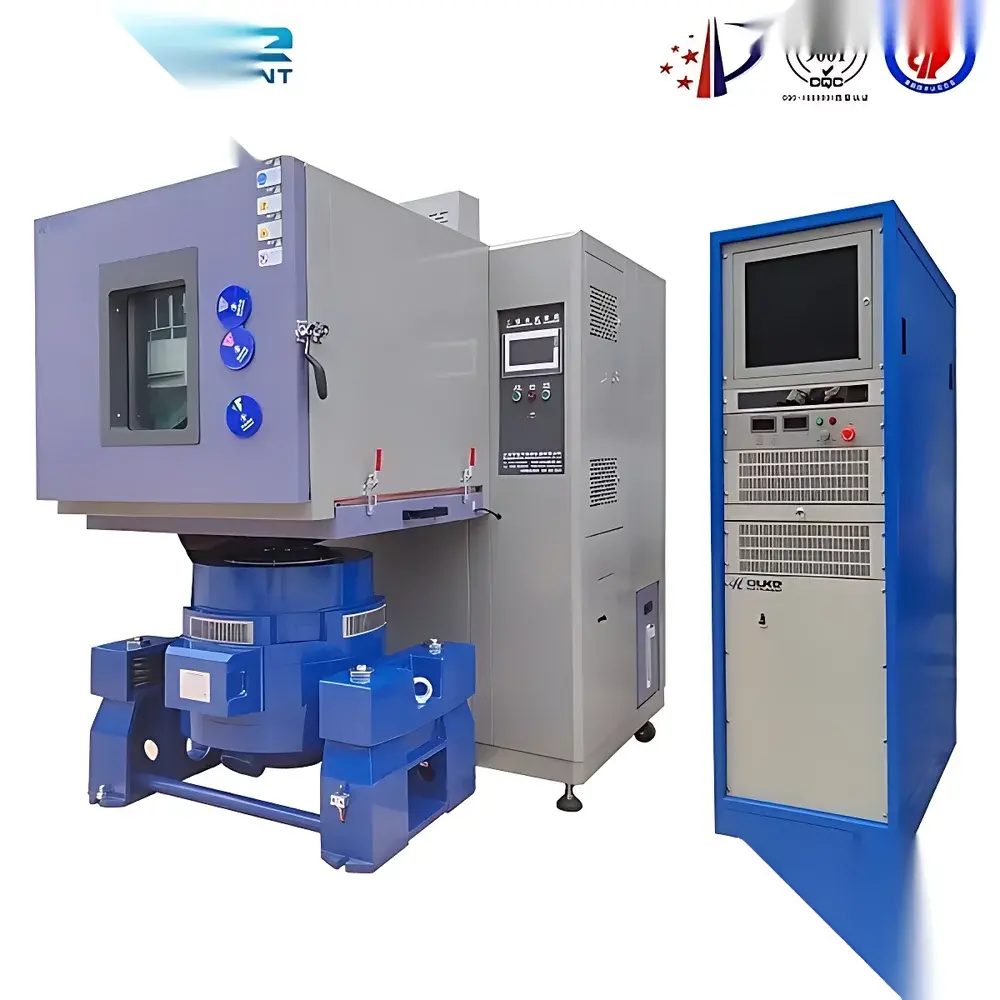
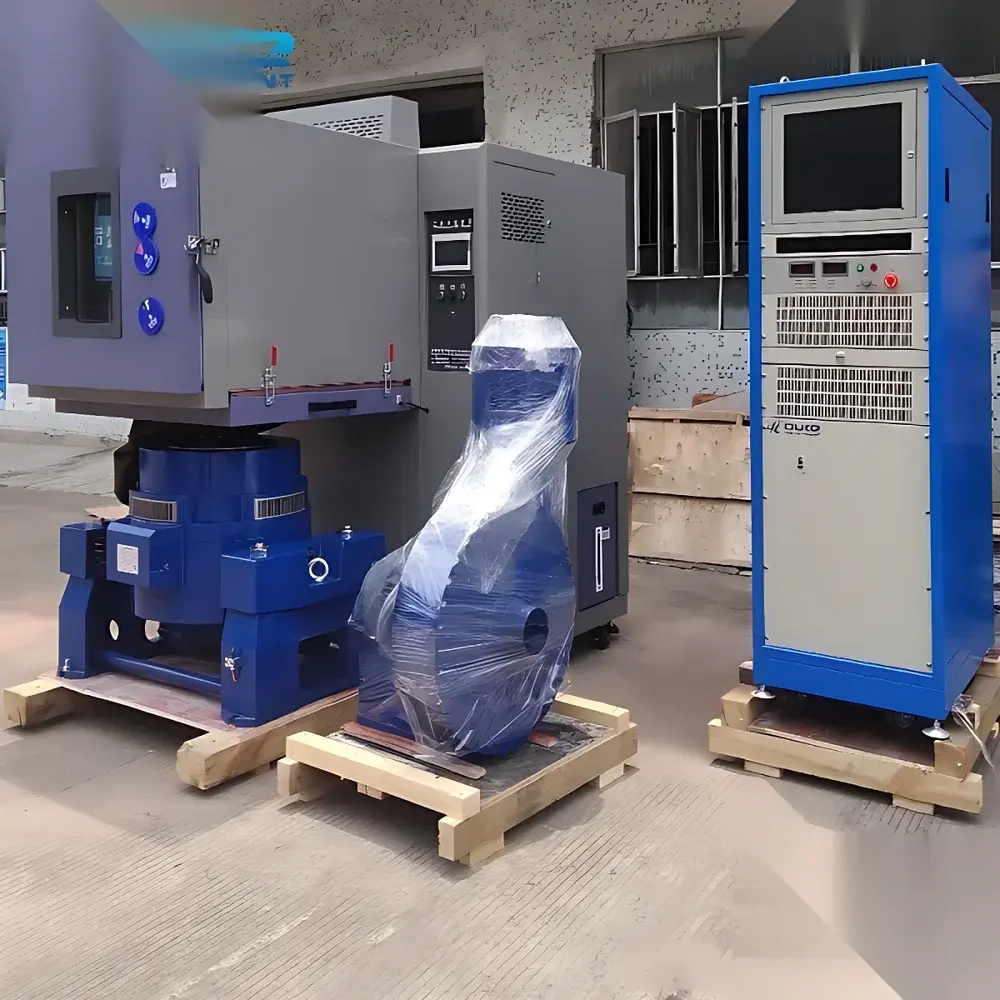
Combined Environmental Stress Screening System: Temperature-Humidity-Vibration Test Chamber with Electrodynamic Shaker
| Temperature Range | -20 °C to +130 °C |
|---|---|
| Humidity Range | 40–98% RH |
| Temperature Uniformity | ±2 °C (unloaded) |
| Temperature Fluctuation | ±0.5 °C (unloaded) |
| Humidity Fluctuation | ±2% RH |
| Heating Rate | -20 °C to +120 °C ≤ 60 min |
| Cooling Rate | Ambient to -20 °C ≤ 45 min (unloaded) |
| Vibration Force (Sine) | 2.94 kN (300 kgf) |
| Frequency Range | 5–2000 Hz |
| Max Acceleration | 980 m/s² (100 g) |
| Max Velocity | 1.1 m/s |
| Max Displacement | 25 mm p-p |
| Moving Mass | 2.7 kg |
| Payload Capacity | 120 kg |
| Table Diameter | 150 mm |
| Vibration Axis | Vertical (Z-axis) |
| Test Duration Setting | 0–999 h |
| Compliance | GB/T 2423.1, GB/T 2423.3, GB/T 2423.4, IEC 60068-2-1 (Cold), IEC 60068-2-3 (Damp Heat), IEC 60068-2-30 (Cyclic Damp Heat) |
Overview
The Combined Environmental Stress Screening System integrates precise climatic conditioning (temperature and humidity) with high-fidelity electrodynamic vibration excitation in a single, co-located test environment. Engineered for reliability validation under realistic operational stressors, it applies simultaneous or sequential thermal, hygroscopic, and mechanical stimuli—mimicking conditions encountered during manufacturing, logistics, and field deployment. Its core measurement architecture conforms to the Couette flow principle for thermal-humidity control and electromagnetic force generation per Lorentz law for vibration actuation. Unlike standalone environmental chambers or shakers, this system enables true triaxial stress correlation—where temperature-induced material softening or humidity-driven interfacial degradation directly modulates dynamic response characteristics. It is not a modular add-on but a structurally unified platform with mechanically decoupled control electronics, thermally isolated shaker interface, and pressure-compensated chamber coupling—ensuring metrological integrity across all three domains without cross-domain interference.
Key Features
- Electrodynamic shaker with sealed CT-2000/PD frequency controller—designed for energy efficiency (60% power reduction vs. legacy analog units) and long-term stability under thermal cycling
- Integrated lift-and-translate positioning platform (2500 mm horizontal travel, 1200 mm vertical stroke, 2-ton lifting capacity) enabling repeatable, tool-free chamber-to-shaker alignment
- Dual-interface chamber base: Ø200 mm circular port for vertical vibration; 1000 × 1000 mm square port for optional horizontal excitation—both fitted with high-flexibility, cryo-rated bellows seals (−70 °C to +150 °C continuous)
- Triple-layer sealing system: Silicone gasket + dual-stage composite waveguide + pressure-relief venting—prevents internal overpressure during high-g vertical sweeps
- Modular blind plate configuration (three interchangeable plates) supports dedicated test modes: temperature-humidity-vibration (TVH), temperature-vibration (TV), and humidity-temperature cycling (HT)—all traceable via unique plate ID calibration records
- SUS304 interior lining with polyurethane/glass fiber insulation (R-value > 3.2 m²·K/W); anti-condensation heating on observation window and door frame per IEC 60068-2-30 Annex A
Sample Compatibility & Compliance
The system accommodates specimens up to 120 kg mass and 150 mm footprint, with thermal-mechanical boundary conditions validated for PCB assemblies, MEMS sensors, automotive ECUs, medical device housings, and hermetically sealed packaging. All structural interfaces meet ISO 2041:2018 definitions for vibration test fixtures and comply with mechanical safety requirements per EN 61000-6-4 (EMC) and EN 61000-6-2 (immunity). Calibration traceability follows ISO/IEC 17025:2017 through third-party accredited providers. Environmental profiles adhere strictly to GB/T 2423 series (equivalent to IEC 60068-2), including Test A (cold), Test B (dry heat), Test Ca (damp heat, steady state), and Test Db (cyclic damp heat). Humidity control meets ASTM E104-22 specification for saturated salt solution verification at 40–98% RH points.
Software & Data Management
Control firmware implements real-time closed-loop regulation of temperature, humidity, and vibration parameters using PID+feedforward algorithms. The embedded HMI supports both manual sweep (frequency step, dwell, resonance search) and programmable multi-segment profiles—including synchronized ramp-hold-sweep sequences across all three domains. All test logs are timestamped, digitally signed, and stored with full audit trail (user action, parameter change, alarm event, hardware status). Data export complies with ASTM E2919-22 for digital test report formatting and supports CSV, XML, and HDF5 formats. Optional 21 CFR Part 11 compliance package includes electronic signature enforcement, role-based access control, and immutable log archiving—fully compatible with GLP/GMP laboratory information management systems (LIMS).
Applications
This system is deployed in R&D labs and production QA environments for accelerated life testing (ALT), HALT (Highly Accelerated Life Testing), and qualification per MIL-STD-810H Method 514.7 (vibration) and Method 502.7 (temperature/humidity). Typical use cases include: fatigue assessment of solder joints under thermal cycling + resonant vibration; moisture ingress evaluation in conformal-coated electronics during damp heat + low-frequency shake; validation of adhesive bond strength in battery enclosures subjected to −40 °C soak + 50 g shock pulses; and reliability screening of IoT sensor modules exposed to 85 °C/85% RH + 2 kHz sine dwell. Its ability to sustain 100 g acceleration at 2000 Hz while maintaining ±0.5 °C thermal stability makes it suitable for aerospace-grade component validation where thermo-mechanical coupling dominates failure mechanisms.
FAQ
Does the system support horizontal vibration testing?
Yes—via the 1000 × 1000 mm square interface port and corresponding blind plate; horizontal axis alignment is verified using laser interferometry during installation.
What is the maximum specimen height allowable inside the chamber during vibration?
The internal clear height is 650 mm; however, displacement amplitude must be subtracted from usable volume—e.g., at 25 mm p-p displacement, net vertical clearance reduces to 637.5 mm.
Is remote monitoring supported?
Standard Ethernet/IP interface enables SNMP-based health telemetry and OPC UA integration for factory-wide MES connectivity.
How is humidity calibrated across the full range?
Traceable chilled-mirror hygrometer (Vaisala HUMICAP®) with NIST-traceable certificate installed internally; quarterly verification against saturated salt solutions per ASTM E104-22.
Can the system perform random vibration profiles?
No—this model is optimized for sinusoidal excitation only; random vibration capability requires upgrade to the RE-series controller option (not included in base configuration).



