
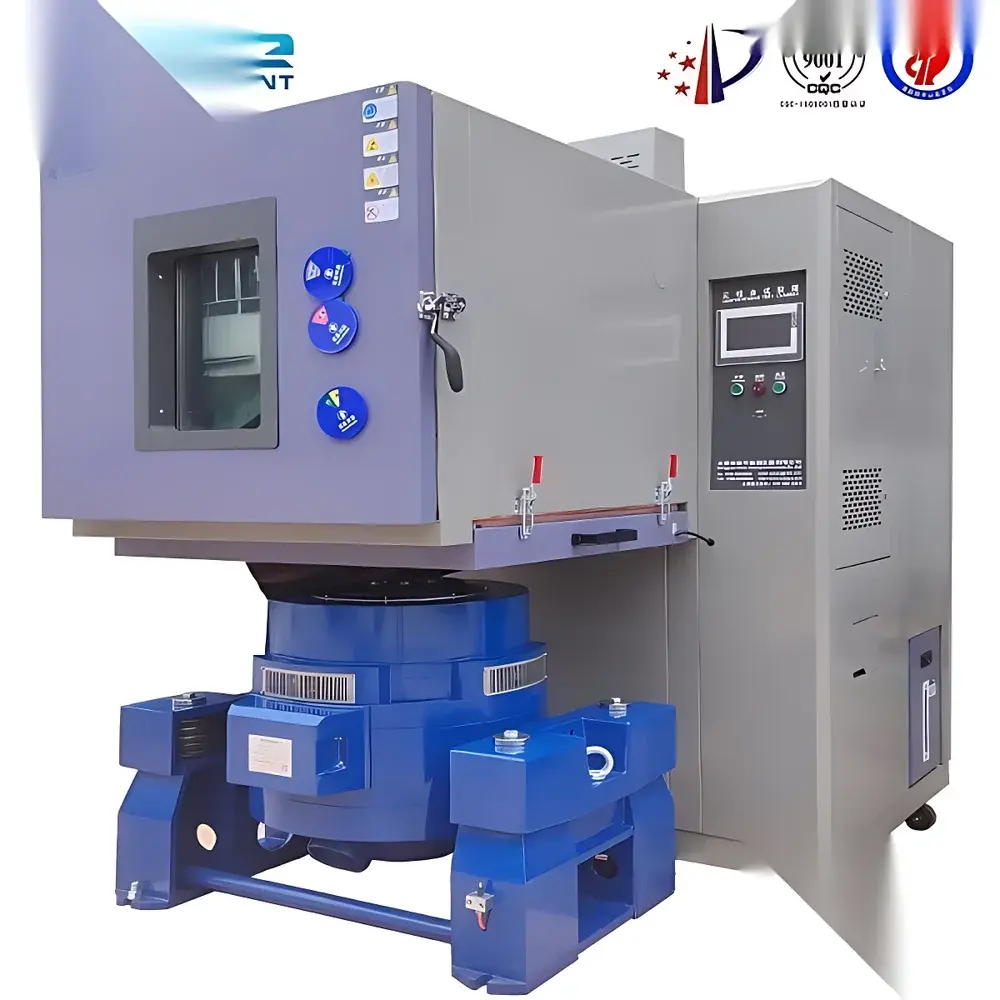
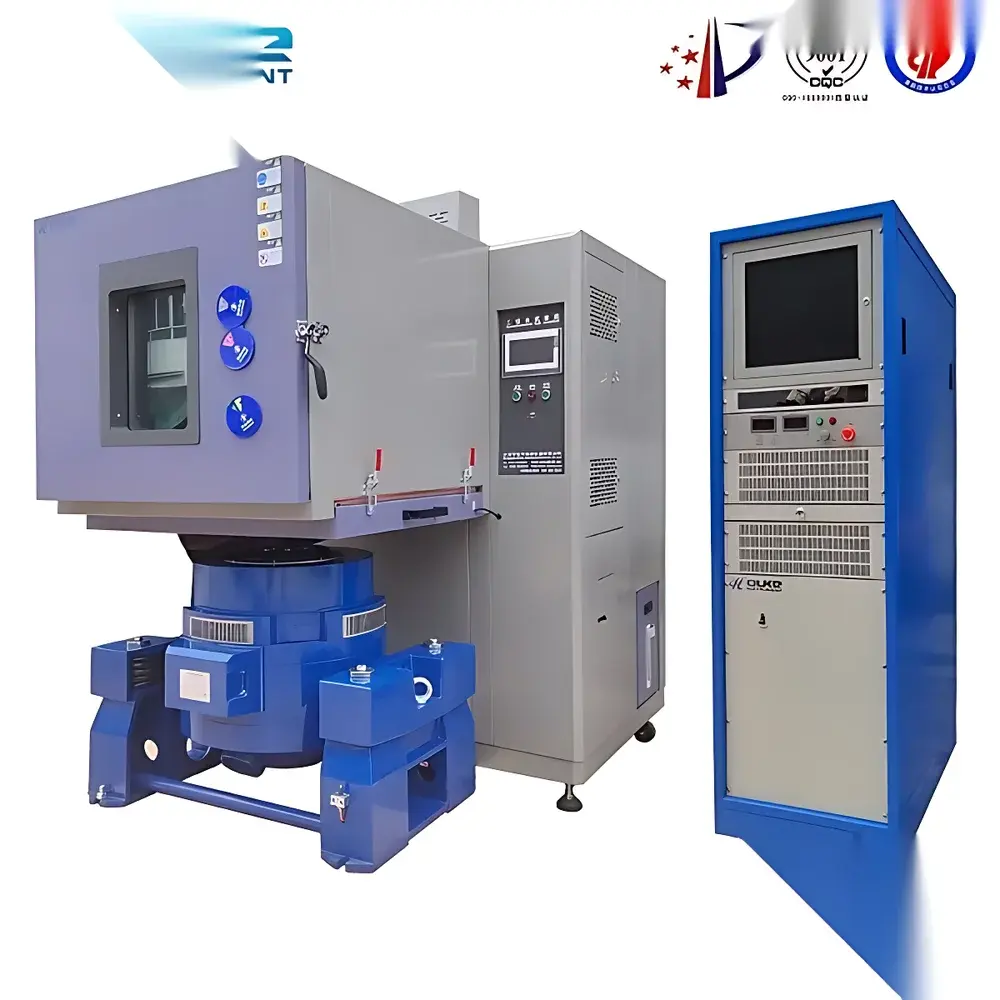
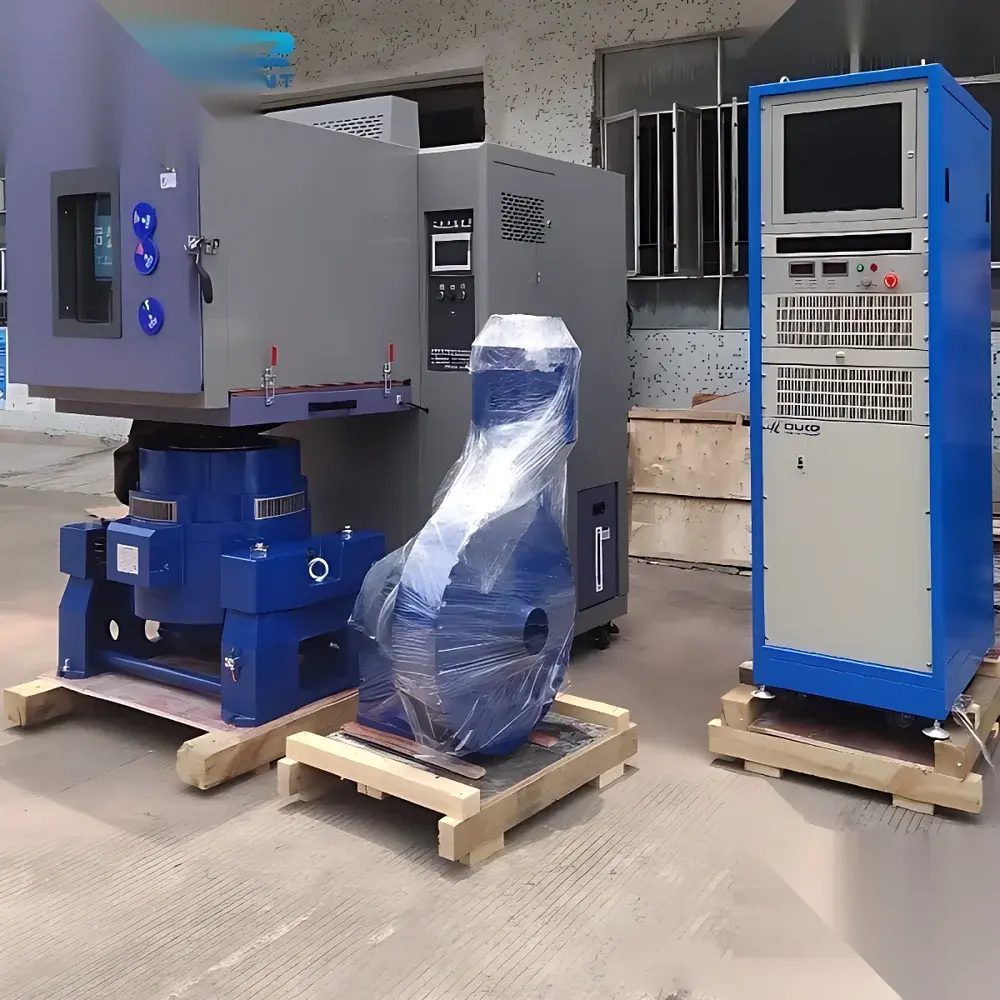
Combined Environmental Test Chamber for Temperature, Humidity and Vibration
| Brand | Other Brands |
|---|---|
| Origin | Imported |
| Manufacturer Type | Authorized Distributor |
| Price | USD 21,000 (FOB) |
| Compliance | GB/T 2423, GJB 150, IEC 60068 |
| Control Interface | 7″ TFT LCD Touchscreen with RS232/RS485 |
| Refrigeration System | Hermetic Scroll Compressor + Dual-Circuit Cascade Cooling |
| Humidity Range | 20–98% RH (non-condensing) |
| Temperature Range | −70°C to +180°C |
| Vibration Integration | Compatible with Electrodynamic Shakers (5–2000 Hz, 100 kN max force) |
| Chamber Volume Options | 150 L to 1000 L |
| Programmable Profiles | Up to 99 segments, 999 cycles per profile |
Overview
The Combined Environmental Test Chamber for Temperature, Humidity and Vibration is an integrated reliability validation platform engineered for simultaneous or sequential application of thermal, hygroscopic, and mechanical stress stimuli. It operates on the principle of multi-axis environmental simulation—where precise climatic control (via refrigerant-based vapor compression and steam/humidification systems) is mechanically decoupled yet spatially synchronized with electrodynamic vibration excitation. This architecture enables realistic replication of field service conditions encountered during aerospace vehicle launch, marine electronics deployment, automotive ECU qualification, and defense-grade avionics life-cycle testing. Unlike single-stress chambers, this system maintains strict cross-coupling integrity: vibration table isolation mounts prevent thermal distortion of shaker armatures, while sealed feedthroughs preserve chamber humidity uniformity (< ±2% RH deviation across working volume) under dynamic loading. The chamber’s structural frame is fabricated from stainless steel 304 with reinforced insulation (polyurethane foam, 150 mm thickness), ensuring thermal stability ≤ ±0.5°C and humidity recovery time < 10 min after door opening.
Key Features
- Modular integration architecture supporting third-party shakers (e.g., LDS V875, TIRA TV 51120) via ISO 10816-compliant mounting interfaces and dynamic load compensation algorithms
- Intelligent dual-stage refrigeration: primary R404A cascade loop for sub-zero operation (−70°C) and secondary R134a loop for rapid temperature ramping (up to 10°C/min at 25°C ambient)
- Steam humidification system with PID-controlled deionized water boiler and condensate recovery circuit, minimizing mineral buildup and enabling stable low-RH operation down to 20% RH
- 7-inch high-brightness TFT touchscreen HMI with embedded real-time data logging (100 ms sampling interval), user-defined alarm thresholds, and password-protected parameter locking
- Standard RS232/RS485 and optional Ethernet (TCP/IP) communication protocols compliant with Modbus RTU and SCPI command sets for lab automation integration
- Chamber interior constructed from electropolished SUS304 stainless steel with radius corners (R15) to prevent condensate pooling and facilitate cleaning under GLP audit requirements
Sample Compatibility & Compliance
The chamber accommodates test specimens up to 500 mm × 500 mm × 500 mm (W×D×H) on standard vibration tables, with custom payload adapters available for irregular geometries. All internal fixtures are non-outgassing and RoHS-compliant. Regulatory alignment includes full traceability to GB/T 2423.1–2423.10 (equivalent to IEC 60068-2 series), GJB 150.3–150.19 (Chinese military standards harmonized with MIL-STD-810H), and ISO 16750-4 for automotive environmental stress screening. Calibration certificates per ISO/IEC 17025 are provided with each unit shipment, covering temperature uniformity (±1.5°C over 1/3 working volume), humidity accuracy (±3% RH at 25°C/60% RH), and vibration amplitude linearity (±2% deviation across 10–1000 Hz bandwidth).
Software & Data Management
The embedded control software supports full-cycle programmability—including step, ramp, soak, and dwell sequences—with automatic transition logic between temperature/humidity/vibration phases. Data export formats include CSV, Excel (.xlsx), and PDF reports with embedded timestamped graphs. Optional PC-based software (ChamberLink Pro v4.2) adds remote monitoring, multi-chamber fleet management, and 21 CFR Part 11-compliant electronic signatures with audit trail generation (user action, timestamp, parameter change, IP address). Raw sensor logs (thermocouple, capacitive RH, accelerometer) are stored locally on industrial-grade SD card (32 GB) with cyclic overwrite protection and tamper-evident file hashing.
Applications
- Aerospace: Accelerated life testing of satellite power converters under combined thermal cycling (−55°C ↔ +85°C) and random vibration (PSD 0.04 g²/Hz, 20–2000 Hz)
- Automotive: Validation of ADAS camera modules per ISO 16750-4, including humidity soak at 85°C/85% RH followed by sinusoidal vibration at resonant frequencies
- Medical Devices: Verification of implantable pulse generator housing integrity under GJB 150.9 (wet heat) + GJB 150.16 (vibration) profiles
- Consumer Electronics: HALT/HASS screening of 5G baseband processors using gradient temperature sweeps (−40°C → +125°C) synchronized with 6-DOF vibration input
- Energy Storage: Cycle-life evaluation of Li-ion battery packs under GB/T 31485-specified thermal-humidity-vibration stress sequences
FAQ
Does the chamber support real-time synchronization between vibration waveform and temperature/humidity setpoints?
Yes—the controller executes synchronized triggers via hardware-level interrupt signals, enabling phase-locked execution of vibration spectra during specific thermal transients (e.g., initiating random shake at peak heating rate).
Can the system be validated for ISO/IEC 17025 accredited calibration?
Each unit ships with a factory calibration certificate issued by an ILAC-MRA signatory lab; on-site requalification services are available through authorized metrology partners.
What is the maximum allowable specimen mass for vibration testing within the chamber?
Payload capacity depends on selected shaker model; standard configurations support up to 100 kg at 50 g peak acceleration, with inertial mass compensation enabled in firmware.
Is dew point control available as an alternative to relative humidity programming?
Dew point mode is supported in advanced firmware versions (v3.8+), allowing direct specification of saturation temperature (−70°C to +90°C range) for condensation-sensitive materials.
How is electromagnetic interference (EMI) managed between the shaker amplifier and chamber sensors?
All signal paths use shielded twisted-pair cabling with ferrite chokes; vibration controller grounding is isolated from chamber earth via 1 kV-rated optical isolators to suppress common-mode noise.
Related Products



