
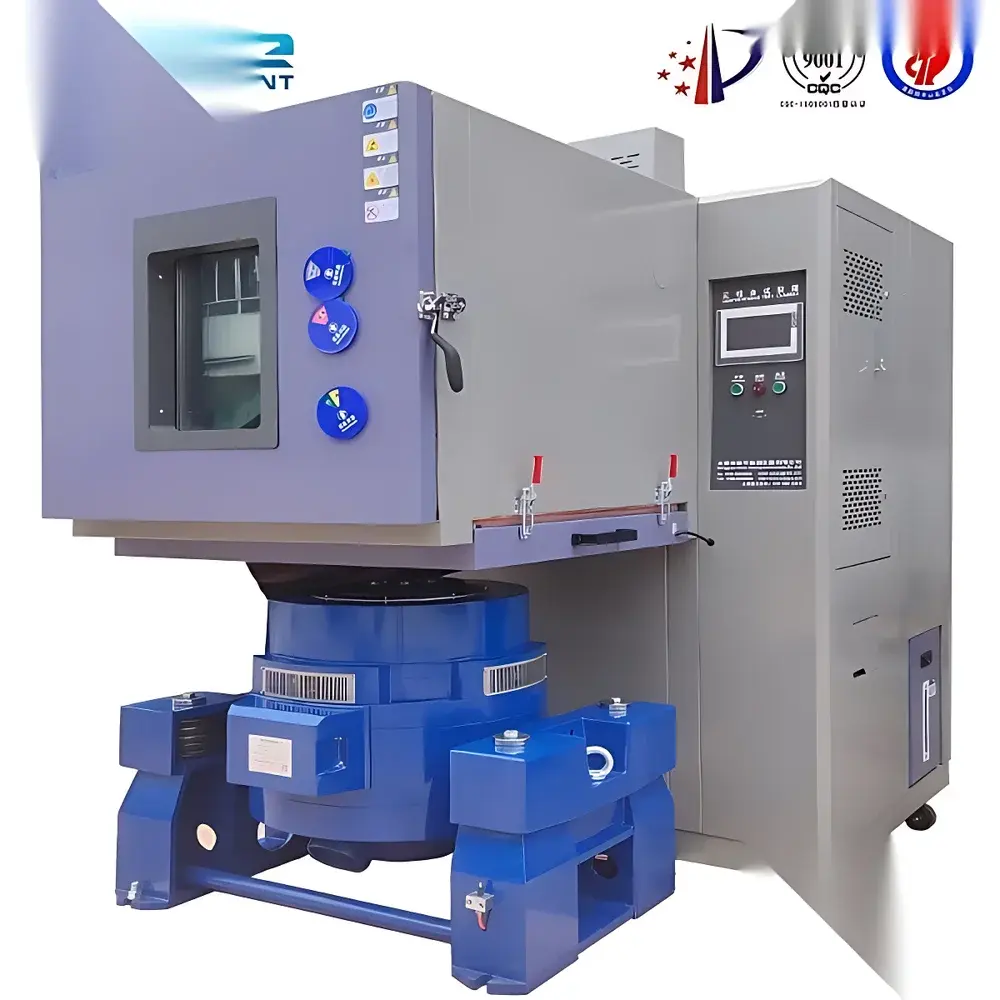
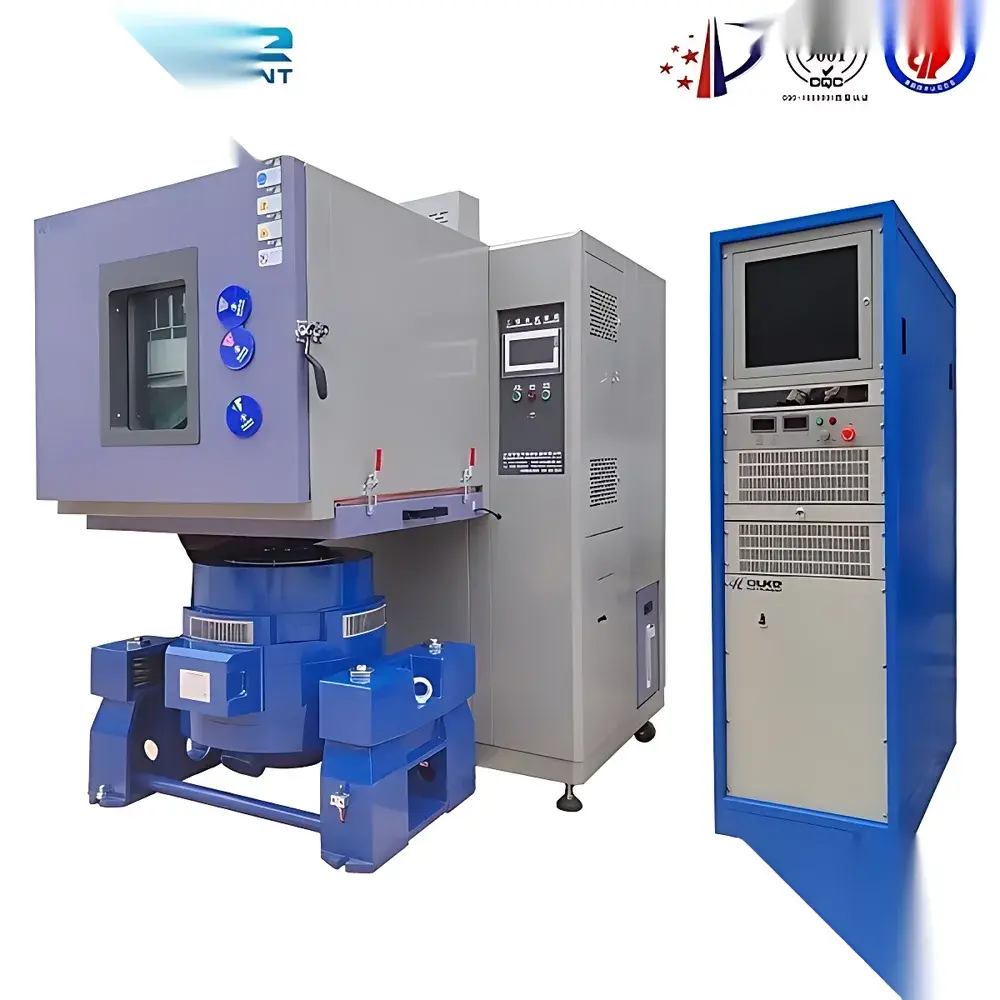
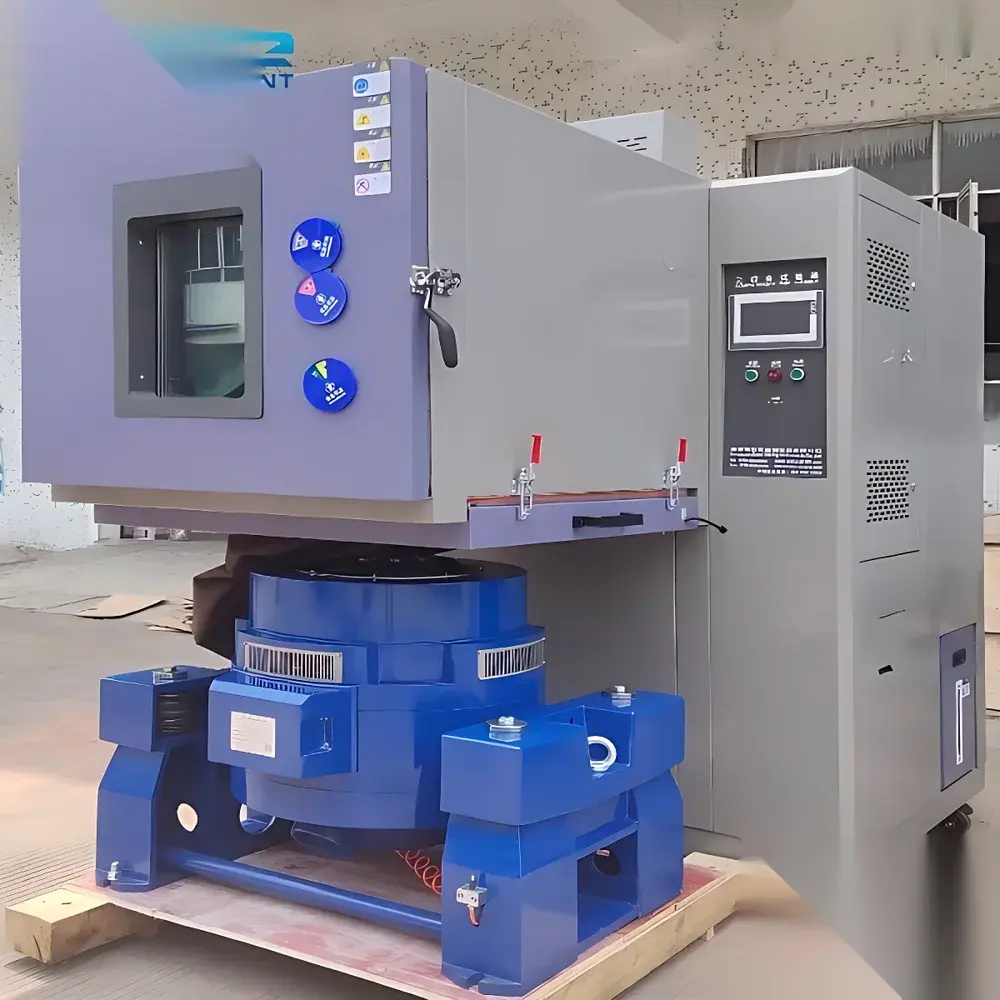
Combined Environmental Test Chamber for Temperature, Humidity and Vibration
| Brand | Other Brands |
|---|---|
| Origin | Imported |
| Manufacturer Type | Authorized Distributor |
| Price | USD 21,000 (FOB) |
Overview
The Combined Environmental Test Chamber for Temperature, Humidity and Vibration is an integrated reliability testing system engineered to simultaneously apply controlled thermal, hygroscopic, and mechanical stress profiles to electronic components, aerospace assemblies, automotive modules, and industrial packaging. It operates on a tri-axial synergistic test principle—precisely coordinating temperature conditioning (−70 °C to +180 °C), relative humidity control (10–98 % RH), and electrodynamic vibration excitation (5–2000 Hz, up to 100 g peak acceleration) within a single chamber volume. This enables accelerated life-cycle validation under realistic field conditions where environmental stressors co-occur—such as condensation-induced corrosion during thermal cycling combined with road-simulated vibration. The chamber’s architecture conforms to the fundamental requirements of MIL-STD-810H Method 520.5 (Combined Environments) and IEC 60068-2-64 for vibration testing in climatic chambers.
Key Features
- Hermetically sealed French “Tecumseh” (original brand name: “Tecumseh France”, now part of Emerson Climate Technologies) compressors for stable low-temperature performance down to −70 °C
- Dual-stage refrigeration circuit design with cascade configuration for extended low-temperature range and improved energy efficiency
- Multi-blade centrifugal circulation fan system with adjustable airflow velocity and laminar flow optimization—ensuring uniformity of ±0.5 °C temperature and ±2 % RH across the working volume (per IEC 60068-3-5)
- Independent heating, cooling, and humidification subsystems—minimizing cross-interference and enabling rapid transition between test phases (e.g., <10 min from −40 °C to +85 °C per ASTM D4332)
- Intelligent dual-channel PID microprocessor controller with touch-sensitive interface, real-time digital display of both temperature and relative humidity, and auto-tuning capability for optimal setpoint tracking
- Power-loss recovery function with non-volatile memory—resuming interrupted tests at exact elapsed time and condition without data loss or manual recalibration
- Structural integration of a high-fidelity electrodynamic shaker (5–2000 Hz, 50 mm stroke, 100 g peak) mounted directly beneath the test chamber floor, decoupled via active isolation to prevent feedback into climate control systems
Sample Compatibility & Compliance
The chamber accommodates test specimens up to 600 mm × 600 mm × 600 mm (W×D×H) with standardized mounting interfaces (ISO 10816-3 compliant fixture plates). It supports both stationary and dynamic load configurations—including PCB-level assemblies, avionics enclosures, battery packs, and sealed consumer electronics. All operational modes meet or exceed the technical specifications outlined in GB/T 2423.1–2022 (cold), GB/T 2423.2–2022 (dry heat), GB/T 2423.4–2022 (cyclic damp heat), GB/T 2423.10–2019 (sinusoidal vibration), and GJB 150.3A–2009 through GJB 150.19A–2009 series. Calibration traceability is maintained to national metrology institutes (NIM, China NMI) per ISO/IEC 17025:2017 requirements.
Software & Data Management
Equipped with proprietary Windows-based control software (v5.2+), the system provides synchronized logging of temperature, humidity, vibration acceleration (X/Y/Z axes), and chamber pressure at configurable sampling intervals (10 ms to 1 s). Raw data exports in CSV and MATLAB-compatible .mat formats support post-test spectral analysis (FFT, PSD, SRS). Audit trail functionality complies with FDA 21 CFR Part 11 requirements—including user authentication, electronic signatures, and immutable record retention. Test profiles can be imported/exported using XML schema aligned with ISTA 3A and JEDEC JESD22-A108F standards.
Applications
- Qualification of automotive ECUs subjected to thermal shock while exposed to road-induced broadband vibration
- Reliability screening of lithium-ion battery modules under combined high-humidity storage and sinusoidal shake conditions
- Validation of hermetic seal integrity in medical device housings using accelerated cyclic damp-heat + random vibration protocols
- Failure mode analysis of solder joints in aerospace-grade printed circuit boards under MIL-STD-810H Method 520.5 exposure
- Environmental stress screening (ESS) of military-grade connectors per MIL-PRF-28876 during production lot acceptance
FAQ
Does the chamber support simultaneous operation of full-range vibration and extreme low-temperature conditions?
Yes—the shaker system and refrigeration plant are thermally isolated and independently powered, enabling concurrent operation at −70 °C and 2000 Hz sine sweep.
Is third-party calibration certification included with delivery?
Calibration certificates traceable to NIM are provided upon request; optional UKAS-accredited calibration is available at additional cost.
Can vibration profiles be imported from external sources such as MATLAB or LMS Test.Lab?
Yes—the software accepts standard ASCII waveform files (.txt, .csv) and binary formats (.tdms, .uff) for direct playback synchronization with climate ramps.
What safety interlocks are implemented to protect samples during abnormal operating conditions?
Hardware-level cut-offs include over-temperature, over-humidity, excessive vibration amplitude, and refrigerant pressure fault detection—all triggering immediate shutdown and audible/visual alarms per IEC 61000-6-2 EMC compliance.
Is remote monitoring and control supported via Ethernet or industrial protocols?
Standard Ethernet (TCP/IP) interface supports Modbus TCP and OPC UA server integration for factory-wide MES/SCADA connectivity.



